
What marketers planned for 2010
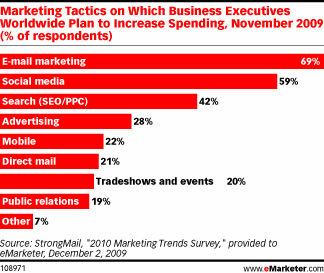
Going into 2010, marketers planned to put much more focus on email and social media marketing. A survey by StrongMail, an email software vendor of that era, found that marketing budgets were set to grow the most for email and social media in 2010. That matched how well both channels were doing at the time.
Trade press reported on the survey, which ran in November 2009. Among businesses planning to raise spending, 69% named email, 59% named social media and 42% named search. On overall budgets, 48% of respondents planned to increase them in 2010 and 41% planned to keep them the same.

Linking the two channels was a top priority for most respondents. Only improving performance and growing their audiences ranked higher: opt-in lists for email and followers for social media.
27% of respondents said they already had a strategy for using email and social media together, and 24% were still planning one. Another 18% of executives wanted to add email and social media to their business plan but did not know where or how to start.

The survey showed plenty of opportunity for people working in email and social media. If the forecasts held, 2010 would be a strong year for both channels.
Find out more at emarketer.com.
Where email and social budgets stand in 2026
Budgets are no longer growing across the board the way the 2010 survey expected. Total marketing spend is roughly flat as a share of revenue. Social media is gaining share inside that budget, and new money is going to AI.
| Measure | 2010 (StrongMail survey) | 2026 |
|---|---|---|
| Overall marketing budget | 48% planned to increase, 41% to hold steady | 7.8% of revenue, up from 7.7% in 2025 (Gartner) |
| Year-over-year spending growth | Expected to rise | Up 1.7% (CMO Survey, Spring 2026) |
| Social media | 59% planned to increase spend | 14.3% of marketing budgets, expected to hit 17.1% in one year and 23.1% in five years (CMO Survey) |
| 69% planned to increase spend | Mostly protected rather than grown; spending has shifted to compliance and measurement | |
| AI initiatives | Not measured | 15.3% of marketing budgets on average (Gartner) |
The two 2026 benchmarks don’t measure the same thing. Gartner surveyed 401 marketing leaders in North America, the UK and Europe, most of them at companies with over $1 billion in revenue. The CMO Survey from Duke’s Fuqua School of Business, Deloitte and the American Marketing Association polls US for-profit companies and puts marketing at 9.0% of revenue. If you run a smaller business, treat both as a rough guide, not a target.
Why email budgets now go to authentication and compliance
Since 2024, inbox access depends on technical requirements that did not exist in 2010. Gmail and Yahoo began enforcing bulk sender rules in February 2024. They cover anyone sending close to 5,000 or more messages a day to personal accounts. Those senders need:
- SPF and DKIM authentication for the sending domain.
- A DMARC record (a
p=nonepolicy is the minimum), with the From domain aligned to SPF or DKIM. - One-click unsubscribe on marketing messages, with requests honored within two days.
- A user-reported spam rate below 0.3%. Google recommends staying under 0.1%.
Google said it would step up enforcement from November 2025. Non-compliant mail now risks temporary (4.7.x) and permanent (5.7.x) rejections, not just a trip to the spam folder. Microsoft followed on 5 May 2025 for domains sending over 5,000 messages a day to Outlook.com, Hotmail.com and Live.com addresses. It requires SPF, DKIM and DMARC, and rejects mail that fails.
A minimal DMARC record looks like this:
_dmarc.example.com. TXT "v=DMARC1; p=none; rua=mailto:[email protected]"
One-click unsubscribe uses two headers, defined in RFC 8058:
List-Unsubscribe: <https://example.com/unsubscribe?id=12345>, <mailto:[email protected]>
List-Unsubscribe-Post: List-Unsubscribe=One-Click
Most email service providers set up the headers for you. You still have to publish the DNS records for your own domain.
Why open rates no longer justify the budget
Apple Mail Privacy Protection launched with iOS 15 in September 2021. It preloads remote images, including tracking pixels, for Apple Mail users who turn it on. Those emails count as opened whether or not anyone read them. Gmail’s image proxy and its Promotions tab also change how and when opens are recorded. If you’re making the case for email budget in 2026, use clicks, conversions and revenue per email, not open rates.
What linking email and social means now
In 2010, “integration” mostly meant share buttons in emails and asking subscribers to follow brand pages. Today it more often means using the same consented audience across channels. For example, you can upload an opt-in email list to Meta Custom Audiences or Google Customer Match, or use social ads to grow a list you own. Only do this with the consent required by GDPR and similar laws. Never use bought or scraped lists.
FAQ
How much of a marketing budget should go to email?
There is no standard percentage. Gartner’s 7.8% of revenue covers all marketing, not email alone. Email usually costs far less per contact than paid social, so set its budget from the revenue it brings in, plus the fixed costs of your email platform, authentication and list hygiene.
Is email still worth funding when social media’s share is growing?
Yes. Social media’s budget share is growing mostly because it’s paid media, and paid media gets more expensive as it grows. Email is an owned channel, and you keep your list even when platform algorithms or ad prices change. The strongest plans use social to grow an opt-in list and email to turn those subscribers into customers.
Do the Gmail and Yahoo sender rules apply to small senders?
The strictest rules apply to senders of about 5,000 or more messages a day to personal Gmail or Yahoo accounts. Google still asks every sender to use SPF or DKIM and to keep spam rates low. Setting up SPF, DKIM and DMARC is cheap, so small senders should do it too.
Why did open rates jump after 2021?
Apple Mail Privacy Protection preloads tracking pixels, so emails opened in Apple Mail count as opened even when nobody reads them. That inflated open rates across the industry and made them unreliable for A/B tests and for deciding where to spend. Clicks and conversions give you a more honest picture.
What does CAN-SPAM require of email marketers?
The FTC’s CAN-SPAM rules apply to every commercial email, not only bulk mail. You need accurate header and subject lines, a valid postal address, and a clear way to opt out. You must honor opt-outs within 10 business days. Penalties can exceed $50,000 for each email that breaks the rules.
Sources
- Google: Email sender guidelines
- Google: Email sender guidelines FAQ
- Yahoo Sender Hub: Sender best practices
- Microsoft Defender for Office 365 blog: Outlook’s new requirements for high-volume senders
- FTC: CAN-SPAM Act compliance guide for business
- Gartner: 2026 CMO Spend Survey press release
- The CMO Survey: Highlights and Insights Report, Spring 2026