
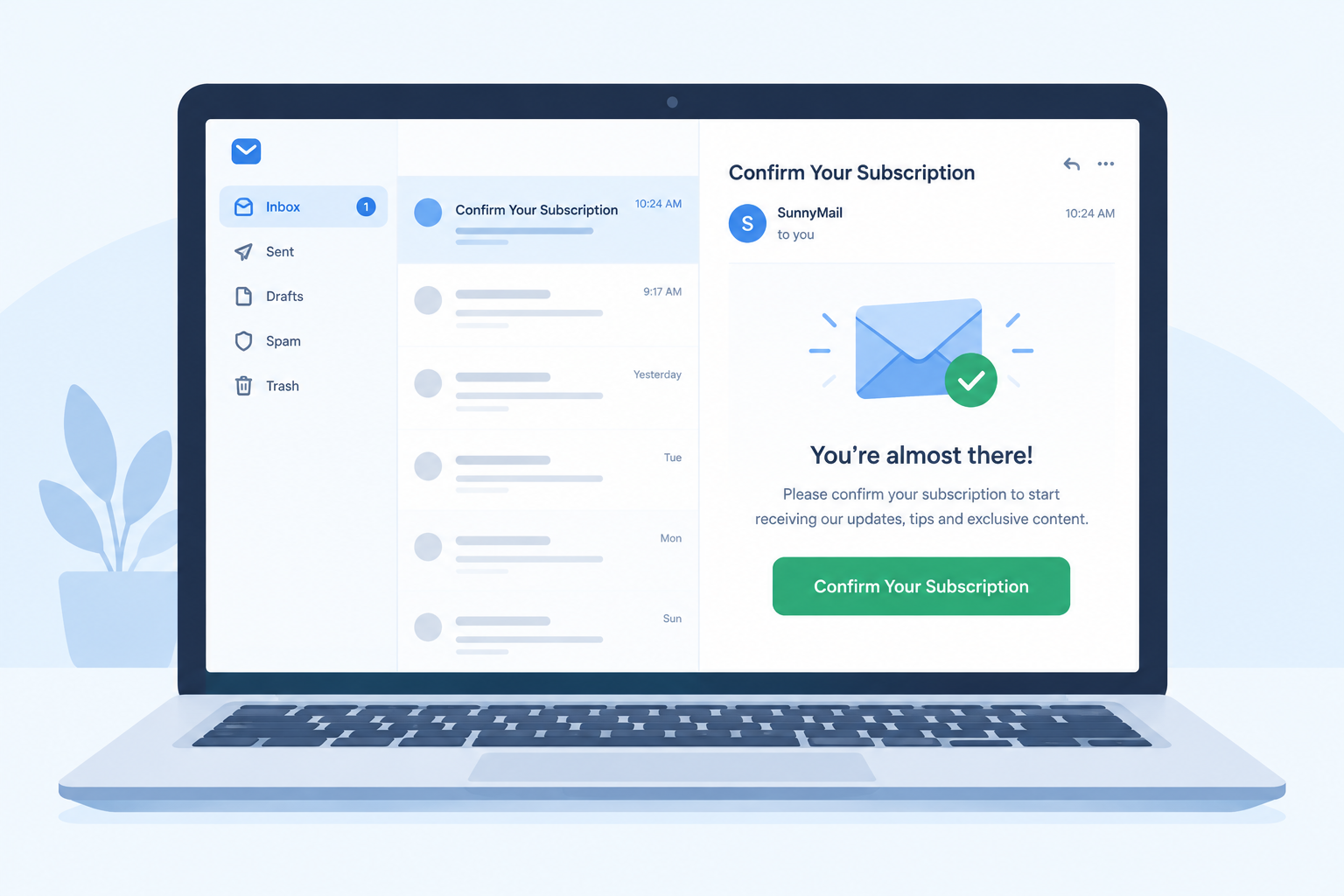
Double opt-in still works in November 2026: a subscriber’s address only joins your list after they click a link in a confirmation email. That gives you proof of consent and keeps typo addresses, bots and most spam traps off your list. What has changed is the cost of a dirty list. Gmail and Yahoo brought in bulk sender rules in February 2024 (SPF, DKIM, DMARC, one-click unsubscribe and spam complaint limits), Microsoft’s Outlook.com followed in May 2025, and Gmail started rejecting non-compliant mail in November 2025. No mailbox provider requires double opt-in. But it is the easiest way to keep complaints low enough to meet those rules.
Asking subscribers to double opt-in (also called confirmed opt-in) is a common standard for email marketing programs. It is still not universal, though. Plenty of good email marketers run single opt-in forms, where an address is added the moment someone submits it. So why does double opt-in matter, and why should you switch if you don’t use it yet?
Why double opt-in proves express permission
With double opt-in, you can show that each person on your list is who they say they are and that they signed up on their own. The confirmation click is the evidence. That makes it the clearest way to show express permission instead of implied consent.
The CAN-SPAM Act of 2003 is an opt-out law. It doesn’t require any opt-in for commercial email in the United States. It requires an accurate header and subject line, a valid physical postal address, a clear way to opt out, and that you honor opt-out requests within 10 business days. The FTC adjusts the maximum penalty for inflation every year, and it now tops $50,000 for each email that breaks the law.
Other laws ask for more:
- The EU’s GDPR, under Article 7(1), says the sender must be able to demonstrate that consent was given. It doesn’t name a method. Double opt-in is the accepted way to meet that duty, and in Germany it is close to the expected norm.
- Canada’s Anti-Spam Legislation (CASL) uses the same two terms, express consent and implied consent. Express consent is the stronger, longer-lasting kind.
Your double opt-in records are your answer when a subscriber, a mailbox provider or a regulator asks how an address got onto your list. Keep these details for every contact:
| Record | Why it matters |
|---|---|
| Signup date and time | Shows when consent was given |
| IP address at signup | Ties the request to a device |
| Form or page used | Shows exactly what the person agreed to |
| Confirmation email sent (time) | Proves you asked them to confirm |
| Confirmation click (time and IP) | Proves the mailbox owner agreed |
| Consent wording shown | Required evidence under GDPR |
Most email service providers (ESPs) store this automatically once double opt-in is on. In Mailchimp, the setting is in the audience’s settings under form settings, as a checkbox called “Enable double opt-in.” Turning it on also switches on reCAPTCHA for the hosted signup form.
How to set up a confirmation flow that works
A good confirmation flow turns most signups into confirmed subscribers. A clumsy one loses them before your first campaign.
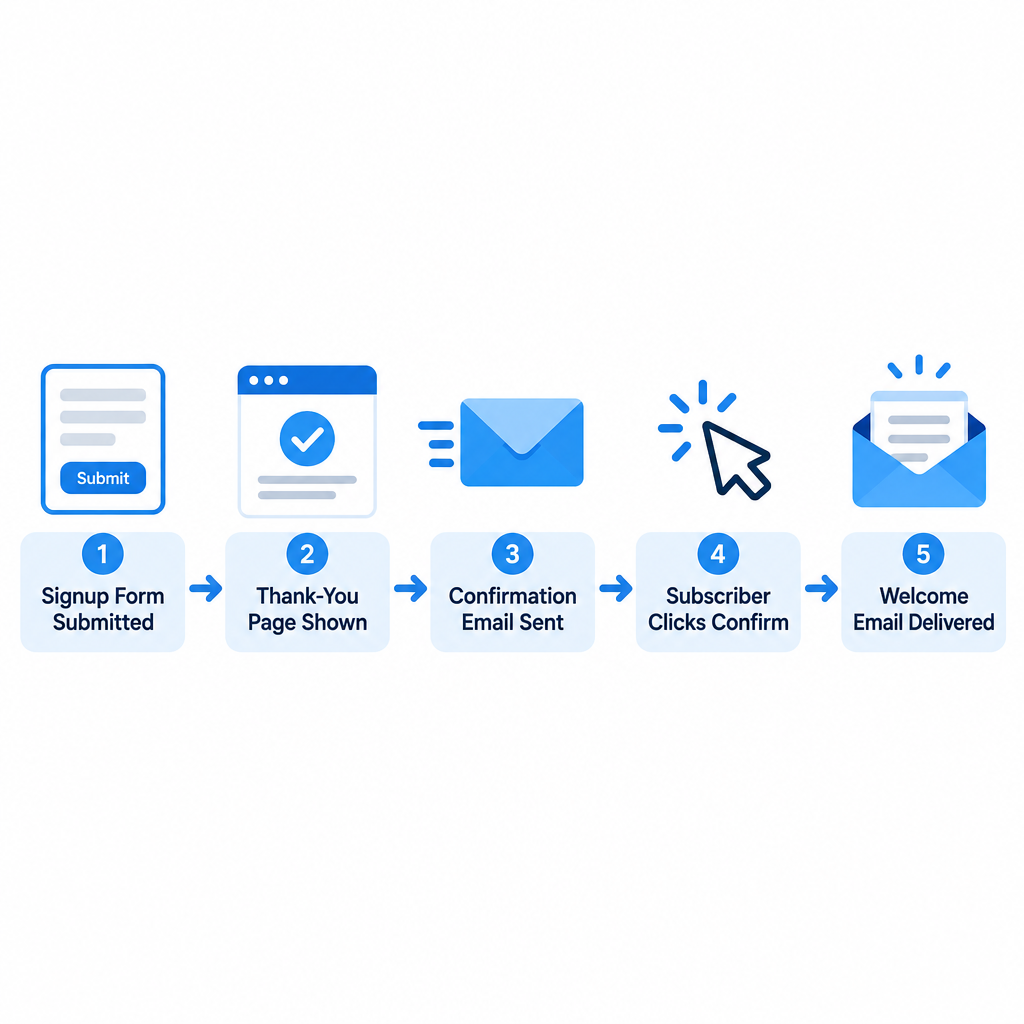
- Show a thank-you page after the form is submitted that says “Check your inbox to confirm.” Name the sender address the email will come from.
- Send the confirmation email right away from your normal, authenticated sending domain.
- Keep that email short: one sentence on what they signed up for, and one large confirm button.
- Send a single reminder after 24 to 48 hours to anyone who hasn’t confirmed, then stop.
- Send the welcome email straight after the click, while the subscriber is still paying attention.
How double opt-in keeps spam traps off your list
Double opt-in protects your list from spam traps, because a trap address never clicks a confirmation link. A spam trap is an address that mailbox providers and blocklist operators such as Spamhaus watch. Any mail it receives counts as a sign of poor list practices.
The original version of this advice said ISPs “drop” spam traps into your database when your signup process is weak. That isn’t quite how it works. Nobody plants traps in your list. They get in through gaps in how you collect addresses:
| Trap type | What it is | How it gets on a list | Does double opt-in stop it? |
|---|---|---|---|
| Pristine | An address that never belonged to a real person | Scraped addresses, bought lists, bots filling in forms | Yes |
| Typo | A misspelled domain, such as a fake version of gmail | Typing mistakes on signup forms | Yes, the typo never confirms |
| Recycled | An abandoned mailbox the provider turned into a trap | Old contacts you keep mailing after they go quiet | No, you need a sunset policy |
Every email you send to a spam trap counts against your sender reputation. Hit enough of them and you can land on a blocklist or see your inbox placement drop at major providers.
Recycled traps are the honest limit of double opt-in. An address confirmed in 2019 can be abandoned, shut down and turned into a trap years later. Double opt-in fixes the way addresses come in. Removing contacts who haven’t engaged in months (a sunset policy) fixes the way old addresses go stale.
Whitelisting then and now
The old version of this page warned that some ISPs wouldn’t whitelist you without a double opt-in process. That reflected an earlier era of paid whitelist and certification programs, such as Goodmail’s CertifiedEmail, which shut down in 2011. Those programs are history.
Today, Gmail, Yahoo and Outlook.com decide where your mail lands mainly from authentication, spam complaint rates and how recipients engage. That makes the quality of your list matter more than it did back then.
What the 2024 and 2025 sender rules mean for your signup process
Since February 2024, Gmail and Yahoo have required bulk senders to authenticate their mail and keep complaints low. Google counts you as a bulk sender if you send about 5,000 or more messages a day to personal Gmail accounts. Microsoft set similar rules for Outlook.com, Hotmail.com and Live.com from May 5, 2025.
| Requirement | Gmail | Yahoo | Outlook.com |
|---|---|---|---|
| SPF and DKIM | Required | Required | Required (5,000+ a day) |
| DMARC | Required, at least p=none | Required | Required, at least p=none, aligned |
| One-click unsubscribe | Required for marketing mail | Required for marketing mail | Recommended best practice |
| Spam complaint rate | Below 0.1%, never 0.3% | Below 0.3% | Low complaints expected |
| Honor unsubscribes | Within 2 days | Within 2 days | Promptly |
A minimal DMARC record, published as a TXT record at _dmarc.yourdomain.com, looks like this:
v=DMARC1; p=none; rua=mailto:[email protected]
In November 2025, Google warned that enforcement was ramping up. Non-compliant mail now gets temporary 4xx errors (delays) or permanent 5xx rejections instead of quietly going to spam.
This is where double opt-in pays off. People who confirmed their signup rarely press “report spam,” and a 0.1% target leaves little room for error. On a 10,000-email send, 0.1% is just 10 complaints.
The trade-off to weigh
Double opt-in shrinks your list. Some people never open the confirmation email, some find it in their spam folder, and some just forget. A single opt-in list grows faster.
For a small business with a clean, low-risk form, single opt-in plus a welcome email, a CAPTCHA and real-time address checks can work. For anyone collecting signups at scale, sending to EU subscribers, or seeing bot signups, the confirmed list is the safer asset. Its lower complaint rate and cleaner engagement data are worth the smaller headcount.
Apple Mail Privacy Protection (MPP), launched with iOS 15 in 2021, inflates open rates by loading images automatically. It doesn’t affect double opt-in, because confirmation depends on a click, not an open.
FAQ
Is double opt-in legally required in the US?
No. CAN-SPAM is an opt-out law, so US senders can legally use single opt-in. You still need a working unsubscribe link, your postal address and honest headers. You must process opt-outs within 10 business days, and within 2 days under Gmail and Yahoo’s bulk sender rules.
Does GDPR require double opt-in?
GDPR doesn’t name double opt-in. Article 7(1) does require you to prove that consent was given, and double opt-in records are the most common way to do that. In Germany, double opt-in is treated as close to mandatory for email marketing.
How many signups confirm with double opt-in?
It depends on how fast the confirmation email arrives and how clear it is, so there isn’t one benchmark that holds for every list. To lift your rate, send the confirmation instantly from an authenticated domain, tell people on the thank-you page to look for it, and send one reminder.
Can bots or security scanners confirm subscriptions?
Yes. Some corporate link scanners open every URL in an email, which can trigger a false confirmation. Most major ESPs guard against this with a confirmation page that needs a real button press. Pair that with a CAPTCHA on the form to block bot signups before they start.
Should old single opt-in contacts be asked to reconfirm?
If a list segment is old, unengaged or of unknown origin, a one-time reconfirmation campaign is worth it. Remove anyone who doesn’t respond. Expect the list to shrink, but complaint rates and spam trap hits usually drop with it.
Does double opt-in protect against all spam traps?
No. It stops pristine and typo traps, but a confirmed address can still turn into a recycled trap years later. Remove contacts who haven’t engaged in roughly six to twelve months.
Sources
- Google: Email sender guidelines
- Google: Email sender guidelines FAQ
- Yahoo Sender Hub: Sender best practices
- Microsoft Tech Community: Outlook’s new requirements for high-volume senders
- FTC: CAN-SPAM Act compliance guide for business
- Federal Register: FTC adjustments to civil penalty amounts (2025)
- Mailchimp: Audience settings and defaults