
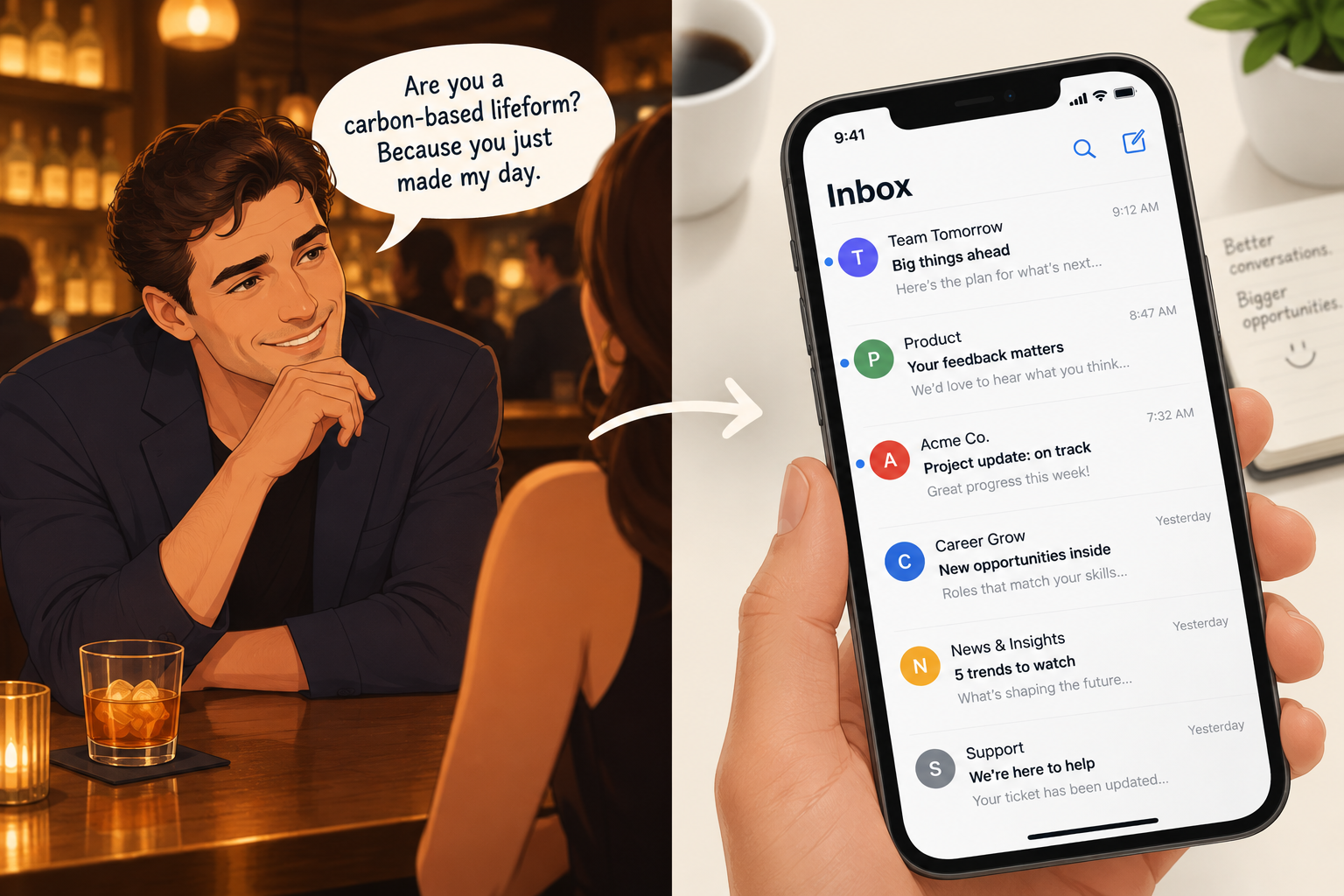
A subject line still decides whether anyone reads the rest of your email. In November 2026 the lines that work are clear, specific and honest about what’s inside. Your open rate no longer tells you much about them, though. Apple Mail Privacy Protection inflates opens, and the 2024 Gmail and Yahoo bulk sender rules turned spam complaints into a deliverability threshold, so a gimmicky line now costs you inbox placement as well as attention.
Why subject lines work like pick-up lines
Lots of things decide how an email campaign performs, but the subject line has the biggest effect on whether people open it. You can compare it to a pick-up line at a bar. It’s your first try at getting someone’s attention, and it tells them who your brand is before they’ve read a word of the message.
The comparison works in one more way. A pick-up line that promises one thing and delivers another leaves a bad impression. In email, that bad impression shows up as a spam complaint. Google’s sender guidelines ask bulk senders to keep their spam rate in Postmaster Tools below 0.1% and to never let it reach 0.3%. Yahoo uses the same 0.3% ceiling. A line that tricks people into opening can push you over those numbers.
Corny lines to avoid
Skip lines like these:
- Girl, you gotta be tired cause you been runnin through my mind all day.
- Do you have a bandage? Cause I just scraped my knee falling for you.
- Help, something’s wrong with my eyes. I just can’t take them off you.
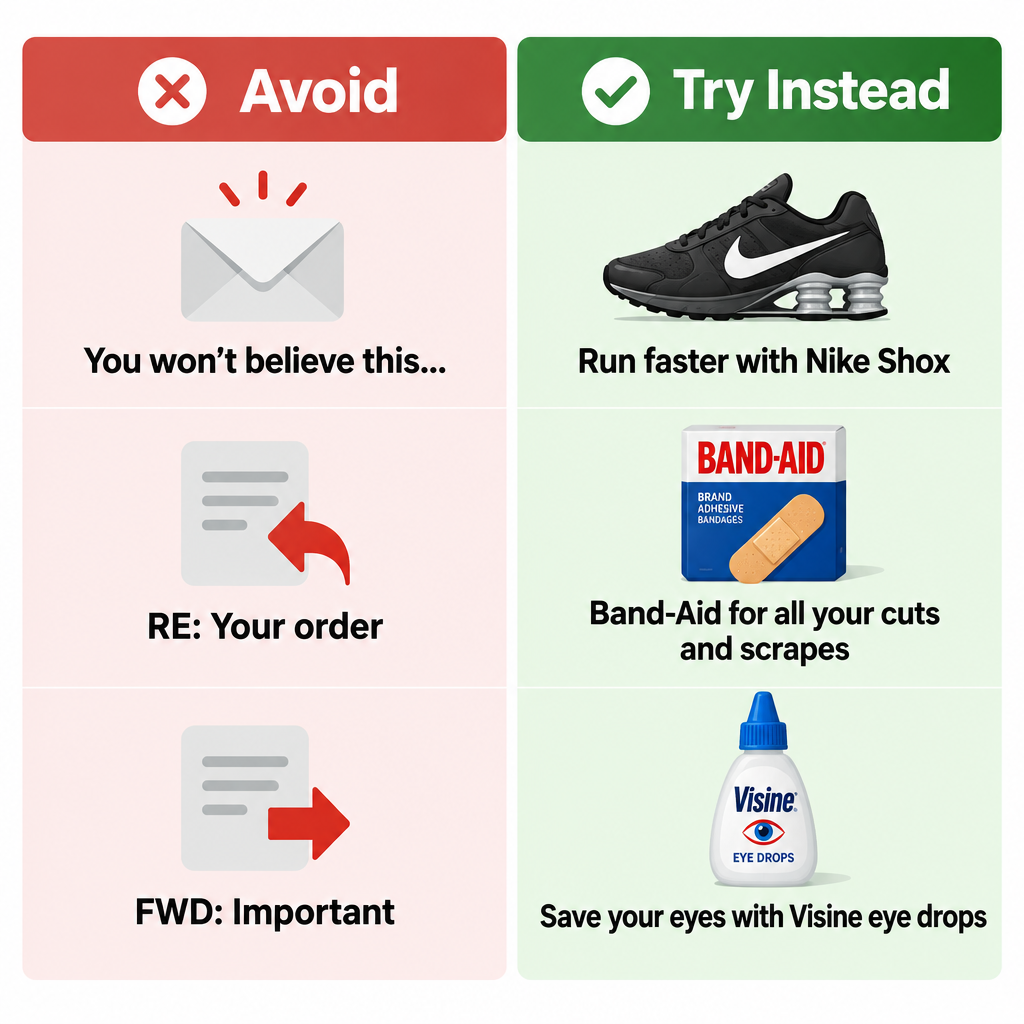
In email, the cheesy version is the subject line that teases without saying anything. “You won’t believe this…”, a fake “RE:” or “FWD:”, or a made-up order alert are the inbox versions of these lines. Under the CAN-SPAM Act, the last two are against the law. The FTC’s compliance guide says the subject line has to reflect the content of the message, and a violation can cost up to $53,088 per email. That’s the 2025 inflation-adjusted figure, and it still applies in 2026 because the 2026 adjustment was cancelled.
Lines to try instead
Try lines like these:
- Run faster with Nike Shox (action-oriented)
- Band-Aid for all your cuts and scrapes (brand recognition)
- Save your eyes with Visine eye drops (value proposition)
All three examples still hold up. Nike still sells the Shox line, with 2026 releases of the Shox TL, R4 and BB4. Band-Aid and Visine are Kenvue brands. Kimberly-Clark’s latest quarterly filing says it completed its purchase of Kenvue on November 2, 2026.
Each line puts a different strength first, and each one would still work in an inbox today:
| Example line | What leads | Why it works in 2026 |
|---|---|---|
| Run faster with Nike Shox | An action verb | Tells the reader what they can do and names the product early, before mobile clients cut the line off |
| Band-Aid for all your cuts and scrapes | The brand name | The brand people already trust sits right next to your From name |
| Save your eyes with Visine eye drops | A benefit | A clear benefit gives Gmail’s AI summaries and the reader the same message |
Two things have changed since these examples were first written. First, keep the most important words near the start. Most people read email on a phone, and phones show less of the subject line than desktop inboxes do. Second, write a preview text line that finishes the thought. In Gmail’s Promotions tab, and in the Gemini summaries Gmail began rolling out in 2026, the subject line and preview text get read together. Marketing platform reports say vague lines suffer most there.
One caution about the Visine-style line: a benefit claim has to be true. A subject line that promises more than the product or the email delivers is the honest-sounding cousin of a misleading subject line.
First impressions count
Your subject line is your first impression. It should show that the email is relevant and make clear who it’s from. In 2026 it also has to match what the email actually says. Mailbox providers watch complaint rates, and readers who feel tricked press “Report spam” faster than they used to.
Judge your lines by clicks, not opens. Mail Privacy Protection preloads messages in Apple Mail and records an open whether or not a person reads the email. That makes open-rate A/B tests unreliable unless your email platform filters out those machine opens. Clicks, replies and conversions show which line actually got people interested.
FAQ
Does a better subject line still improve open rates?
Yes, but the open rates you see are partly inflated. Apple Mail Privacy Protection counts machine opens, so a better line raises real opens while your dashboard also shows opens nobody made. Compare subject lines on click rate or conversions, or filter out privacy opens if your platform supports it.
Can a subject line get me in legal trouble?
It can. The CAN-SPAM Act prohibits deceptive subject lines in commercial email, and the FTC says the subject line must reflect what the message is about. Each violating email can carry a penalty of up to $53,088. Both the company being promoted and the company sending the email can be held responsible.
Do subject lines affect deliverability under the Gmail and Yahoo rules?
Indirectly, yes. Since February 2024, Gmail and Yahoo have required bulk senders to authenticate with SPF, DKIM and DMARC, offer one-click unsubscribe on marketing mail, and keep spam complaint rates below 0.3%. A misleading or clickbait line drives complaints, and complaints count against that threshold.
Should I write subject lines for Gmail’s AI summaries?
Write for people first. A clear, specific subject line and preview text help both readers and Gmail’s Gemini features. Marketing platforms covering the 2026 rollout advise putting the real offer, any discount and any deadline in plain words rather than hiding them behind a tease.
Are puns and humor still okay in subject lines?
Yes, as long as the reader can still tell what the email is about. Pick-up-line humor works when the brand and the benefit come through too. It backfires when the joke is all there is. Test a playful line against a plain one and compare clicks to see which one wins with your audience.
Sources
- Google Workspace Admin Help: Email sender guidelines
- Google Workspace Admin Help: Email sender guidelines FAQ
- Yahoo Sender Hub: Sender best practices
- FTC: CAN-SPAM Act, A Compliance Guide for Business
- Federal Register: FTC Adjustments to Civil Penalty Amounts (2025)
- Klaviyo: Email subject lines and open rates