
Moosejaw’s old welcome emails still teach a simple lesson. A confirmation message written in a real brand voice gets read, and a generic “thanks for signing up” doesn’t. In November 2026 the copywriting advice still holds, but sending the same email now means meeting rules that didn’t exist when it went out: since 2024, Gmail and Yahoo require bulk senders to use SPF, DKIM and DMARC, offer one-click unsubscribe and keep spam complaints low, Microsoft’s Outlook.com added similar rules in May 2025, and Apple Mail Privacy Protection makes open rates a weak measure of whether a welcome email worked. The brand itself is history too. Walmart bought Moosejaw in 2017, Dick’s Sporting Goods bought it in 2023, and the website shut down in August 2024. The Moosejaw domain now redirects to Dick’s Public Lands outdoor chain.
Why MooseJaw’s emails stood out
The best thing about Moosejaw’s email program was that it sounded like a person with a sense of humor, not a database. The case below follows one ordinary online purchase. Online shopping wins on convenience first and access second: you can buy furniture, clothing, movie and concert tickets and gifts at any hour. This purchase came from MooseJaw. The shopper was going on an Alaskan cruise in just over a month and needed cold-weather gear, because home was Florida, where it rarely gets cold except in an air-conditioned office. During checkout the shopper signed up for the newsletter, and this is the welcome message that arrived:
Hey [first name] – Thanks for signing up to get emails from Moosejaw. When you get an email from Moosejaw you should print the email legal size and get it framed for your foyer. We recommend a mahogany frame. If you don’t have a foyer please consider hanging all your emails in your kitchen or bedroom.
To celebrate receiving our emails you get Double Moosejaw Rewards Points on your next order. Really, it’s true. Moosejaw was named one of the Top 50 Best Web Sites by Internet Retailer in 2007 so we must know what were doing. We actually have no clue what we’re doing but Double Rewards means you get 20% of your first purchase back in rewards points to use for gear and apparel at MoosejawRewards.com. So, if you purchase a $200 jacket, you get $40 back to spend at MoosejawRewards.com.*
Love the Madness.
Moosejaw
This welcome message stood out because it went past the standard “thanks for signing up” wording. It did three things in a few short paragraphs. It confirmed the signup, it gave a concrete reason to buy again (20% back, with a worked example of a $200 jacket earning $40), and it made fun of itself so the offer didn’t read like a sales pitch.
The offer is history now. The Moosejaw Rewards program and MoosejawRewards.com ended along with the brand’s own store, so read the quote as an example of how to write a welcome email, not as a live deal.
The second confirmation email
The second message came after the order was placed. Checkout asked again whether the shopper wanted the newsletter before it processed the order. Saying yes meant the same address went in twice, right after the first signup, and a well-built system should notice that and merge the two. Moosejaw’s system sent a different message instead, and it was even funnier:
Thanks for signing up. Did you know the first account ever created was when Julius Caesar signed up for mime classes in 60BC? We recommend buying seven items and telling nine people about Moosejaw. When you’re bored please check out the Moosejaw Madness section at http://www.MoosejawMadness.com. The Moosejaw Madness section was called “extraordinary” by made up customer #847. I’ll stop bothering you now. Love the madness. Moosejaw http://www.moosejaw.com
It was completely random, and it still worked. The shopper read every line and was more excited about the emails than about the purchase. Both URLs in that quote are dead now. The Madness microsite is gone and the main domain points to Public Lands.
There’s a lesson in the duplicate signup too. In 2026, sending two different welcome emails to one address is something to fix, not to admire. Most ESPs, including Klaviyo, Mailchimp and Shopify Email, let you remove duplicate profiles and stop a welcome flow from starting again for someone who is already subscribed. Funny copy can make up for a duplicate once. It can’t make up for a list that keeps creating duplicates.
The order summary email
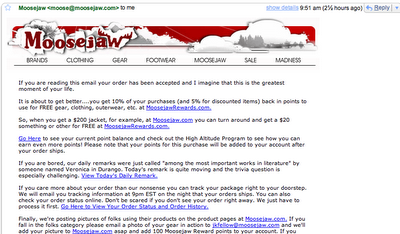
Last came the order summary:

Look at how many useful links it holds: discounts, order status, rewards and community. Those links bring the customer back to the site, which raises time-on-site numbers. They also get the customer thinking about what else the trip needs.
That idea has aged well. Transactional emails such as order confirmations and shipping notices get some of the highest engagement of any email a store sends, because the customer is waiting for them. Two things are different today:
- Most people will read it on a phone. A grid of small text links like the one above should become a short stack of tap-friendly buttons. It should also be tested in dark mode, where text and logos baked into images can become unreadable.
- Keep the promotion small. Under the FTC’s CAN-SPAM rules, an email whose main purpose is transactional, like an order confirmation, can include some promotional content without becoming a commercial message. If the promotion takes over, the email has to meet the commercial rules, including an opt-out link and a postal address.
What a Moosejaw-style welcome email needs in 2026
The voice still works. The technical setup underneath it has to meet the rules that mailbox providers now enforce. The main changes since these emails were written:
| What changed | When | What it means for a welcome email |
|---|---|---|
| Gmail tabs | 2013 | Brand emails often land in the Promotions tab. A strong subject line and sender name matter more than ever. |
| Gmail image proxy | 2013 | Gmail caches images, so image-based opens became less accurate. |
| Apple Mail Privacy Protection | iOS 15, 2021 | Apple Mail can preload images, which inflates opens. Judge welcome emails by clicks and first purchases. |
| Gmail and Yahoo bulk sender rules | February 2024, one-click unsubscribe enforced from June 2024 | SPF, DKIM, DMARC, one-click unsubscribe, unsubscribes honored within 2 days, spam rate kept low |
| Outlook.com high-volume sender rules | May 5, 2025 | Domains sending more than 5,000 emails a day need SPF, DKIM and DMARC, or their mail goes to junk |
Google counts you as a bulk sender if you send more than 5,000 messages a day to Gmail addresses. It asks senders to keep their user-reported spam rate below 0.1% and never let it reach 0.3%. A minimal setup that meets the authentication rules looks like this, with your ESP’s values in place of the examples:
example.com. TXT "v=spf1 include:_spf.youresp.com ~all"
s1._domainkey.example.com. TXT "v=DKIM1; k=rsa; p=MIIBIjANBgkqh..."
_dmarc.example.com. TXT "v=DMARC1; p=none; rua=mailto:[email protected]"
Bulk senders mailing more than 5,000 messages a day to Gmail accounts also need the one-click unsubscribe header pair defined in RFC 8058 on marketing and subscribed messages, welcome emails included. The List-Unsubscribe header must contain a valid URI:
List-Unsubscribe: <https://example.com/unsub?id=abc123>, <mailto:[email protected]>
List-Unsubscribe-Post: List-Unsubscribe=One-Click
A voice people enjoy can also help on the spam-rate side. People who enjoy a brand’s emails rarely click “Report spam.” Still, a joke doesn’t replace a visible unsubscribe link in the body of the email.
FAQ
Is Moosejaw still in business?
Not as its own retailer. Walmart bought Moosejaw in February 2017 for $51 million and sold it to Dick’s Sporting Goods in 2023. Dick’s closed most Moosejaw stores and folded the brand into Public Lands, its separate outdoor retail brand, while continuing to run its namesake Dick’s stores. The last Moosejaw stores closed and the website shut down in August 2024, and the Moosejaw domain now redirects to Public Lands.
What should a welcome email include?
Confirm the signup, say what the subscriber will get and how often, and give one clear reason to come back, such as a first-order reward. Moosejaw’s version did all three in a few short paragraphs. A commercial welcome email also needs a working unsubscribe option and a valid physical postal address under CAN-SPAM.
Does a funny brand voice hurt deliverability?
No. Mailbox providers judge your authentication, your sending reputation and how recipients react, not whether your copy is funny. A voice people enjoy usually means fewer spam complaints. Just keep the joke out of the sender name and subject line if it could look like a phishing attempt.
Are open rates still a good way to measure welcome emails?
Not on their own. Apple Mail Privacy Protection preloads images, and Gmail serves images through its proxy, so opens are overcounted for a large share of readers. Clicks, first purchases and unsubscribe or complaint rates from the welcome flow give a more honest picture.
Do transactional emails like order confirmations need an unsubscribe link?
The FTC treats a message whose main purpose is transactional as exempt from most CAN-SPAM rules, but it still can’t contain false or misleading routing information. Once the promotional content becomes the main purpose, the email counts as commercial and needs the full opt-out and address requirements. Gmail’s one-click unsubscribe requirement covers marketing and subscribed messages, not purely transactional ones.
What are the CAN-SPAM penalties for a non-compliant welcome email?
According to the FTC’s CAN-SPAM compliance guide, each separate email in violation is subject to penalties of up to $53,088. The FTC adjusts that amount for inflation, and $53,088 is the figure set in January 2025. It still applies in 2026 because no adjustment was made this year. You must also honor opt-out requests within 10 business days.
Sources
- Google: Email sender guidelines
- Google: Email sender guidelines FAQ
- Yahoo Sender Hub: Best practices
- Microsoft Tech Community: Outlook’s new requirements for high-volume senders
- FTC: CAN-SPAM Act compliance guide for business
- Federal Register: FTC adjustments to civil penalty amounts (2025)