
A strong email pitch is usually under 150 words. It opens with something specific to the recipient, offers one clear piece of value and ends with one easy ask. Below are 14 email pitch examples for sales prospects, journalists and potential partners, with notes on why each works and when to use it. After the examples you’ll find follow-up timing, the deliverability setup and the legal rules that decide whether anyone reads your pitch.
The four parts every pitch needs
Every pitch that gets a reply has the same skeleton, whatever the context. Strip away the tone and the industry jargon and you’ll find four parts.
- The hook. The first line proves you know who they are. It could be a recent article, a new job posting, a product launch or a mutual connection. A generic compliment doesn’t count.
- The bridge. One or two sentences that connect their world to yours. This answers “why are you emailing me, and why now?”
- The value. What they get. For a prospect, that’s a result. For a journalist, it’s a story their readers will care about. For a partner, it’s access to an audience or a product gap filled.
- The ask. One action, small enough to say yes to in ten seconds. “Worth a 15-minute call Thursday?” works better than “Let me know your thoughts.”
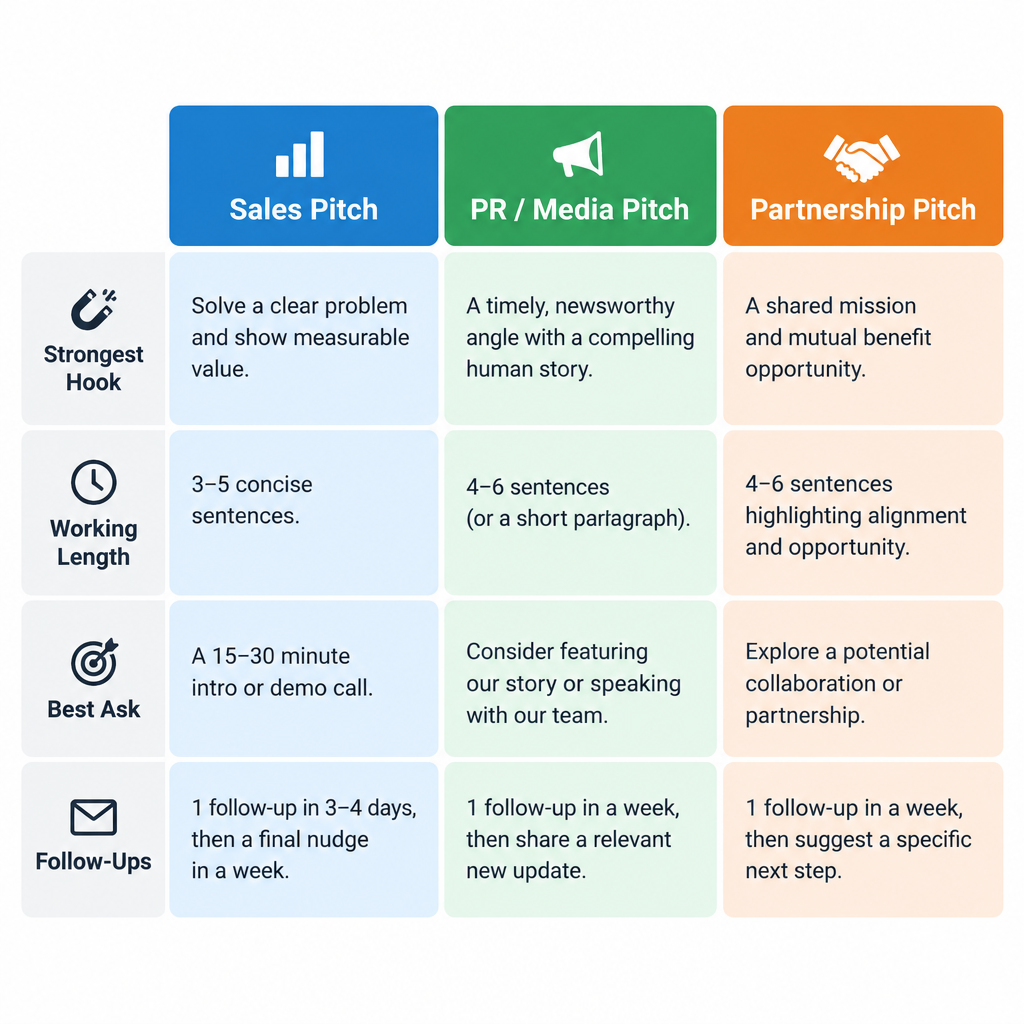
The weight of each part shifts by pitch type. Sales prospects care about their problem, reporters care about their readers, and partners care about the trade. The table below shows the working ranges I use. They come from practice, not from a survey.
| Sales pitch | PR / media pitch | Partnership pitch | |
|---|---|---|---|
| Question in the reader’s head | Does this fix a problem I have? | Will my audience care? | What do we each get? |
| Strongest hook | Trigger event, peer result | Fresh data, exclusive, timely angle | Audience overlap, complementary product |
| Working length | 50-125 words | 100-200 words | 100-150 words |
| Best ask | Short call or yes/no question | “Want the full data?” | Short call or a specific proposal |
| Follow-ups | 2-3 over two to three weeks | 1, three to five days later | 1-2 over two weeks |
What 12 million outreach emails tell you
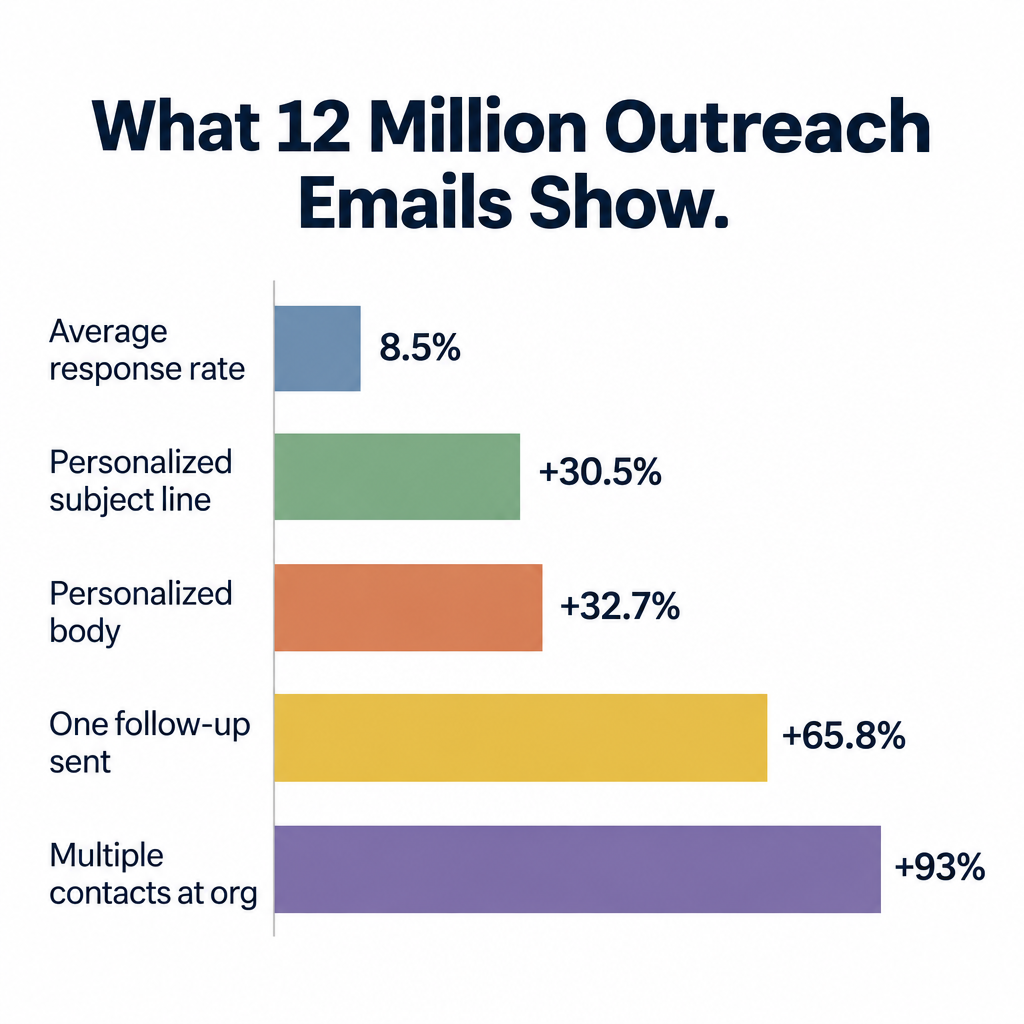
The most useful public dataset on cold pitching is still the analysis Backlinko ran with outreach platform Pitchbox. It looked at 12 million outreach emails and was published in 2019. That makes it old, and inboxes have only grown more crowded since, so treat the response rate as a ceiling rather than a target. The relative findings still match what most outreach teams see today.
| Finding (Backlinko and Pitchbox, 12M emails, 2019) | Result |
|---|---|
| Average response rate across all outreach | 8.5% |
| Personalized subject line vs none | 30.5% higher response rate |
| Personalized message body vs none | 32.7% higher response rate |
| Sending at least one follow-up | 65.8% more responses |
| Contacting multiple people at the same organization | 93% higher response rate |
| Subject line length with the best response rate | 36-50 characters |
Two things stand out. First, more than 90% of cold pitches get no reply at all, so silence is the default rather than a verdict on you. Second, the biggest lifts come from things that take effort: personalizing, following up and finding the right second contact. No template does that part for you.
Find the angle before you write a word
Most bad pitches fail before the first sentence because the sender never found an angle. They had a product or a press release and went looking for people to send it to. Flip that order.
Three rules for getting replies
- Relevance beats volume. Ten pitches to people who have written about, bought or partnered on exactly your thing will outperform 500 to a loosely related list. Every annual journalist survey from Cision and Muck Rack puts irrelevant pitches at the top of reporters’ complaints.
- Give before you ask. Lead with a data point, a fix, a quote or an introduction they can use even if they ignore the rest of the email.
- Make yes easy. One ask, one time slot, one attachment at most. Every extra decision you hand someone lowers the chance they make any of them.
Where good angles come from
Good angles come from a handful of reliable places. Recent work is one: an article they wrote, a podcast they appeared on, a feature their product shipped. Trigger events are another, such as funding rounds, new leadership, hiring sprees, expansions and pricing changes.
Your own data counts too: customer results, survey findings and usage patterns nobody else has. So do gaps, meaning a story their competitor covered and they didn’t, or a product category their customers keep asking for.
If you can’t name the angle in one sentence, you aren’t ready to send.
Subject lines that get opened
The subject line has one job: get the email opened by the person it was written for. It shouldn’t sell, explain or tease. It should signal relevance.
Subject lines that tend to work:
Your piece on four-day weeks(references their work)Data: 61% of freelancers raised rates in Q1(leads with the hook for a reporter)Northwind + Fieldstack webinar idea(partnership, both names)Broken link on your pricing page(useful, specific, hard to ignore)Question about your SDR hiring(short, personal, curious)
Subject lines that get deleted:
Quick question(every cold emailer uses it)Partnership opportunity!!(vague and shouty)Re: our conversationwhen there was no conversation (deceptive, and a CAN-SPAM problem)PRESS RELEASE: Company X Announces...(reads like a wire dump)
Inbox tip
Write the subject line last. Once the hook is clear in your body copy, the subject line is usually the hook in five to eight words.
Sales email pitch examples
Company names, people and figures in every example below are placeholders. Swap in your own verified numbers. A pitch with an invented result is worse than one with no result at all.
Example 1: The trigger event pitch
When to use it: The prospect just did something public that creates a problem you solve, like hiring, raising money or launching in a new market.
Subject: Your six new SDR roles
Hi Priya,
Saw Northwind is hiring six SDRs this quarter. Congrats on the growth.
When outbound teams double in size, ramp time usually becomes the bottleneck. Fieldstack, a 40-person sales team in a similar spot, used Lumen Coach to cut new-rep ramp from 14 weeks to 9.
Worth a 15-minute look before your new hires start? I’m free Thursday at 11 or 2 your time.
Sam
Why it works: The opening line could only have been written to Priya. The bridge names the problem her hiring creates before she has felt it, and the proof comes from a comparable company. The ask offers two specific times, so replying takes one word.
Example 2: The “results” email
When to use it: You have a strong case study from a customer the prospect will recognize or relate to.
Subject: How Brightline cut refund requests by 22%
Hi Marcus,
You and Brightline sell into the same mid-market retail buyers, so this might be useful.
Their support team was handling about 900 refund requests a month. After adding our pre-purchase sizing quiz, that dropped 22% in one quarter, and the quiz paid for itself in the first month.
I put the before-and-after numbers on a single page. Want me to send it over?
Dana
Why it works: It leads with the result in the subject line, which is the only thing a busy buyer wants to know. The ask is a yes/no question about receiving a document rather than booking a meeting. That’s a smaller step and a natural opening for a reply.
Example 3: The relevant share email
When to use it: Early in a relationship, or with a prospect who isn’t ready to buy, to build familiarity without pushing.
Subject: Benchmark for your onboarding emails
Hi Leah,
I noticed Copperleaf just rebuilt its welcome sequence. It looks sharp.
We recently pulled activation data from 140 SaaS onboarding flows and found that the second email, not the first, drives most trial-to-paid conversions. The full breakdown is in a short PDF. No form, no gate.
Happy to send it if it’s useful. No pitch attached.
Owen
Why it works: It delivers something useful with no strings, and the observation proves Owen looked. Some prospects will reply just to get the PDF, which opens a conversation on your terms. Use this one sparingly. Three “no pitch attached” emails in a row and the reader stops believing you.
Example 4: The typo email
When to use it: You spotted a genuine error on the prospect’s site, app or emails, ideally one related to what you sell.
The typo email has been a staple of link-building outreach for years, and it works just as well in sales. You hand someone a fix before you ask for anything.
Subject: Broken link on your pricing page
Hi Tomas,
Quick heads-up: the “Compare plans” button on your pricing page returns a 404 on mobile Safari. I checked twice this morning.
I only noticed because I was looking at how SaaS teams handle plan comparison. We build pricing page tests for companies like yours, and broken mobile CTAs are the most common leak we find.
Either way, worth fixing today. If you’d like a free audit of the rest of the page, just reply “audit.”
Rina
Why it works: The first paragraph has value with no conditions attached. The pitch is one sentence and naturally connected to the problem. The ask is a one-word reply.
Be accurate. Point out an error that isn’t real, or one they’ve already fixed, and you look careless rather than helpful.
Example 5: The breakup follow-up
When to use it: As the final email in a sequence, after two or three unanswered attempts.
Subject: Closing the loop
Hi Priya,
I’ve reached out a couple of times about ramp time for your new SDRs and haven’t heard back, which usually means the timing’s wrong.
I’ll stop emailing about this. If onboarding becomes a priority later in the year, reply to this thread and I’ll pick it up from there.
Thanks either way,
Sam
Why it works: It’s honest, it removes pressure and it gives a clear exit. Breakup emails often get more replies than the emails before them, because people answer to say “not now, try in Q3.” That’s a useful answer. Stick to your word afterward. A breakup email followed by another pitch next week burns the relationship.
PR and media pitch examples
Journalists get far more pitches than they can read, so the rules tighten. Put the story in the first two lines. Paste the key facts into the email body instead of attaching them. Never pitch a reporter something outside their beat.
Example 6: The story pitch
When to use it: You have a human story with a clear arc, a tension and a person willing to talk on the record.
Subject: Bakery that moved to a 4-day week and grew 30%
Hi Jordan,
Your piece on the four-day week pilots got a lot of people in our town talking, including the owner of Crumb & Co.
Ellie Park moved her 18 staff to four-day weeks last spring, expecting to lose money. Instead, revenue grew 30% year over year and she hasn’t lost an employee since. She’s candid about what went wrong in the first two months too, including a rota disaster that nearly ended the experiment.
Ellie’s available for an interview this week and can share her monthly numbers. Would this fit something you’re working on?
Mia Chen
Communications, Crumb & Co.
Why it works: It ties the pitch to the reporter’s own coverage, and the story has tension: she expected failure. It also offers something the reporter needs, an on-record source with real numbers and a willingness to talk about mistakes. Polished success stories are dull. Admitted struggles are a story.
Example 7: The exclusive research email
When to use it: You’ve commissioned a survey or have proprietary data, and you want one strong placement before wide release.
Subject: Exclusive: 61% of freelancers raised rates in Q1
Hi Sofia,
You’ve covered freelance pay more closely than anyone on the beat, so I wanted to offer you this first.
We surveyed 1,200 US freelancers in March. Three findings stood out:
- 61% raised their rates in Q1, up from 38% a year earlier
- Designers raised rates most often; writers least
- 1 in 4 now require a deposit before starting work
I can offer this to you exclusively until 9 a.m. ET on May 14, with the full dataset and methodology. Interested?
Raj
Why it works: The headline finding sits in the subject line. The bullets let the reporter judge the story in five seconds. The exclusive has a clear deadline, so she knows what she’s being offered and when it expires.
If she passes, honor the exclusive window before you take the data to anyone else. Methodology matters as well. Have sample size, dates and how respondents were recruited ready to send, because serious reporters will ask.
Example 8: The related story email
When to use it: A reporter covered a topic recently, and you have a genuine follow-up angle, new development or missing perspective.
Subject: Follow-up to your EV charger piece
Hi Andre,
Your story last month on broken public EV chargers named reliability as the top complaint. We track uptime across 4,000 chargers in the Northeast, and our April numbers suggest the problem is concentrated in a small set of hardware models rather than spread across the network.
I can share the model-by-model breakdown and put you in touch with our head of field operations, who’s happy to go on record.
Would a follow-up angle on this be useful?
Kate
Why it works: It doesn’t ask the reporter to start from scratch. It extends a story he already owns and offers a narrower, more surprising angle. Reporters like follow-ups because their editor already approved the topic once.
A second version of this pitch works when a reporter covered your competitor. “You wrote about X’s approach; here’s a company doing the opposite, with different results” is a legitimate angle, provided you can back the difference with numbers.
Example 9: The infographic email
When to use it: You’ve turned data into a clear visual and want editors, bloggers or newsletter writers to use it.
Subject: Chart for your remote work roundup
Hi Grace,
Your weekly remote work roundup regularly includes a “chart of the week,” so I thought this one might fit.
We mapped average home-office spending by country from our 2,000-customer dataset. The gap between Germany and the US surprised even us. A preview is pasted below, and the full-size chart and source CSV are free to use with credit.
[chart preview pasted inline]
Want the files?
Leo
Why it works: It targets a specific recurring slot in Grace’s newsletter, which shows research. The visual is in the body rather than hidden behind an attachment, and the source data is offered upfront, which matters to any editor who checks numbers.
Keep the inline image small. A large image with little text is a classic spam-filter signal, and many corporate mail systems block images by default.
Example 10: The expert commentary email
When to use it: A big news story just broke, and you have a credible expert who can add something reporters don’t already have.
Subject: Source on today’s Gmail spam rule change
Hi Nadia,
If you’re covering today’s Gmail sender announcement, our deliverability lead, Chris Okafor, has audited authentication for 300+ brands and can explain what changes for small senders.
One line you’re welcome to use: “Most small businesses already pass SPF. The ones who’ll get hurt are those who never set up DMARC and don’t know who’s sending email in their name.”
Chris is available by phone until 6 p.m. ET today.
Ben
Why it works: Speed and a usable quote. Reporters on deadline need sources who can talk now. A strong, quotable line in the email itself often gets used even without a call. Only send this when your expert truly has standing on the topic. Newsjacking with a weak source annoys reporters and gets you remembered for the wrong reasons.
Partnership pitch examples
Partnership pitches are closer to negotiations than requests. Both sides need to see the trade quickly, and the trade has to be roughly even. If the email reads like you want their audience for free, it’s dead.
Example 11: The co-marketing webinar pitch
Subject: Northwind + Fieldstack webinar idea
Hi Elena,
Our customers keep asking how to connect their CRM data to onboarding emails, and Fieldstack is the integration we recommend most often.
Idea: a 45-minute joint webinar in June, “From signed deal to activated customer,” with one speaker from each side. We’d handle production and promotion to our 22,000 subscribers. You’d promote to yours, and both teams get the full registrant list.
If that’s interesting, I can send a one-page outline. Does a quick call next week work?
James
Why it works: It starts from a real overlap, shared customers, and names a specific format, date and title. That saves Elena from having to invent the idea herself. Spelling out who does what and who gets the leads answers her biggest question before she asks it.
Check consent before you promise registrant lists. Under GDPR in particular, sharing leads between companies needs a clear basis, usually stated on the registration form.
Example 12: The integration partnership pitch
Subject: 140 of your customers already use us
Hi Arjun,
We looked at our customer base and found 140 accounts that also use Ledgerly. Most of them export invoices to CSV and re-upload them into our dashboard every week.
A native integration would kill that step. We’ve scoped it at roughly six weeks of work on our side using your public API. We’d just need a sandbox account and a technical contact for questions.
Would you be open to listing it in your marketplace once it’s live? Happy to share the scope doc.
Wen
Why it works: It opens with a number that matters to Arjun, his own customers, and it shows the pain they’re living with. Then it lowers the effort on his side to almost nothing. Partners say yes to integrations that make their product stickier and cost them little.
Example 13: The newsletter sponsorship or creator pitch
Subject: Sponsoring your April issues
Hi Theo,
I’ve read your newsletter on indie SaaS pricing for about a year. Your teardown of usage-based plans is still pinned in our team channel.
We’d like to sponsor two issues in April. We make billing software for small SaaS teams, which seems a natural fit for your readers, and we’re happy to follow your usual format and disclosure rules.
Could you send your current rates and open dates?
Ana
Why it works: It’s direct. Creators get plenty of vague “let’s collaborate” emails, and one that says “we want to pay you, here’s when” stands out. Respecting their format and disclosure rules signals you won’t be a difficult sponsor. In the US, the FTC expects paid placements to be clearly disclosed, so a sponsor who mentions it upfront is easier to work with.
Example 14: The guest content or newsletter swap pitch
Subject: Content swap for May?
Hi Carla,
Your readers are mostly freelance designers and ours are mostly freelance developers. Both lists keep asking how to work together without scope creep.
Proposal: I write a piece for your blog on “how to brief a developer,” and you write one for ours on “how to brief a designer.” Each about 1,200 words, each linking back to the author’s site. We’d also feature yours in our newsletter, which goes to 9,000 subscribers.
Here are two posts I’ve written recently, so you can judge the fit: [titles pasted]
Interested?
Rob
Why it works: The trade is symmetrical and spelled out in two sentences. The topic idea already fits both audiences, and including writing samples answers the quality question before it’s raised.
Before and after: rewriting a weak pitch
Here’s a pitch that looks like thousands sent every day.
Subject: Partnership opportunity
Hi there,
I hope this email finds you well! My name is Jake and I’m the founder of Taskwise, an innovative AI-powered productivity platform that is revolutionizing the way teams work. We’ve been featured in several publications and have a growing user base.
I came across your website and think there could be some great synergies between our companies. We’d love to explore potential partnership opportunities, whether that’s co-marketing, integrations or something else.
Let me know if you’d be open to a call to discuss!
Best,
Jake
What’s wrong with it:
- “Hi there” tells the reader it went to a list.
- The first two sentences are about Jake, not the recipient.
- “Innovative,” “revolutionizing” and “synergies” carry no information.
- “Partnership opportunities… or something else” means Jake hasn’t done the thinking.
- The ask is a call with no agenda, which is a big commitment for zero clarity.
Here’s the rewrite.
Subject: Taskwise + Plannly: shared calendar sync
Hi Ruth,
Your changelog last week mentioned that calendar sync is the top request on your roadmap board. About a third of our 6,000 users also use Plannly, and they ask us for the same thing.
We’ve already built two-way sync with Google and Outlook calendars. We could expose it to Plannly through a lightweight integration, with no engineering needed on your end beyond OAuth approval.
Would a 20-minute walkthrough next Tuesday or Wednesday be useful?
Jake
The rewrite is about the same length. Every sentence now carries information, the opening is about Ruth’s roadmap, and the proposal is specific enough to say yes or no to.
Following up without being annoying
The Backlinko data shows at least one follow-up lifts responses by nearly two-thirds. Most replies to cold outreach still come from the first email, and each follow-up brings in fewer, but those later replies come from people who saw your pitch, meant to reply and forgot.
A cadence that works for most sales pitches:
| Timing | What it does | |
|---|---|---|
| 1. Pitch | Day 0 | Full hook, value, ask |
| 2. Nudge | Day 3-4 | Reply in the same thread, one or two lines, a new detail |
| 3. Value add | Day 8-10 | Share a relevant resource or result |
| 4. Breakup | Day 15-20 | Close the loop politely (Example 5) |
For journalists, one follow-up is the norm. Send it three to five days later and only if you have something to add, like a new data point, a confirmed interview slot or a timely news peg. “Just checking you saw this” adds nothing. A reporter who wanted it would have replied.
For partnerships, one or two follow-ups over two weeks is fine. If you have a mutual connection, the second follow-up is the moment to ask them for a warm intro instead.
A follow-up that adds something:
Hi Elena,
One addition to my webinar note: we just confirmed our VP of Customer Success as a speaker. She ran onboarding at a 2,000-seat rollout last year and has some good stories. Still keen if June works for your team.
James
Always reply in the same thread so the original pitch stays visible. And keep your sign-off consistent. A clean signature with name, role, company and one way to reach you looks more credible than a banner ad. If yours needs work, our email signature examples are a good place to steal from.
Get your pitches into the inbox
The best pitch in the world does nothing in a spam folder. Cold pitches are risky for deliverability because recipients haven’t asked for your email, and mailbox providers judge you on how people react.
Send from your own authenticated domain
Pitching from a free Gmail or Outlook address looks amateur to journalists and buyers, and you can’t authenticate it properly. Set up domain email on your company’s own address first. Then publish the three authentication records Gmail, Yahoo and Microsoft check.
Setup steps
- Create a mailbox on your company domain in Google Workspace, Microsoft 365 or your host.
- Add an SPF record listing every service that sends mail as your domain.
- Turn on DKIM signing in your mail provider’s admin console and publish the key it gives you.
- Publish a DMARC record starting at p=none with reporting turned on.
- Send a test to a Gmail address, open Show original and confirm SPF, DKIM and DMARC all say PASS.
An SPF record for a domain that sends through Google Workspace looks like this. If you send through other services too, add their include statements to the same single record.
example.com. TXT "v=spf1 include:_spf.google.com ~all"
DKIM is a public key published at a selector your provider names. In Google Workspace, you generate it under Admin console > Apps > Google Workspace > Gmail > Authenticate email.
google._domainkey.example.com. TXT "v=DKIM1; k=rsa; p=MIIBIjANBgkqhkiG9w0BAQEFAAOCAQ8AMIIBCgKCAQEA..."
A starter DMARC record monitors without blocking anything and sends aggregate reports to an address you control:
_dmarc.example.com. TXT "v=DMARC1; p=none; rua=mailto:[email protected]"
Once reports show all your legitimate mail passing, move to p=quarantine and then p=reject to stop others spoofing your domain.
The sender rules you’re working under
| Provider | Effective date | Rules that matter for pitching |
|---|---|---|
| Gmail (all senders) | February 1, 2024 | SPF or DKIM, valid forward and reverse DNS, TLS, spam rate kept below 0.3% (Google advises under 0.1%) |
| Gmail (5,000+ messages a day to Gmail accounts) | February 1, 2024, with one-click unsubscribe required from June 1, 2024 | SPF, DKIM and DMARC (p=none minimum), From domain aligned with SPF or DKIM, one-click unsubscribe on marketing mail |
| Yahoo (bulk senders) | February 2024 | SPF, DKIM, DMARC, spam rate below 0.3%, one-click unsubscribe, unsubscribes honored within 2 days |
| Microsoft Outlook.com, Hotmail, Live (5,000+ messages a day) | May 5, 2025 | SPF, DKIM and DMARC (p=none minimum) aligned with SPF or DKIM; non-compliant mail first routed to Junk, with rejection to follow |
Most individual pitching never reaches 5,000 messages a day. Meet the bulk-sender rules anyway. Authentication costs nothing, and a single spam complaint from a cold pitch counts against you whatever your volume.
Keep volume human
Mailbox providers also cap how much one account can send. Google lists 500 messages a day for a free Gmail account and 2,000 per user for paid Google Workspace (limits as published by Google in 2025, lower during trials). Microsoft 365 caps most mailboxes at 10,000 recipients a day. Stay far below those. Pitching is a one-to-one activity, and 20 to 50 carefully researched emails a day is a sensible ceiling for a single sender.
Don’t run cold pitches through your newsletter tool either. Most small business email platforms, Mailchimp included, prohibit sending to contacts who haven’t opted in, and they will suspend your account for it.
Deliverability risk
Bounce rates above 2% or a burst of spam complaints from one cold campaign can push your whole domain into spam, including invoices and password resets. Verify every address before you send, and never pitch purchased or scraped lists.
High-volume sales teams often send outreach from a subdomain, such as mail.example.com, so a bad campaign doesn’t drag down the main domain. That’s reasonable for sales. For PR and partnership pitches, send from a real person’s mailbox on your main domain. A reporter who sees an unfamiliar lookalike domain has every reason to be suspicious.
The legal rules for cold pitches
Cold email is legal in many places when done right, but the rules vary by where the recipient is. A media pitch about genuine news is arguably not “commercial” under some laws. Sales and partnership pitches clearly are. The safe approach is to treat every pitch as if the rules apply.
| Law | Where | What it requires for cold B2B pitches | Penalties |
|---|---|---|---|
| CAN-SPAM Act | United States | Accurate From and subject lines, your physical postal address, a clear way to opt out, opt-outs honored within 10 business days; applies to B2B email too | Up to $53,088 per violating email (FTC’s January 2025 inflation adjustment) |
| GDPR | EU and UK | A lawful basis (legitimate interest is common for B2B), telling people where you got their data, honoring objections promptly | Up to €20 million or 4% of global annual turnover (UK: £17.5 million) |
| PECR / national ePrivacy rules | UK and EU member states | UK allows cold email to corporate addresses with an opt-out; sole traders and individuals need consent. Several EU countries, including Germany, are much stricter | Set by national regulators |
| CASL | Canada | Consent required; implied consent can apply when an address is conspicuously published, carries no “no unsolicited email” notice and your message is relevant to the person’s role. Identify yourself and include an unsubscribe | Up to C$10 million per violation for businesses |
This isn’t legal advice. For any outreach program beyond a handful of personal pitches, have a lawyer review your process for the countries you target. A short line at the bottom of sales pitches costs you nothing and keeps you on the right side of most of these rules. “Not relevant? Reply ‘no thanks’ and I won’t email again” works well.
Metrics worth tracking
Open rates are a weak signal for pitches. Apple Mail Privacy Protection, launched with iOS 15 in September 2021, preloads tracking pixels and inflates opens. Tracking pixels can also hurt deliverability on low-volume cold email. Many experienced outreach teams turn open tracking off entirely. Watch these instead:
- Reply rate: replies divided by delivered emails. Compare it to the 8.5% Backlinko average with caution, since that data is from 2019.
- Positive reply rate: replies that move things forward, such as a meeting, an interview or a “send me the data.” This is the number that matters.
- Outcome rate: meetings booked, articles published, partnerships signed per 100 pitches.
- Bounce rate: keep it under 2%. Above that, your list research needs fixing.
- Spam complaint rate: check Google Postmaster Tools if you send enough volume to see data, and keep it under 0.1%.
Review results by pitch type and angle, not just in aggregate. You’ll usually find one angle, often the trigger event or exclusive data pitch, outperforming everything else by a wide margin. Double down on it.
FAQ
What is an email pitch?
An email pitch is a short, personalized message asking someone to take one specific action. That might be a sales meeting, press coverage or a partnership. It differs from a newsletter or announcement because it’s written for one recipient and built around a reason they in particular should care.
How long should a pitch email be?
Aim for 75 to 150 words for sales and partnership pitches, and up to about 200 words for a media pitch that includes data. If the recipient has to scroll on a phone, it’s too long. Move detail into a follow-up or a one-page document they can request.
What are good email pitching examples for beginners?
Start with the typo email (Example 4) and the related story email (Example 8). Both are built on something you can verify, a real error or a real article. You don’t need a big brand or impressive results to make them work, only careful research.
How many follow-ups should I send?
For sales, two or three follow-ups over two to three weeks, ending with a breakup email. For journalists, one follow-up after three to five days, and only with new information. Stop immediately if anyone asks you to.
Should I attach a press release or pitch deck?
No, at least not in the first email. Attachments from unknown senders trigger spam filters, and many recipients won’t open them for security reasons. Paste the key facts into the body and offer the full document if they’re interested.
When is the best time to send a pitch?
Send during the recipient’s working hours, early in their week, and avoid Friday afternoons and holidays. For journalists, morning sends tend to fit editorial planning better than late-day pitches. Timing matters much less than relevance, though. A well-aimed pitch sent at a bad time beats a generic one sent at the perfect minute.