
No. Since about 2021, reported open rates have mostly gone up, but much of that rise is noise from privacy features that load images automatically. Apple Mail Privacy Protection, launched with iOS 15 in 2021, preloads remote content whether or not anyone reads the message, and Gmail has served images through its own proxy since December 2013. The 2005 problem was undercounting: image blocking hid real opens. Today the opposite is true, so you should judge campaigns on clicks, conversions and inbox placement under the Gmail, Yahoo and Microsoft bulk sender rules, with opens as a secondary signal.
What the 2004 and 2005 benchmarks showed
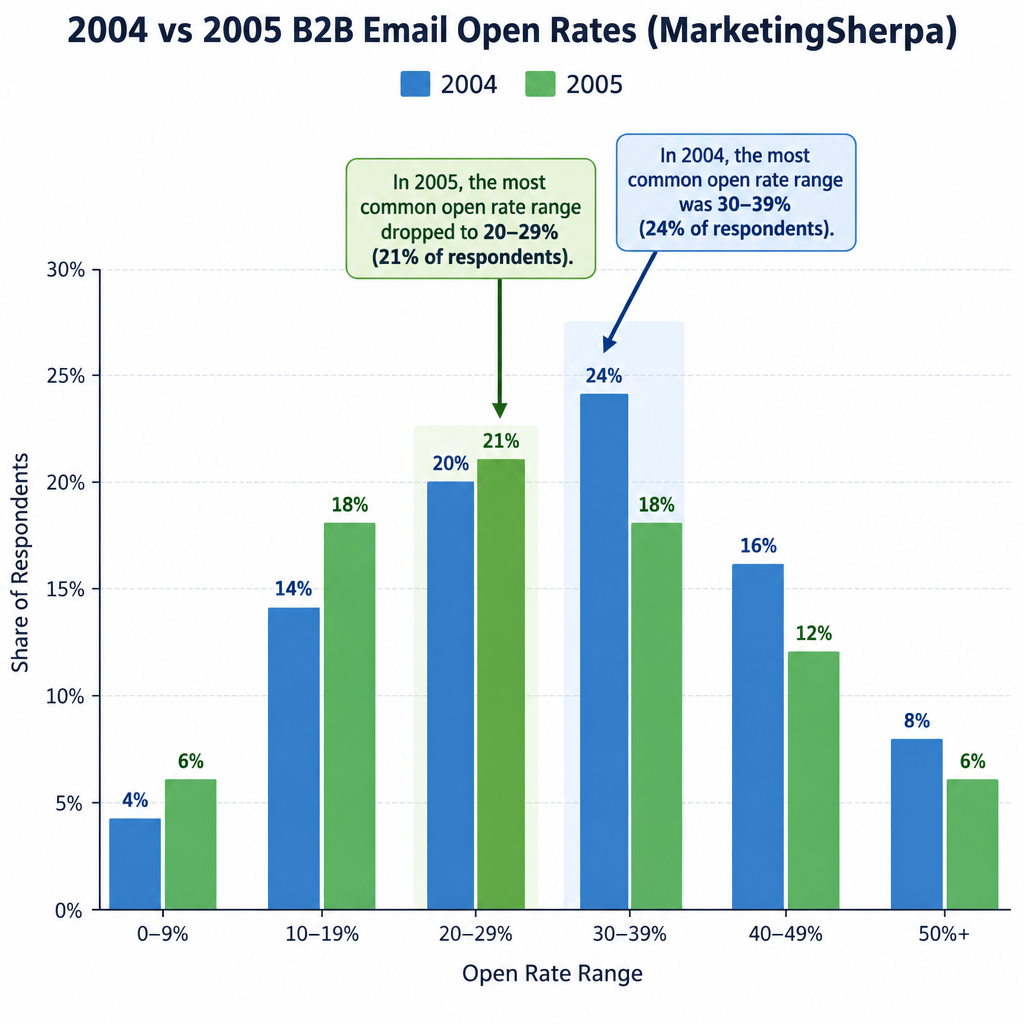
The MarketingSherpa Email Marketing Benchmark survey of October 2005 recorded a clear drop in B2B open rates. In 2004, the most common B2B open rate range was 30% to 39%, reported by 24% of respondents. In 2005, the most common range had fallen to 20% to 29%, reported by 21% of respondents.
These are historical figures from a survey of marketers, not measured averages, and they come from a time when the main open-tracking problem was blocked images. For a current comparison, Mailchimp’s benchmarks page lists an all-user average open rate of 35.63% and a click rate of 2.62%. That higher open figure says more about how opens are counted now than about readers paying more attention.
Why image blocking cut measured opens in the mid-2000s
To protect users from spam and questionable content, email clients started blocking images by default. Spam filtering also got stricter, which sent more mail to bulk and junk folders. An open is only recorded when a one-pixel tracking image loads, so image blocking pulled measured open rates down even when people were reading the messages.
That approach still works the same way. Open tracking depends on a remote image being requested. What has changed is who requests it. In the 2000s, a blocked image meant a missed open. Now a proxy or privacy feature can request the image when no person ever looked at the email.
The preview pane and Outlook in 2005
The EmailLabs Preview Pane Study of November 2005 found that 52% of business people always used the preview pane, 33% read entire emails there, and nearly 80% used Outlook as their email client. At the time, Outlook 2003 and Outlook Express with Windows XP Service Pack 2 blocked images by default. Your messages were probably reaching more people than the open rate suggested.
That software is history now. Outlook Express was discontinued long ago and Outlook 2003 is no longer supported. Classic Outlook for Windows still blocks automatic picture downloads by default unless the user changes that setting or trusts the sender. But Outlook’s share of opens has dropped sharply. Litmus’s mid-2026 client data, as reported by third parties, puts Outlook desktop at under 6% of tracked opens, Gmail at about a quarter, and Apple at roughly six in ten.
What changed after 2005
Three changes reversed the trend described in this post.
- Gmail tabs and the image proxy (2013). In May 2013, Gmail introduced inbox tabs, which moved many marketing emails into the Promotions tab. In December 2013, Gmail started showing images by default and serving them through Google’s proxy servers. That brought back many opens that image blocking had hidden. It also meant one cached image request no longer reliably showed each time a message was reopened.
- Apple Mail Privacy Protection (2021). With iOS 15 and macOS Monterey, Apple let Mail users hide their IP address and load all remote content privately in the background. Because tracking pixels load whether or not the message is opened, Apple Mail users with the feature turned on can show as “opened” when they never read the email. Apple’s large share of opens is the main reason open rates went up.
- Bulk sender rules (2024 and 2025). In February 2024, Gmail and Yahoo began enforcing requirements for bulk senders: SPF and DKIM authentication, a published DMARC record, a user-reported spam rate kept under 0.3% (Google’s target is below 0.1%), and from June 2024, one-click unsubscribe for marketing mail, with unsubscribes honored within two days. Google defines a bulk sender as anyone sending close to 5,000 or more messages to personal Gmail accounts in a 24-hour period. Microsoft followed with similar rules for Outlook.com, Hotmail and Live addresses, effective May 5, 2025.
Mobile reading and dark mode add to the noise. A message that looks broken in dark mode on a phone can still count as an open, then get no clicks.
Look past opens to clicks and conversions
Opens dropped in 2005, but click-through rates did not drop with them. That pointed to a measurement problem, not an audience problem. If the HTML was never displayed, no open was recorded, yet the clicks showed people were reading.
The same thinking applies today, in reverse. When open rates rise without a matching rise in clicks, privacy features are the likely cause, not more engaged readers. When you review campaign results, give the most weight to these numbers:
- Click-through rate and click-to-open rate. Clicks still require a real person to act. Click-to-open rate is less reliable now, because its denominator includes machine opens.
- Conversions and revenue per email. These connect email to business results.
- Spam complaint rate. Check it in Google Postmaster Tools and keep it under the 0.3% limit, aiming for below 0.1%.
- Unsubscribe rate and bounces. These show list fatigue and list hygiene problems early.
- Opens with Apple privacy opens filtered out. Many ESPs now flag or exclude opens caused by Mail Privacy Protection. Use this filtered number for trends and subject line tests.
An open rate alone has never told the whole story, and today it tells less of it than ever.
FAQ
Why did my open rate jump in late 2021?
Apple released Mail Privacy Protection with iOS 15 in September 2021. Once it is turned on, Apple Mail loads tracking pixels in the background for every message, so opens are recorded even for unread email. If a large part of your list uses Apple Mail, your reported open rate likely rose with no real change in reader behavior.
Are open rates still useful at all?
Yes, with limits. Opens can still help you spot deliverability problems, such as a sudden drop at one mailbox provider, and compare subject lines among non-Apple readers if your ESP filters out privacy opens. Don’t use raw opens to measure campaign success or to decide who counts as engaged.
What is a good email open rate in 2026?
Mailchimp’s benchmarks page lists an average open rate of 35.63% across all users. Figures vary a lot by industry and by how much of your list uses Apple Mail. Compare against your own past results and your industry’s click rate before an all-industry open average.
Do the Gmail and Yahoo rules apply to small senders?
The strictest requirements, including DMARC and one-click unsubscribe, apply to bulk senders. Google sets the line at close to 5,000 or more messages to personal Gmail accounts in a 24-hour period, and Yahoo publishes no exact number. All senders still need SPF or DKIM and a low spam rate, and authenticating fully is the safest choice at any volume.
Does Gmail’s image proxy inflate open rates the way Apple’s does?
Not as much. Gmail usually fetches images when the recipient opens the message, then caches them, so it tends to undercount repeat opens rather than invent first opens. Some security scanners and automated checks can still trigger opens, so very fast “opens” right after a send are worth checking.
Do I need to follow CAN-SPAM as well as the mailbox provider rules?
Yes. The FTC’s CAN-SPAM rules require accurate header information, a valid physical postal address, and a clear way to opt out, with opt-outs honored within 10 business days. Gmail and Yahoo set the stricter two-day window for bulk senders, so meeting their rule also meets the legal minimum.
Sources
- Google Workspace Admin Help: Email sender guidelines
- Google Workspace Admin Help: Email sender guidelines FAQ
- Yahoo Sender Hub: Sender best practices
- Microsoft Tech Community: Outlook’s new requirements for high-volume senders
- FTC: CAN-SPAM Act, A Compliance Guide for Business
- Mailchimp: Email marketing benchmarks
- Litmus: Apple Mail Privacy Protection resources