
“I Believe in Harvey Dent” was a fake political campaign for The Dark Knight. 42 Entertainment ran it for Warner Bros. as part of the “Why So Serious?” alternate reality game, and it used email to send fans to real-world events such as the Dentmobile bus tour in March 2008. The campaign is history now: the film opened on July 18, 2008, and the game went on to win the Grand Prix at the Cannes Cyber Lions in 2009. It still works as an example of storytelling by email, but the plain, image-heavy email it sent would face very different inbox rules today. Gmail and Yahoo have required SPF, DKIM, DMARC, one-click unsubscribe and low spam rates from bulk senders since 2024, and Apple Mail Privacy Protection has made open rates far less reliable than they were in 2008.
For film fans, The Dark Knight was the most anticipated movie of 2008. In early 2008 the release was still a few months away, so the regular advertising push hadn’t really started. The “viral” marketing had, though. The most visible piece was the “I Believe in Harvey Dent” campaign. 42 Entertainment had started it in May 2007 with campaign posters for Dent and Joker playing cards hidden in comic book stores. By February 29, 2008, the campaign site was asking fans for their email addresses and phone numbers.
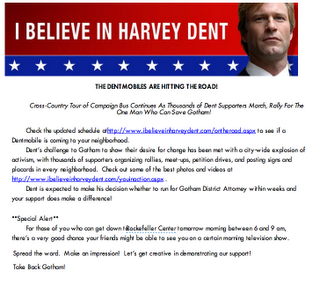
This fake political campaign took its cues from the real 2008 presidential race. It had phone messages, billboards and even a bus tour. On purpose, it didn’t look like a high-profile campaign with big donors behind it. It looked like a local district attorney race, and that meant a deliberately cheap look and identity. Fans got the first Dentmobile emails from the campaign’s “take back our city” address on March 12, 2008, and the Chicago stop was set for the next day. Here is the campaign email that announced the bus.

As you can see, it’s nothing special. It even has spacing problems, which may well have been intentional. A real small-town campaign email looks a bit rough, and the fiction depended on the email looking real.
The bus tour also showed how real-world stunts can go wrong. HollywoodChicago reported that Chicago police broke up the Chicago Dentmobile stop. Other stops went ahead, including Portland, Oregon.
The original 2008 sign-up page for the Harvey Dent email campaign was here. That list belongs to history now, because the campaign wrapped up when the film opened.
How the Dentmobile email would fare in 2026
If the same email went out to a large list today, it would need much more than a good story to reach the inbox. Since February 2024, Google’s email sender guidelines have required anyone sending 5,000 or more messages a day to personal Gmail accounts to do several things. They must authenticate with SPF, DKIM and DMARC (at least p=none), offer one-click unsubscribe on marketing mail, honor opt-outs within two days and keep the spam rate reported in Postmaster Tools below 0.3%. Gmail began rejecting non-compliant bulk mail more strictly in November 2025. Yahoo enforces the same core rules, and Microsoft added SPF, DKIM and DMARC requirements for high-volume senders to Outlook.com, Hotmail and Live addresses on May 5, 2025.
A minimal DMARC record for a campaign domain looks like this:
_dmarc.example.com. IN TXT "v=DMARC1; p=none; rua=mailto:[email protected]"
The design would need work too. An email built mostly from one image, as this one was, often shows up as a blank box when images are blocked. It can also be hard to read on a phone or in dark mode. Live text with a short image banner would carry the same story more safely. Measuring the campaign would be harder as well. Since Apple launched Mail Privacy Protection with iOS 15 in 2021, opens from Apple Mail users get inflated, so clicks, replies and event sign-ups are better signs that fans are actually engaging.
The U.S. law hasn’t changed. Under the FTC’s CAN-SPAM rules, even an email written as fiction must not use misleading header information. It must include a valid physical postal address and give recipients a clear way to opt out, honored within 10 business days.
FAQ
What was the “I Believe in Harvey Dent” campaign?
It was a fake district attorney campaign for the character Harvey Dent. 42 Entertainment created it to promote The Dark Knight, and it ran from May 2007 until the film opened in July 2008 as part of the “Why So Serious?” alternate reality game. Fans could sign up by email and phone, receive campaign messages and turn up at real-world events.
How big was the Why So Serious campaign?
Cannes Lions entries for the campaign credit it with more than 10 million unique participants in 75 countries over about 15 months. It won the Grand Prix at the Cannes Cyber Lions on June 24, 2009.
Can a brand still run an in-character email campaign like this?
Yes, as long as the email is still honest about who is sending it. Under CAN-SPAM, the “From” details and routing information must identify the real sender, and the subject line must not mislead people about what the message is. The story can be fiction, but the sender, the postal address and the opt-out have to be real.
Do the Gmail and Yahoo bulk sender rules apply to a small campaign list?
Gmail’s strictest rules apply once you send about 5,000 messages a day to personal Gmail accounts. Basic authentication and a spam rate below 0.3% apply to all senders. Yahoo applies its spam rate limit to everyone, and a film or game promotion can pass 5,000 a day quickly. It’s safest to set up SPF, DKIM, DMARC and one-click unsubscribe before the first send.
Why are open rates unreliable for campaigns like this today?
Apple Mail Privacy Protection preloads images, including tracking pixels, for users who turn it on. That marks many emails as opened even when nobody read them. Clicks, event check-ins and replies show real fan engagement better than opens do.
Sources
- Google: Email sender guidelines and the email sender guidelines FAQ (Gmail Help)
- Yahoo Sender Hub: Sender best practices and FAQs
- Microsoft: Outlook.com requirements for high-volume senders
- Federal Trade Commission: CAN-SPAM Act: A Compliance Guide for Business
- Apple: Mail Privacy Protection overview (Apple Support)
- Cannes Lions (Love the Work): “Why So Serious?” campaign entries