
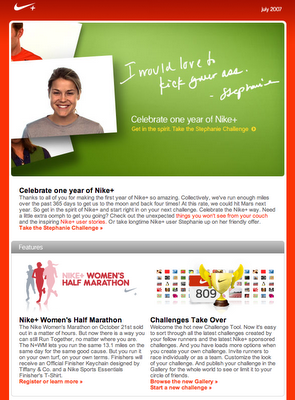
Trash talk works in email when it comes from real members, ties to a live competition, and ends in one clear action, such as a button that says “join this challenge.” Nike’s first Nike+ email did exactly that in 2007: it led with a member taunting other runners and invited readers into her challenge. The idea still holds in 2026. Since then, the challenges have moved into the Nike Run Club app, Apple Mail Privacy Protection has made open rates unreliable, and Gmail, Yahoo and Microsoft now require bulk senders to authenticate their mail, offer one-click unsubscribe and keep spam complaints low.
What the Nike+ website got right
The Nike+ website was a smart piece of marketing, and its users kept coming back. In the months after launch, some runners checked it several times a week.
It gave people who used the Nike + iPod Sport Kit plenty of reasons to return. Nike and Apple introduced the kit on May 23, 2006. It used a sensor placed under the insole of a Nike+ shoe and a receiver attached to an iPod nano, and the sensor-and-receiver kit sold for $29. On the personal side, runners could track their runs, look at their split times and compare each run with earlier runs over the same distance.
There was a social layer too. Runners around the world took part in distance challenges, and each challenge had its own space where participants could “talk trash.” The winner got a virtual trophy at the end. Nike also offered widgets that showed a runner’s runs, goals and challenges on their own blog or website.
Most of that is history now. Apple stopped selling the standalone Sport Kit once the Nike+ feature was built into the iPod touch and iPhone. The Nike+ Running app became Nike+ Run Club in August 2016, and it is now called Nike Run Club. Challenges came back inside the app in February 2018. According to Nike’s help pages, you can still join Individual Challenges (a set distance within a set time) and Community Challenges, and you still earn a trophy under Achievements when you finish one.
The missing piece was email
Nike+ had a busy community, but one piece of the Web 2.0 puzzle was missing: email.
When challenges ended, Nike sent participants nothing. That was a missed opportunity. Ending a challenge is a natural moment to message the people in it: who won, how each runner placed, and which challenge to join next. Even a monthly email would have been better than silence.

The first email led with a member talking trash
Nike’s first Nike+ email had the subject line “Celebrating a Year of Nike+.” Fitting the challenge theme, the main message was a Nike+ member talking trash and inviting readers to join her challenge.
The timing was good. The week before, Nike had upgraded the challenge area so challenges were easier to find and join. Linking straight to one challenge showed users how easy joining had become. For competitive readers, the trash talk alone might be enough to get them fired up and out to show Stephanie who’s boss.
Three things made the email work:
- The voice came from a member, not the brand. A taunt from another runner reads as a dare. The same line from Nike would read as an ad.
- It made one ask. The email pointed to one challenge, so readers had one obvious next step.
- It matched a product change. The email went out right after the challenge area got easier to use, so the click led somewhere that worked.
How to use trash talk in email today
The tactic still works, but the rules around it have changed. Before you build a campaign around member taunts, check these points.
| Area | What changed | What to do |
|---|---|---|
| Where the competition lives | Challenges like Nike’s have moved into apps, with push notifications and in-app feeds | Use email for the moments that need more room: challenge recaps, final results, invitations to the next challenge |
| Measuring success | Apple Mail Privacy Protection preloads images through Apple’s proxy servers, which records opens that never happened | Judge the campaign on clicks, challenge joins and completed challenges |
| Gmail and Yahoo rules (from February 2024) | Bulk senders need SPF, DKIM and DMARC, one-click unsubscribe, unsubscribes honored within 2 days, and a spam rate below 0.3% | Get authentication in place before you send, and keep the visible unsubscribe link in the email body as well as the header |
| Microsoft rules (from May 5, 2025) | Domains sending more than 5,000 emails a day to Outlook.com, Hotmail and Live.com addresses must pass SPF, DKIM and DMARC | Make sure your From domain aligns with the domain used for SPF or DKIM |
| Member content | A quote from a real user is personal data and part of your brand’s message | Get the member’s permission before you quote them, and leave out anything insulting or personal |
Gmail’s bulk sender threshold is 5,000 or more messages a day to Gmail addresses. Google counts your spam rate in Postmaster Tools. Yahoo has the same 0.3% complaint threshold but does not publish a volume number, so even smaller senders should follow its rules.
Keep the trash talk friendly. Competitive copy can feel aggressive, and some readers will hit “report spam” when they meant to unsubscribe. A playful dare tied to an activity people already signed up for gets clicks. Insults sent to cold or inactive contacts get complaints.
FAQ
Does user-generated content work in email marketing?
Yes, when it is tied to something readers already care about. A member’s challenge, review or result works because it comes from a peer instead of the brand. It works best with one clear call to action next to it, as Nike’s first Nike+ email showed.
Do I need permission to quote a customer in a marketing email?
Get it, in writing or through clear terms the member agreed to. A quote with a real name or username attached is that person’s content and data. Asking first also protects you if the person later regrets what they said.
How should I measure a challenge or community email now that open rates are inflated?
Use clicks, sign-ups and completed actions, such as challenge joins. Apple Mail Privacy Protection loads images in the background, so opens get recorded even when no one read the email. Some ESPs, including SendGrid, flag opens they think came from Apple’s proxy, but clicks are still the more reliable signal.
What are the 2024 Gmail and Yahoo bulk sender requirements?
Since February 2024, Gmail and Yahoo require bulk senders to authenticate with SPF and DKIM and to publish a DMARC policy, offer one-click unsubscribe in applicable marketing and subscription mail, and honor unsubscribes within two days (Google says 48 hours). You must also keep your spam complaint rate below 0.3%. Gmail defines a bulk sender as one that sends 5,000 or more messages a day to Gmail addresses.
Does CAN-SPAM apply to community or challenge emails?
Yes. If the main purpose of the email is to promote your product or service, it is commercial. That means an honest subject line, a valid physical postal address, and a working opt-out that you honor within 10 business days. Pure account notices, like a password reset, fall under the lighter rules for transactional messages.
Should a brand with an app still send email?
Yes. Push notifications are good for quick nudges, but people turn them off. Email reaches users who haven’t opened the app in weeks. Challenge recaps, results and invitations to the next event are good uses for it.
Sources
- Google: Email sender guidelines
- Yahoo Sender Hub: Sender best practices
- Microsoft Tech Community: Outlook’s new requirements for high-volume senders
- FTC: CAN-SPAM Act compliance guide for business
- Nike Help: What challenges are there in the NRC app?
- Twilio SendGrid: Understanding Apple Mail Privacy Protection and open events