
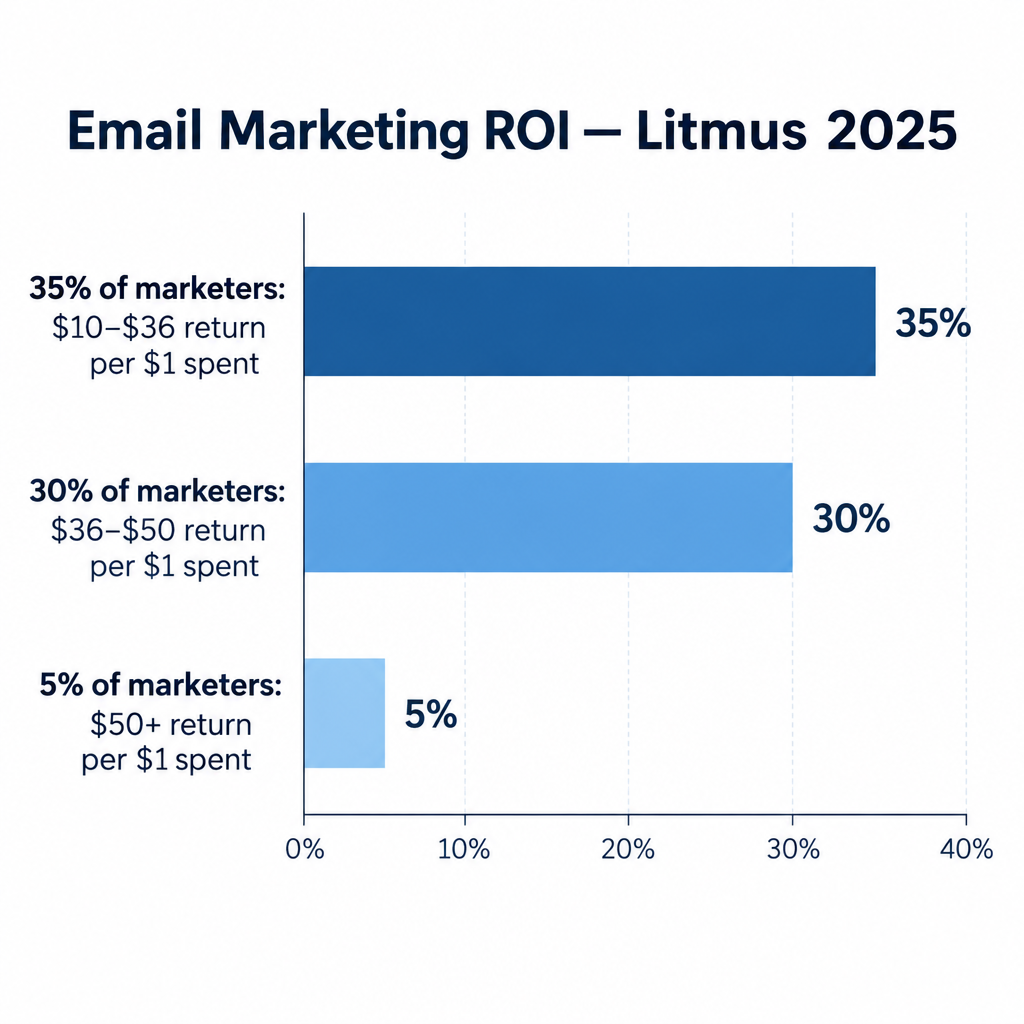
No. As of November 2026, email marketing hasn’t stalled, but it is harder to do well. In Litmus’s 2025 State of Email research, 35% of marketers reported a return of $10 to $36 for every $1 spent, 30% reported $36 to $50, and 5% reported more than $50. What changed is the job. Gmail, Yahoo and Microsoft now require authenticated mail and one-click unsubscribe from bulk senders. Apple Mail Privacy Protection has made open rates unreliable. And most email is now read on phones, often in dark mode, so the work has moved toward deliverability, consent and clicks.
The original question
The question came from this post on the No man is an iland blog: “Why is email marketing becoming stagnant?” Its evidence was a drop in 2006 in B2C emails carrying free offers and sales offers. The blog suggested a few reasons:
- Statistical anomalies
- New marketers still learning how email marketing works
- General malaise
- Marketers overshooting their email list quotas
- Microsoft Outlook 2007, which was hard to design for
Some of those points held up. A few important factors were missing.
What the original diagnosis got right
Outlook 2007 really was hard to code for. When Microsoft switched Outlook’s rendering from Internet Explorer to the Microsoft Word engine, designers lost basic CSS support, including background images. Today that is history, but only partly. Classic Outlook for Windows still renders email with Word, and Microsoft has said it will support classic Outlook until at least 2029. The new Outlook for Windows uses a standard browser engine, so you often have to code for both until your audience moves over.
It was also true that many emails lacked charisma and creativity, and that the field was full of newcomers who didn’t know the basics. Both are still true. The difference now is that mailbox providers punish the basics being wrong. Since February 2024, Gmail and Yahoo have required bulk senders to authenticate their mail and keep spam complaints low. In November 2025, Google said it was stepping up enforcement on mail that doesn’t comply, including temporary and permanent rejections.
What the original diagnosis left out
Budgets moving to other channels
A big part of the story was that people had more places to find information online. That probably cut into B2C email’s share. Companies were putting more of their online budgets into ads, viral campaigns and search engine marketing (SEM). Even so, email was still the online channel with the highest return on investment.
That pattern has held. Litmus’s 2025 research found that 21% of marketing leaders don’t measure email ROI, down from 36% in 2023. When nobody can prove a channel’s return, it struggles to win budget.
Proving the value to the business
So what was the problem? Part of it was getting those facts across to the people who approve budgets, and that is still the weak spot. Open rates make it worse. Apple Mail Privacy Protection launched with iOS 15 on September 20, 2021. Apple preloads images through its own proxy, so the tracking pixel can register an “open” even if nobody read the email. Litmus estimates that Mail Privacy Protection now affects roughly 55% to 60% of all email opens. A report built on opens can’t support an ROI argument. Clicks, conversions, revenue per email and list churn can.
Rich media in the inbox
The other question was whether email was held back because embedded Flash or video didn’t work widely. At the time, Apple’s Mac Mail was the main client that played video.
Flash is gone now. Adobe ended support for it at the end of 2020, so that part of the question no longer applies. Video is still only partly supported. Apple Mail on iOS and macOS can play HTML5 video, but Gmail, Yahoo and Outlook.com show a fallback image instead. The standard method today is a still image or animated GIF with a play button, linked to a landing page where the video plays. YouTube embeds don’t work in email because they need JavaScript.
Which clients you design for matters more than the video itself. Litmus’s market share tracking consistently ranks Apple Mail and Gmail as the two largest email clients by tracked opens, though their combined share varies by reporting period. Testing in those two clients, in light and dark mode, does more for results than any rich-media trick.
What has actually changed since the original post
This table compares the concerns raised at the time with where things stand in November 2026.
| Then | Now (November 2026) |
|---|---|
| Outlook 2007 dropped background images and modern CSS | Classic Outlook still uses the Word engine (supported until at least 2029); the new Outlook for Windows uses a browser engine |
| Flash and video rarely played in email | Flash is discontinued; HTML5 video plays mainly in Apple Mail, and other clients show a fallback image |
| Open rates used as proof of engagement | Apple Mail Privacy Protection inflates opens; clicks and revenue are the reliable signals |
| Little sender authentication was required | Gmail and Yahoo (February 2024) and Microsoft Outlook.com (May 5, 2025) require SPF, DKIM and DMARC from bulk senders |
| Unsubscribe was a footer link | Gmail and Yahoo require one-click unsubscribe headers (RFC 8058) for bulk marketing mail |
| Desktop inbox reading | Most opens are on mobile, and many happen in dark mode |
If you send in bulk, the baseline is now a published DMARC record. The minimum policy is p=none:
_dmarc.example.com. TXT "v=DMARC1; p=none; rua=mailto:[email protected]"
You also need one-click unsubscribe headers on marketing messages:
List-Unsubscribe: <https://example.com/unsub?id=abc123>, <mailto:[email protected]>
List-Unsubscribe-Post: List-Unsubscribe=One-Click
Google asks bulk senders to keep the spam rate shown in Postmaster Tools below 0.1% and to never let it reach 0.3%. Unsubscribe requests should be processed within two days.
Working on it together
The original answer to problems like these was to work with other email specialists. The post sent readers to the Email Marketer’s Club (EMC), a place for practitioners to start a conversation and work through these questions together.
That advice still holds, even though the communities have changed. Today the useful shared knowledge comes from mailbox providers’ own documentation, deliverability communities, and the reports ESPs and testing vendors publish. Following what Google, Yahoo and Microsoft publish for senders will help you more than any single benchmark.
FAQ
Is email marketing still worth it in 2026?
Yes, for senders who measure it. Litmus’s 2025 State of Email research found that most programs earn at least $10 for every $1 spent, and 35% earn $36 or more. The programs that struggle are usually the ones that don’t track revenue at all.
Why did my open rates jump without any change in results?
Apple Mail Privacy Protection is the usual cause. Apple preloads images, which fires the tracking pixel whether or not anyone reads the message. Judge campaigns on clicks, conversions and revenue, and treat opens as a rough signal only.
What are the Gmail and Yahoo bulk sender rules?
From February 2024, senders of more than 5,000 messages a day to personal Gmail accounts must use SPF, DKIM and DMARC, include one-click unsubscribe on marketing mail, and keep spam complaints under 0.3%. Yahoo has similar rules but publishes no numeric threshold. Gmail’s enforcement tightened from November 2025, and mail that doesn’t comply can now be rejected outright.
Does Microsoft have the same requirements?
Yes, for Outlook.com, Hotmail.com and Live.com addresses. Since May 5, 2025, domains sending more than 5,000 messages a day to those consumer mailboxes need to pass SPF and DKIM and publish a DMARC record of at least p=none. Microsoft prefers alignment with both SPF and DKIM.
Can you put video in a marketing email?
Only partly. Apple Mail plays HTML5 video, but Gmail, Yahoo and Outlook.com show a fallback image instead. The safe approach is a thumbnail with a play button that links to the video on a landing page.
What does CAN-SPAM require of commercial email?
The FTC’s guide requires accurate header and subject lines, identification of the message as an ad where that applies, and a valid physical postal address. You also need a clear way to opt out, and opt-outs must be honored within 10 business days. The law applies to every commercial message, not just bulk sends.
Sources
- Google: Email sender guidelines
- Google: Email sender guidelines FAQ
- Yahoo Sender Hub: Sender best practices
- Microsoft Tech Community: Outlook’s new requirements for high-volume senders
- Microsoft Tech Community: New Outlook for Windows, a guide to product availability
- FTC: CAN-SPAM Act compliance guide for business
- Litmus: State of Email reports
- Litmus: Email client market share
- Litmus: Apple Mail Privacy Protection for marketers