
Every email platform still reports an open rate. As of November 2026, though, it counts how many times a tracking pixel loaded, which is a different thing from how many people read your email. Apple Mail Privacy Protection, launched in September 2021, preloads images in the background when a message arrives, so many “opens” happen with nobody looking. Litmus measured Apple Mail at 62.26% of tracked opens in July 2026. In 2009 the problem ran the other way: blocked images hid real opens. Today automatic image loading creates opens that never happened, so clicks, conversions and complaint rates are better guides than opens.
The way open rates were measured in 2009 was already broken, and the logic behind it was no longer accurate. The reason it failed back then was simple: most major email clients and webmail services blocked images by default.
If you are new to this, here is how it works. An email counts as “opened” when a tiny, transparent 1×1 image, the tracking pixel, loads on the recipient’s screen. In 2009 most people never changed their settings to let images display. Years earlier, the pixel had been a fair way to measure opens. That changed when spammers flooded inboxes with image-heavy messages. Because of spam, mailbox providers and email clients cracked down and started blocking images by default. Outlook 2007, Gmail and Windows Live Hotmail all did this. From that point on, the open rate as marketers knew it was out of date. Gmail now shows images by default, but it still lets users choose whether images display automatically or whether they are asked first.
Rewind to 2009 and the picture looks like this: the EEC has an on-going discussion on what to do about this issue for email marketers. The Email Experience Council argued that ESPs and marketers first needed one standard way to count, and that was the right place to start. Someone could open an email, click a link, reach a landing page and buy something without a single image displaying, and that visit still would not count as an “open”. The EEC’s Measurement Accuracy Roundtable proposed calling the metric a “render rate”, which describes much more accurately what the pixel actually records.
The open question was how long the industry would take to adopt it. The EEC asked marketers for feedback and offered its “Email Render Rate” whitepaper as a download here.
What happened to the render rate and the open rate after 2009
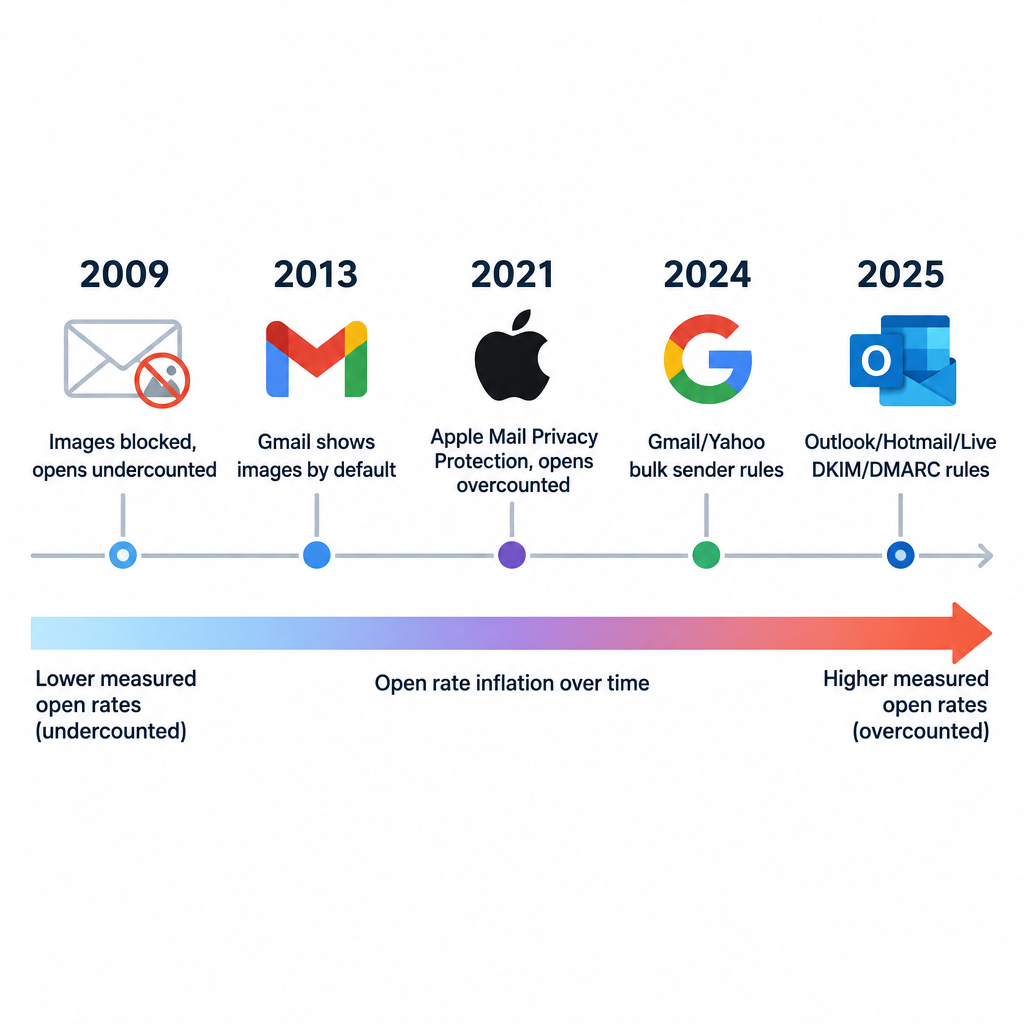
The render rate never caught on. ESPs kept the label “open rate”, and two later changes turned the original problem upside down. In 2009, blocked images caused opens to be undercounted. Since 2021, automatic image loading has caused them to be overcounted.
| Date | Change | Effect on open rates |
|---|---|---|
| 2009 | Images off by default in clients such as Outlook 2007, Gmail and Windows Live Hotmail | Real opens went uncounted, so open rates read low |
| December 2013 | Gmail began showing images by default and serving them through Google’s image proxy | More first opens were recorded, but recipient IP and location were hidden and repeat opens could be cached |
| September 2021 | Apple launched Mail Privacy Protection with iOS 15, iPadOS 15 and macOS Monterey | Remote content, including the pixel, preloads when mail arrives, so open rates read high |
| February 2024 | Gmail and Yahoo bulk sender rules took effect: SPF, DKIM, DMARC, one-click unsubscribe (enforced from June 2024) and a spam rate kept below 0.1%, with 0.3% as a hard cap | Inbox placement now depends on authentication and complaint rates, and the published rules set no open-rate target |
| May 5, 2025 | Outlook.com, Hotmail.com and Live.com began requiring SPF, DKIM and DMARC from domains that send more than 5,000 emails a day | Microsoft joined the same rules, with authentication as the entry ticket |
Why Apple Mail Privacy Protection matters most
Apple’s change did the most damage to the metric. Apple’s privacy documentation says that with “Protect Mail Activity” turned on, Mail downloads remote content privately in the background when a message arrives, not when the reader views it. It routes that content through proxy servers that hide the reader’s IP address. The pixel fires either way, so the sender’s report records an open.
Mailchimp’s help center lists the side effects: inflated open numbers, a lower “clicks per unique open” rate, and unreliable location and email client data for Apple Mail users. With Apple Mail accounting for well over half of tracked opens in Litmus’s data, a 40% open rate today often says more about how many of your subscribers use iPhones than about how good your subject line was.
Why Gmail’s proxy is a smaller problem
Gmail’s proxy changes what you can see, but it does not create fake opens. Since 2013, Gmail has fetched images through Google’s servers. You still learn that a message was opened at least once. What you lose is the reader’s IP address and location, and repeat opens may be cached and never reach you. For Gmail subscribers, opens remain a reasonable rough signal.
What to measure instead of opens
Build your reporting around actions that need a real person behind them, and keep opens as a secondary trend line.
- Clicks and click-to-delivered rate. Mail Privacy Protection hides whether a recipient opened an email by downloading remote content in the background when the message arrives, regardless of engagement, so clicks give a more useful read on engagement than opens.
- Conversions and revenue per email. Track these with UTM tags or your store integration so each campaign is tied to orders, sign-ups or bookings.
- Replies. For newsletters and B2B mail, replies are strong proof that someone read the message, and mailbox providers read them as a positive signal.
- Unsubscribe rate. A rising rate warns you about frequency or relevance before it turns into spam complaints.
- Spam complaint rate. Watch it in Google Postmaster Tools and through Yahoo’s Complaint Feedback Loop. Google asks senders to stay below 0.1% and never reach 0.3%.
- Opens from non-Apple segments. Gmail and Outlook opens can still help you compare subject lines over time, as long as you filter out the proxy opens your ESP flags.
The honest counter-argument is that opens still have some uses. They help with A/B tests run inside the same audience, with spotting sudden delivery drops (a campaign with almost no opens from Gmail users usually means a spam folder problem), and with timing analysis for non-Apple readers. The mistake is treating a single open-rate number as proof that people read your email.
Be most careful with sunset and re-engagement rules. A subscriber using Mail Privacy Protection can look “active” forever without reading a line, while an engaged Gmail reader who blocks images can look inactive. If your list-cleaning rules are based on opens, add a click or purchase condition, or you will keep mailing people who stopped reading long ago.
FAQ
Are open rates still worth tracking in 2026?
Yes, as a rough trend, but not as a headline metric. Since Apple Mail Privacy Protection launched in 2021, a large share of recorded opens come from automatic preloading, not from readers. Use opens to compare campaigns sent to the same audience, and judge results by clicks, conversions and complaint rates.
How does Apple Mail Privacy Protection affect open rates?
It loads remote images, including the tracking pixel, through Apple’s proxy servers in the background when a message arrives. The sender records an open whether or not the person ever looks at the email. It also hides the reader’s IP address, which makes location and device data from Apple Mail users unreliable.
What happened to the EEC’s render rate?
The Email Experience Council proposed the render rate in 2009 as a more honest name for what pixel tracking measures. The industry never adopted it as standard, and ESPs still use “open rate”. The idea behind it still holds: a pixel load tells you an image was rendered, and that is not the same as a person reading.
Do Gmail and Yahoo use open rates to decide spam folder placement?
Neither publishes an open-rate threshold. The written rules for bulk senders, in force since February 2024, cover SPF, DKIM and DMARC authentication, one-click unsubscribe for marketing mail, honoring unsubscribes within two days, and a spam complaint rate below 0.1%, with 0.3% as a hard cap that must never be reached. Engagement still shapes filtering, but complaints are the number they publish.
Can I remove Apple proxy opens from my reports?
Many ESPs now flag opens that come from Apple’s proxy and let you filter them out or show them separately. Check the reporting section of your platform’s help center for the exact setting. Once those opens are removed, your remaining open rate gives a fairer view of non-Apple readers.
Should I clean my list based on opens?
Not on opens alone. Mail Privacy Protection makes inactive Apple Mail subscribers look engaged, and image blocking can make real readers look inactive. Base sunset rules on clicks, purchases or replies over a set window, and send a re-engagement campaign before you remove anyone.
Sources
- Google Workspace Admin Help: Email sender guidelines FAQ
- Yahoo Sender Hub: FAQs
- Microsoft Tech Community: Outlook’s new requirements for high-volume senders
- Apple: Mail Privacy Protection & Privacy
- Mailchimp Help: Apple Mail Privacy Protection (MPP) FAQs
- Litmus: Email client market share