
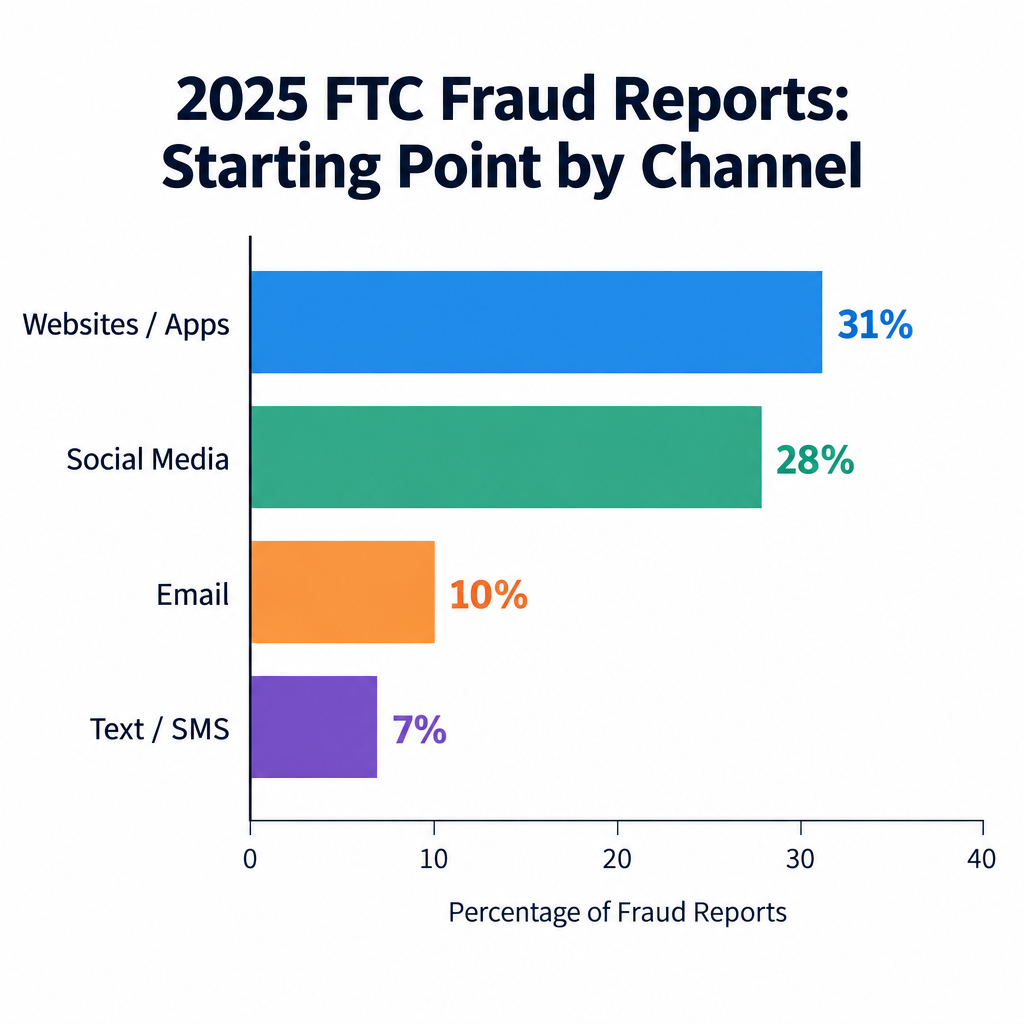
Email is still around, and spam never stayed in the inbox. The instant messaging services this post was written about are mostly gone: AOL Instant Messenger shut down on December 15, 2017, and Microsoft retired Skype on May 5, 2025. The real competition now comes from text messages, social media and in-app messaging. In 2025, FTC fraud reports with a loss named websites or apps (31%) and social media (28%) as the starting point far more often than email (10%) or texts (7%). Email has also become a stricter channel since this was written. Gmail and Yahoo began enforcing bulk sender rules in February 2024 (SPF, DKIM, DMARC, one-click unsubscribe and a spam rate below 0.3%), and Microsoft’s Outlook.com added similar rules on May 5, 2025.
Email Alternatives That Compete With Email
Several alternatives to email have grown into serious players. They can compete with email directly, by replacing it, or indirectly, by taking your audience’s attention. When this post first appeared, the rising alternatives were instant messaging (IM), mobile marketing, RSS feeds and desktop apps. Each raised questions about how flexible email would stay, and each gave spammers new ways to push messages out.
Here is what happened to each one:
| Channel (as named in the original post) | Status in November 2026 | Spam problem today |
|---|---|---|
| Instant messaging (AIM, MSN, Yahoo) | The consumer IM networks are gone. AIM closed in 2017 and Skype in 2025, when Microsoft moved users to Teams Free | Spam and phishing moved to WhatsApp, Telegram, Discord and workplace chat |
| Mobile marketing (SMS) | Now a major marketing channel | Text scams cost consumers about $470 million in 2024, according to the FTC |
| RSS | Still used by podcasts and some readers, but niche since Google Reader closed on July 1, 2013 | Minimal, since readers choose every feed |
| Desktop apps | Replaced by mobile apps and push notifications | Websites and apps were the top contact method in 2025 FTC fraud reports with a loss |
What MarketingSherpa Said About IM Spam (SPIM) in 2005
MarketingSherpa’s Email Marketing Metrics Guide 2005 said that worries about spam over instant messaging were growing, but that there were barriers to IM spam, or “SPIM.” The guide listed three barriers (spelling fixed here):
- The company controls IM list access. To market to a large number of buddies, you had to talk to AOL first.
- Corporations rarely had standard IM naming. Unlike with email, a spimmer could not use one address to spray messages at a group.
- IM had no opt-out mechanism. Users had to actively accept a new buddy before that buddy could send them a message. “However, there have already been cases of fraudulent ‘robot buddies’ that steal buddy lists and spread virally while recording sign-in names.”
How Those Barriers Held Up
All three barriers have weakened since 2005, and the first one no longer applies at all.
- Gatekeepers. AOL no longer controls anything here, because AIM is gone. The platforms that replaced it are the gatekeepers now. Meta controls access to WhatsApp Business, and Microsoft controls Teams. Brands that want to send marketing messages in those apps go through the platform’s business programs and opt-in rules.
- Predictable addresses. Phone numbers took the place of screen names. Phone numbers follow a fixed format, so spammers can generate them in sequence. That is a big reason text and “wrong number” scams grew.
- Opt-in by acceptance. Many messaging apps now accept messages from strangers by default, or sort them into a request folder. Accepting a contact is no longer a real barrier.
- Robot buddies. The bots arrived. The FTC’s text scam warnings describe automated fake delivery notices, fake fraud alerts and unpaid toll messages sent at scale.
How Close the SPIM Nuisance Got
The original post ended with a question. Instant messaging was spreading through offices, so how far off was SPIM, and when would the robots really come? The answer is that they came, just not on AIM. Unwanted messages spread across every channel that has a big audience and an easy way to reach it.
Email went the other way. It became harder to abuse at scale. Since February 2024, Google and Yahoo have required bulk senders to authenticate their mail, offer one-click unsubscribe and keep complaint rates low. Microsoft’s Outlook.com rules for senders of more than 5,000 messages a day took effect on May 5, 2025. A mailbox provider can now trace a message back to a verified domain and filter it on that domain’s reputation. Most messaging channels have never had a standard like that.
A minimal DMARC record of the kind all three providers expect looks like this:
_dmarc.example.com. IN TXT "v=DMARC1; p=none; rua=mailto:[email protected]"
Start with p=none so you can read the reports, then move to p=quarantine or p=reject once every legitimate source of your mail passes SPF or DKIM and aligns with your From domain.
What This Means for Email Marketers
The other channels have not replaced email. They have added to it, and each has its own consent rules.
- Email is regulated in the US by CAN-SPAM. The FTC can seek civil penalties of more than $53,000 per violating email. Gmail, Yahoo and Microsoft add their own technical requirements on top of the law.
- SMS marketing falls under the Telephone Consumer Protection Act (TCPA) and generally needs prior express written consent. That bar is higher than CAN-SPAM’s opt-out model.
- Messaging apps each have their own business policies, and they can shut off a sender with no appeal through a mailbox provider.
For most programs, email is still the channel you control best. You own the list, you set up the authentication, and Google Postmaster Tools and Yahoo Sender Hub show you how your mail is doing.
FAQ
What is SPIM?
SPIM is spam sent over instant messaging rather than email. The term caught on in the early 2000s, when AIM, MSN Messenger and Yahoo Messenger were the main IM networks. Today the same problem appears in SMS, WhatsApp, Telegram, Discord and workplace chat tools, though the old word is rarely used.
Has texting replaced email as the main channel for spam?
No single channel has taken over. In the FTC’s 2025 fraud reports that included a loss, websites or apps (31%) and social media (28%) ranked first and second, followed by phone calls (11%), email (10%) and texts (7%). Email had been the top contact method in 2023 and 2024, so the shift is recent.
What do Gmail and Yahoo require from bulk senders?
Since February 2024, Gmail has required senders of 5,000 or more messages a day to its users to set up SPF, DKIM and DMARC, support one-click unsubscribe on marketing mail and keep reported spam below 0.3%. Google recommends staying under 0.1%. Yahoo’s Sender Hub lists the same core rules without publishing a fixed volume threshold, and both providers expect unsubscribe requests to be honored within two days.
Does CAN-SPAM apply to text messages?
CAN-SPAM covers commercial email. Commercial texts sent to phones fall mainly under the TCPA and FCC rules. Those rules generally require prior express written consent before you send marketing texts, so a list that is fine for email cannot simply be reused for SMS.
Is RSS still a useful alternative to email newsletters?
Only for a small, technical audience. RSS lost much of its mainstream reach when Google Reader shut down on July 1, 2013, though it still runs podcast distribution and some news readers. It is a decent extra channel for a blog, but it does not replace an email list you own.
Should marketers move budget from email to messaging apps?
Test messaging apps alongside email rather than instead of it. Messaging platforms can change their rules or pricing and cut off a sender’s access, while an email list stays yours as long as you send authenticated, wanted mail. Put new channels to work where they clearly perform better, such as time-sensitive alerts by SMS for subscribers who opted in.
Sources
- Google Workspace Admin Help: Email sender guidelines
- Yahoo Sender Hub: Sender Best Practices
- Microsoft Tech Community (Outlook blog): Outlook’s new requirements for high-volume senders
- Federal Trade Commission: CAN-SPAM Act, A Compliance Guide for Business
- Federal Trade Commission: Data Spotlight on reported losses to scams on social media (April 2026)
- Federal Trade Commission: New FTC data show top text message scams of 2024 (April 2025)