
Friday is not a sure winner for email sends in November 2026, but it still makes a good test. Omnisend’s 2026 research covered about 26 billion emails and found Tuesday best for opens and Friday best for sales. MailerLite’s 2025 data put Friday just ahead on opens. Two things have changed since this post was written. Apple Mail Privacy Protection now inflates open rates, and Gmail, Yahoo and Microsoft now require authenticated mail and low spam complaint rates. So test send days on your own list, and judge them by clicks and conversions rather than opens.
Why open rates seemed to be falling
 Email open rates dropped over several quarters in the mid-2000s. Image blocking took part of the blame. Yahoo Mail, Gmail, Outlook 2003 and several other email clients hid images by default. That meant the invisible tracking pixel never loaded, so a real read was never counted as an open. Marketers were left asking the same question: how do you improve open rates for a campaign?
That particular problem is history now. Microsoft ended support for Outlook 2003 in April 2014. In December 2013 Gmail started loading images automatically through its own image proxy. Today the problem runs the other way. Apple Mail Privacy Protection launched with iOS 15 in September 2021. It preloads images on Apple’s servers, so opens get recorded that no person made.
The study that pointed to Friday
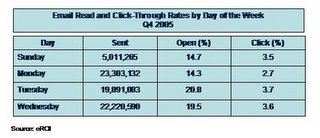
eROI, an email marketing agency, published a study that suggested sending on Friday. Its reasoning was about inbox volume. During the work week, fewer emails went out on Fridays than on any other day. With less competing mail in their inboxes, subscribers might be more likely to notice your message.
Today’s mailbox providers work differently. Gmail sorts mail into Primary, Promotions and other tabs, so your newsletter mostly competes with other promotional email, not with the whole inbox. A quiet day for business mail can still be a busy one in the Promotions tab.
What the data showed
eROI collected data over two quarters, and it showed higher open rates and click-through rates on Friday. Tuesday came second for open rates, and Thursday came second for click-through rates. The advice at the time was to test delivery days while planning 2006 campaigns, to see which day your subscribers were most likely to open.
That advice to test still holds. What has changed is how the results should be measured.
How Friday compares in newer research
The large studies from 2025 and 2026 disagree on the best day, and the gaps between weekdays are small. Friday keeps showing up near the top, often for sales rather than opens.
| Study | Data behind it | Best day for opens | Best day for clicks or sales |
|---|---|---|---|
| eROI (mid-2000s, the original study) | Two quarters of campaign data | Friday, then Tuesday | Friday, then Thursday |
| Omnisend (2026 research) | About 26 billion emails | Tuesday | Friday, for conversions |
| MailerLite (2025 data) | Customer campaigns across its platform | Friday, narrowly ahead of Monday (about 49.7% vs 49.4%) | Not the focus here |
Different methods explain much of the disagreement. Platforms count opens in different ways, and some filter out machine opens while others don’t. Their customers also sell different things to different audiences. The fact that three datasets name different winners tells you the day matters less than who is on your list.
Why open rate is a weak way to pick a send day
Opens can no longer settle the question, because Apple Mail Privacy Protection records “opens” whether or not anyone reads the message. Twilio SendGrid reported that in the months after launch, MPP triggered 10.5% of all opens and 18.2% of unique opens that it processed. Apple Mail is popular, so the true share on many consumer lists is now higher.
This changes how a send-day test should work:
- Use clicks, conversions and revenue per email as the main measure. They require a person to act.
- Filter machine opens if your email service provider (ESP) can mark them. Many now label Apple proxy opens separately.
- Compare opens only as a trend between two variants sent to the same audience. The machine noise then affects both sides equally.
- Fix open-based automations. Re-engagement flows that rely on opens will treat Apple Mail users as engaged when they may not be.
Make sure your Friday email reaches the inbox
No send day helps mail that gets filtered or rejected. Since February 2024, Gmail and Yahoo have required bulk senders to authenticate their mail, offer one-click unsubscribe and keep complaints low. Microsoft added similar rules for Outlook.com in May 2025.
| Mailbox provider | Who it applies to | Core requirements |
|---|---|---|
| Gmail | Senders of 5,000+ messages a day to personal Gmail accounts | SPF, DKIM and DMARC; one-click unsubscribe on marketing and subscribed mail; spam rate kept below 0.1% and never reaching 0.3% |
| Yahoo Mail | Bulk senders | SPF, DKIM and DMARC aligned to the From domain; one-click unsubscribe (enforced from June 2024); spam rate under 0.3% |
| Outlook.com | Domains sending 5,000+ messages a day (from May 5, 2025) | SPF, DKIM and DMARC, at least p=none and aligned with SPF or DKIM |
Gmail began enforcing these rules more strictly in November 2025. Mail that doesn’t comply can now get temporary or permanent rejections, not just a spam-folder placement. Unsubscribe requests should be honored within two days.
Here is a minimal DMARC record you can start from, published as a TXT record:
_dmarc.example.com. TXT "v=DMARC1; p=none; rua=mailto:[email protected]"
One-click unsubscribe (RFC 8058) is handled separately, through the List-Unsubscribe and List-Unsubscribe-Post email headers. Most ESPs add them for you:
List-Unsubscribe: <https://example.com/unsubscribe?id=abc123>, <mailto:[email protected]>
List-Unsubscribe-Post: List-Unsubscribe=One-Click
How to test send days on your own list
A fair test changes only the day and measures something a person did.
- Pick one campaign type. Newsletters and promotions behave differently, so don’t mix them in a single test.
- Split the list at random into two or more groups of equal size. Use your ESP’s A/B testing or send-time tools where they exist.
- Send the same email at the same local time of day, changing only the weekday (for example Tuesday against Friday).
- Measure clicks, conversions and revenue per recipient over the same window for each group, such as 72 hours.
- Repeat for at least three or four rounds before you change your schedule. One send can’t tell a pattern from a lucky week.
- Watch complaints and unsubscribes too. If the winning day also raises your spam rate in Google Postmaster Tools, it isn’t a win.
The best audience for Friday is retail and ecommerce, where people shop heading into the weekend. Omnisend’s conversion data supports Friday for these senders. B2B senders whose readers wind down on Friday afternoons often do better earlier in the week. The honest case against Friday is that a message landing late Friday may sit unread until Monday, buried under the weekend’s mail. That makes the time of day as important as the day itself.
If your list is under a few thousand people, one send-day result is mostly noise. You will gain more by cleaning out inactive subscribers and fixing authentication than by moving your send day. Once those basics are in place, a Friday test costs nothing and can pay off.
FAQ
Is Friday a good day to send marketing emails?
Friday is a good day to test, especially for retail. Omnisend’s 2026 research across about 26 billion emails found Friday had the highest conversion rate, while Tuesday led for opens. Your own list’s results should decide your schedule.
What is the best day to send emails in 2026?
No single day wins for every list. Tuesday leads most often for opens in large datasets, and Friday often leads for conversions. The differences between weekdays usually amount to a percentage point or two, so test on your own audience.
Are open rates still reliable for send-time testing?
Not on their own. Apple Mail Privacy Protection has preloaded images since iOS 15 in 2021, which records opens that no person made. Use clicks and conversions as your main measure, and filter machine opens if your ESP labels them.
Do the Gmail and Yahoo sender rules affect when you should send?
They don’t set send days, but they decide whether your mail arrives at all. If you send 5,000 or more messages a day to personal Gmail accounts, you need SPF and DKIM authentication, a published DMARC record, one-click unsubscribe on marketing and subscribed messages, and a spam rate kept below 0.1% that never reaches 0.3%. Yahoo has similar rules, and Microsoft applies matching ones to Outlook.com.
Should you send on weekends?
Weekends tend to show lower open rates in many datasets, but some consumer brands do well on Saturday or Sunday because their buyers have time to browse. Test a weekend send against your best weekday before you commit. Measure sales, not opens.
Does CAN-SPAM limit which days you can send?
No. The FTC’s CAN-SPAM rules don’t restrict send days or times. They do require an accurate sender and subject line, a valid physical postal address and a working opt-out that you honor within 10 business days. Gmail and Yahoo expect unsubscribes to be processed faster, within two days.
Sources
- Google: Email sender guidelines FAQ
- Yahoo Sender Hub: FAQs
- Microsoft Tech Community: Outlook’s new requirements for high-volume senders
- FTC: CAN-SPAM Act compliance guide for business
- Omnisend: 26 billion emails point to Tuesday for opens and Friday for sales
- MailerLite: The best time to send email
- Twilio SendGrid: Apple Mail Privacy Protection and how email senders can adapt