
REI’s sale emails are still a useful model because every part of them pushes toward one click: the headline, the navigation and a second clearance offer all point the same way. That lesson still holds in November 2026, but the inbox around it has changed. Gmail now sorts most retail mail into the Promotions tab and loads images through its own proxy, and Apple Mail Privacy Protection inflates open rates. Since February 2024, Gmail and Yahoo have also required bulk senders to authenticate with SPF, DKIM and DMARC, offer one-click unsubscribe and keep spam complaints under 0.3%. So judge a call to action like REI’s by clicks and sales, and make sure it reaches the inbox and reads well on a phone and in dark mode.
REI has been consistent in its email marketing for a long time, and it keeps trying new things. A good example was their implementation of animated gifs (as a replacement for embedded video). It was a smart move. Subscribers got motion without depending on video playback, which most email clients never supported. Brands still use the same approach today. Animated GIFs play in Apple Mail, Gmail, Outlook on the web and the new Outlook for Windows. Classic Outlook for Windows may show only the first frame, so the first frame has to work as a still image on its own.
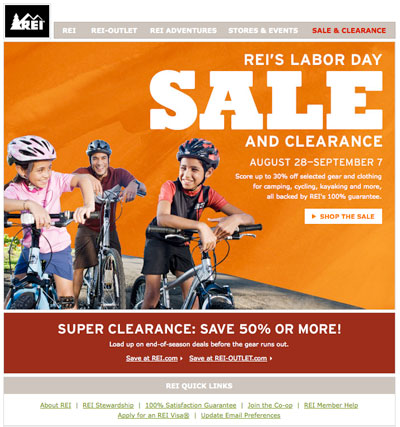
REI’s sale emails share the same look and feel (layout, fonts and so on), but each one is different enough from the last to grab attention in its own way. One email sent on a Friday afternoon is a strong example:

Everything about this email says “buy now, click now.” The stark “SALE” headline over a photo of a father and his two kids on mountain bikes, the “sale & clearance” link in the navigation and the secondary call to action for “SUPER CLEARANCE” all make the same point: click through, save money and spend it with REI.
Pushy, but effective
Some readers will find an email like this desperate, a bit obnoxious and pushy. That’s a fair criticism. But a hard-sell email is built for exactly the person who isn’t shopping. Someone with no plans to buy a tent clicks out of curiosity, lands on a Half Dome tent, sees how much the sale saves and buys anyway. One loud call to action, repeated in several places, creates that impulse path.
The tent from that email is still on sale. REI calls the Half Dome its number one selling tent, and it updated the design for the line’s 45th anniversary.
The trade-off is easier to measure now than when this email went out. If too many subscribers react to hard-sell emails by clicking “report spam,” the sender’s complaint rate in Google Postmaster Tools rises toward Gmail’s 0.3% limit. Above that level, Google won’t consider the sender for help with delivery problems. Loud is fine. Loud every day to people who never engage is how a strong call to action ends up in the spam folder.
What B2C senders can still learn from REI
Plenty of B2C companies can learn from REI’s emails in general. The call to action strategy is solid, and so are other parts of the design. When this email was sent, REI always included links to mobile and text versions, matched its email navigation to its site navigation and linked to all the major social media sites. Marketers treated all of these as essentials at the time. Some have aged better than others:
| Element | Then | Now (November 2026) |
|---|---|---|
| Link to a mobile version | Standard practice | Outdated. Responsive design adapts one email to any screen, and most reading happens on phones |
| Link to a text version | Common courtesy | Outdated as a link. ESPs send a plain-text part alongside the HTML automatically, and many keep a “view in browser” link |
| Navigation that mirrors the website | Smart and consistent | Still good practice. Keep links big enough to tap on a phone |
| Icons for every major social network | Treated as essential | Optional. Fine in the footer, but they shouldn’t compete with the main call to action |
| Animated GIF in place of video | New and clever | Still standard. Design the first frame for clients that don’t animate |
| Dark mode | Didn’t exist | Check that logos, text inside images and the “SALE” headline still read on dark backgrounds |
If you want to see how REI handles calls to action today, you can sign up for their emails here.
FAQ
What makes a strong call to action in a retail sale email?
A strong call to action makes one clear action the obvious next step and repeats it in a few places: the headline, a button and the navigation. REI’s email works because the image, the “SALE” text and the clearance offer all point to the same click. Use a live text button rather than one baked into an image, so it still shows when images are blocked.
Do animated GIFs still work in email?
Yes. Apple Mail, Gmail, Outlook on the web, Outlook for Mac and the new Outlook for Windows all play them. Classic Outlook for Windows may show only the first frame, so put the offer and the call to action in that frame. Keep file sizes small, because heavy GIFs load slowly on mobile data.
Are open rates still a good way to measure a sale email?
Not on their own. Apple Mail Privacy Protection loads tracking pixels whether or not the person actually reads the email, and Apple’s clients make up a large share of tracked opens in Litmus market share data. Clicks, conversions and revenue per email tell you far more about whether a call to action worked.
What do Gmail and Yahoo require from bulk senders?
Senders of more than about 5,000 messages a day to personal Gmail accounts must authenticate with SPF and DKIM, publish a DMARC policy, support one-click unsubscribe, honor unsubscribe requests within two days and keep spam complaint rates under 0.3%. Yahoo sets similar rules but publishes no exact volume threshold. Google announced that it would begin ramping up enforcement on non-compliant traffic in November 2025, and its guidance says mail that doesn’t comply can face temporary and permanent rejections. Microsoft’s Outlook.com applies its own authentication rules to high-volume senders, in effect since May 5, 2025.
Can an aggressive sales email hurt deliverability?
Tone alone doesn’t land you in spam, but reader reactions can. If frequent hard-sell emails lead subscribers to report spam instead of unsubscribing, your complaint rate rises and inbox placement drops. Send the loudest offers to engaged subscribers, and make unsubscribing easy for everyone else.
Does CAN-SPAM apply to promotional emails like this one?
Yes. Under the FTC’s CAN-SPAM guidance, a commercial email needs accurate header information, a subject line that isn’t deceptive, a clear statement that it’s an ad, a valid postal address and a working opt-out. You have to honor opt-outs within 10 business days, and the opt-out must keep working for at least 30 days after you send.
Sources
- Google, Email sender guidelines and Email sender guidelines FAQ (Gmail Help)
- Yahoo, Sender Hub best practices for bulk senders
- Microsoft, Outlook requirements for high-volume senders (Microsoft Tech Community, Outlook blog)
- Federal Trade Commission, CAN-SPAM Act: A Compliance Guide for Business
- Litmus, Email client market share
- REI Co-op Newsroom, Half Dome tent 45th anniversary announcement