
In November 2026 there is still no standard share of a B2B marketing budget that goes to email. The most-cited benchmark is Gartner’s 2026 CMO Spend Survey. It puts total marketing budgets at 7.8% of company revenue, up slightly from 7.7% in 2025, with an average of 15.3% of that budget going to AI initiatives. Email is a smaller line inside that figure, and its size depends on list size, platform pricing and the staff time you count. The biggest change since 2008 is in what you have to pay for. Google and Yahoo’s sender requirements, announced in October 2023 and enforced from February 2024, and Microsoft’s Outlook.com rules for high-volume senders from May 5, 2025, made SPF, DKIM and DMARC a cost of reliable inbox delivery for bulk senders, with other requirements varying by provider. Apple Mail Privacy Protection, meanwhile, made open rates a weak way to justify spend.
What the 2008 survey asked
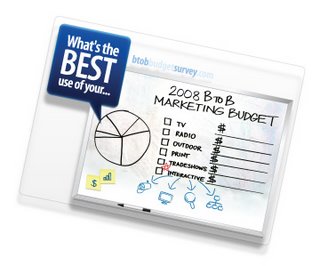
The survey below was a 2008 study of how B2B marketers set and spent their email budgets. It closed long ago. The original material is kept here for reference.

In 2008, MarketingSherpa ran a survey of B2B marketers to build a detailed analysis of email marketing budgets for that year. Marketers who wanted to take part were directed to the survey details below.
http://www.btobbudgetsurvey.com.
MarketingSherpa told participants that all answers would be kept confidential.
What the research of that era found
The budget question was new at the time. MarketingSherpa’s 2008 Email Marketing Benchmark Guide, released in December 2007, added a budget question for the first time. It found that more than a third of in-house email marketers had no separate line item for email in any budget. This was not only a small-company problem: 68% of those respondents worked at companies with more than 100 employees.
Spending was shifting online in the same period. BtoB magazine’s survey of the time reported that the average share of the marketing budget spent on online marketing would reach 33.8% in 2008, up from 26.5% in 2007.
How B2B email budgets look in 2026
Most budget planning now starts from total marketing spend as a share of revenue and works down to channels. Email is rarely its own headline number in the big surveys. In practice it is split across the email platform, deliverability work and the people who run the program.
| Benchmark | 2008 era | 2026 |
|---|---|---|
| Main budget reference | MarketingSherpa 2008 Email Marketing Benchmark Guide | Gartner 2026 CMO Spend Survey |
| Headline finding | Over a third of in-house emailers had no separate email budget line | Marketing budgets at 7.8% of company revenue |
| Survey sample | Email marketers across B2B and B2C | 401 CMOs and marketing leaders in North America, the UK and Europe, surveyed January to March 2026 |
| Budget pressure | Online share rising from 26.5% to 33.8% (BtoB magazine) | 56% of CMOs say they lack the budget to deliver their 2026 strategy |
| New spending category | Deliverability certification programs, now history | AI, at 15.3% of marketing budgets on average |
Costs that did not exist in 2008
Authentication used to be optional. Now it is required. Google requires bulk senders, those sending close to 5,000 or more messages to personal Gmail accounts in a 24-hour period, to authenticate with SPF and DKIM and publish a DMARC record, and it requires one-click unsubscribe for bulk marketing and subscribed messages and a spam rate below 0.3% as measured in Postmaster Tools. Yahoo’s bulk-sender requirements also call for SPF, DKIM, DMARC, easy unsubscribe and a spam complaint rate below 0.3%. Gmail began enforcing its requirements gradually in February 2024, starting with temporary errors for non-compliant bulk mail. From November 2025 it ramped up enforcement, and non-compliant messages can now get temporary and permanent rejections. Microsoft applies similar rules to domains sending more than 5,000 messages a day to Outlook.com, Hotmail.com and Live.com addresses.
At minimum, a compliant DMARC record looks like this:
_dmarc.example.com. TXT "v=DMARC1; p=none; rua=mailto:[email protected]"
Most B2B teams now set aside budget for DMARC report monitoring and for the setup time needed to move from p=none to p=quarantine or p=reject.
Why open rates no longer justify the budget
Apple Mail Privacy Protection launched with iOS 15 in September 2021. It preloads images, so many Apple Mail opens get recorded even when nobody read the message. Budgets built on open-rate growth now overstate results. Clicks, replies, meetings booked and pipeline influenced give finance teams a more honest number. Mobile and dark mode reading also mean design and testing now take a larger share of production costs than they did in the Outlook 2007 rendering era.
FAQ
What percentage of the marketing budget should go to email?
No standard figure exists, and the large surveys do not report one you can rely on. A better approach is to start from your total marketing budget (Gartner’s 2026 average is 7.8% of revenue) and add up what email actually costs you: platform fees by contact tier, deliverability tools, content production and staff hours. Then compare that total with the pipeline email influences.
Should email have its own budget line?
Yes. In 2008, more than a third of in-house email marketers had no separate line item, and that made the channel hard to defend when budgets got cut. A dedicated line makes the cost of authentication, list hygiene and platform upgrades visible before they turn into deliverability problems.
Do the Gmail, Yahoo and Microsoft sender rules raise email costs?
They mostly add setup time and some tooling rather than large recurring fees. You need SPF, DKIM and DMARC on your sending domain, one-click unsubscribe, and a way to watch complaint rates through Google Postmaster Tools and Yahoo Sender Hub. Skipping this work costs more in the end, because Gmail now rejects non-compliant bulk mail.
Does CAN-SPAM apply to B2B email?
Yes. The FTC’s CAN-SPAM guidance states that the law has no exception for business-to-business email. Each non-compliant message can draw a penalty of up to $53,088. The 2025 inflation-adjusted figure stays in force for 2026 because that year’s adjustment was cancelled.
How do you prove email ROI to finance when opens are unreliable?
Report on clicks, form fills, meetings and revenue tied to email touches in your CRM, not on opens. Apple Mail Privacy Protection inflates open counts, so treat opens as a rough signal of deliverability, not of engagement.
Sources
- Gartner, 2026 CMO Spend Survey press release (May 2026)
- Google, Email sender guidelines (Gmail Help)
- Yahoo, Sender Hub best practices for senders
- Microsoft, Outlook requirements for high-volume senders (Microsoft Tech Community, April 2025)
- Federal Trade Commission, CAN-SPAM Act: A Compliance Guide for Business
- Federal Register, FTC notice on 2026 civil penalty amounts
- MarketingSherpa, 2008 Email Marketing Benchmark Guide announcement (December 2007)