
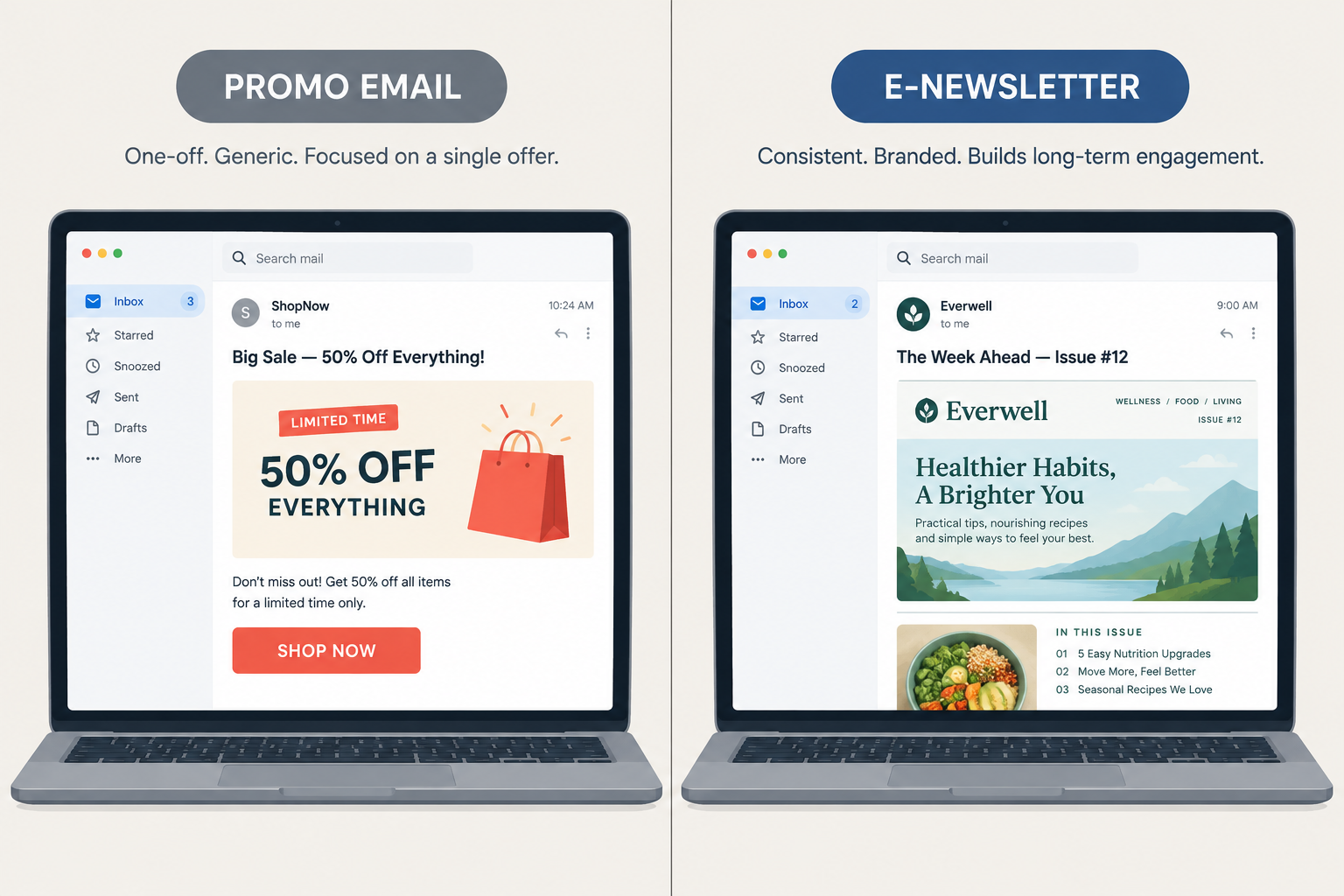
Why newsletters blur into ordinary email
Many consumers, and many marketers, have trouble telling a promotional company email apart from an e-newsletter. The usual reason is that companies skip the things that make an e-newsletter work: a fixed schedule, a clear editorial voice and content shaped by what readers actually do. When those are missing, the typical subscriber can’t tell the two apart, and the e-newsletter becomes “just another email.”
Jeanniey Mullen made this point in her ClickZ column “E-Mail vs. E-Newsletters: Is There a Difference?” (July 2005). She noted that many companies ran email and e-newsletters through separate teams, with different databases and sending cycles. When she informally asked 25 people whether they knowingly signed up for one rather than the other, their answers came down to “an email is an email.” Her conclusion was that the newsletter has to earn its separate identity. Her suggestions are listed below.
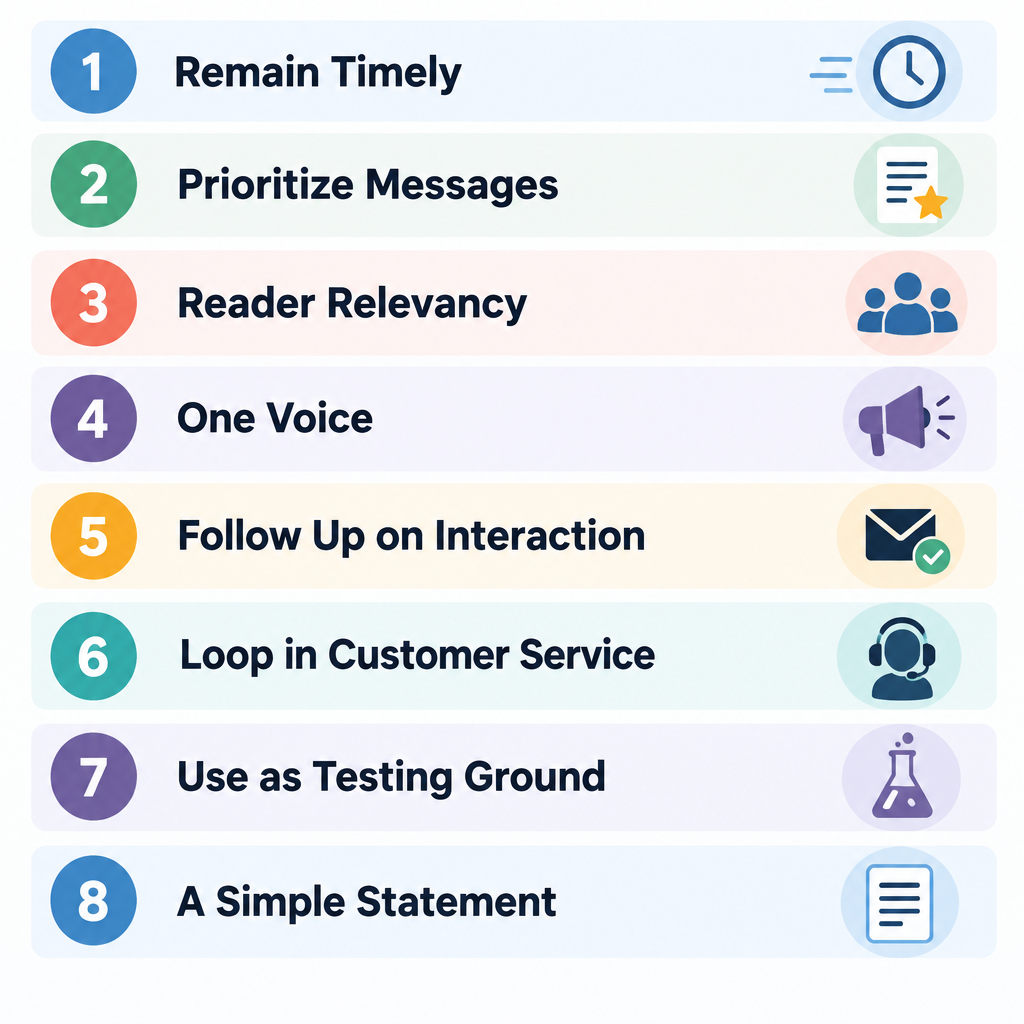
Jeanniey Mullen’s eight rules for a successful e-newsletter
- Remain timely. “Don’t call it ‘Tuesday News’ if you can’t send it every Tuesday. But do establish a scheduled delivery calendar.”
- Prioritize messages. “What’s the key takeaway? Make it prominent, clear, and intriguing so people will click through for more information.”
- Reader relevancy is sacred. “Use subscription centers and click-through activity to guide message content and context.”
- Speak with one voice. “Content often comes from different sources; make sure the copy tone is consistent.”
- Follow up on downloads and polls. “Failing to acknowledge reader interaction can be damaging. Sharing action-based results in future e-newsletters drives loyal readership.”
- Add customer service to your e-newsletter loop. “Even information-focused content can wake a sleeping tiger. Ensure that your customer service department has copies of your e-newsletters and is ready to respond to reader questions.”
- Use your e-newsletter as a testing ground. “A recent B2B case study focuses on a company that only collects e-mail addresses from its readers. It wanted to enhance its profile. By analyzing click-through activity for vertically focused offers, the company was able to determine the reader’s general position in the company and adjusted the future content appropriately.”
- A simple statement goes a long way. “A B2C client of mine adds a simple statement at the top of every e-newsletter. New readers receive a thank-you for requesting the information. Ongoing subscribers are told their patronage is appreciated. It’s simple, effective, and powerful.”
(ClickZ, July 2005)
How the eight rules hold up in 2026
All eight rules still work. Two of them matter more now than in 2005, and the tools behind several others have changed.
| Rule | Still valid? | What has changed since 2005 |
|---|---|---|
| 1. Remain timely | Yes, and more important | Gmail’s “Manage subscriptions” view lists senders by how often they mailed you in recent weeks, so readers notice an irregular or overly frequent newsletter. |
| 2. Prioritize messages | Yes | Most newsletters are now read on phones, so the key takeaway has to show in the subject line, the preheader and the first screen. It also has to stay readable in dark mode. |
| 3. Reader relevancy | Yes, and more important | Preference centers are still the best tool. Complaints now carry hard limits: Google and Yahoo treat 0.3% as a ceiling, and Google advises staying below 0.1%. |
| 4. One voice | Yes | No change. A consistent sender name and From address also help recognition in the inbox. |
| 5. Follow up on interaction | Yes | Poll and survey replies can feed segments in any modern ESP automatically. |
| 6. Loop in customer service | Yes | Replies to a no-reply address go nowhere. Use a monitored reply-to address so questions reach support. |
| 7. Newsletter as a testing ground | Yes, with a caveat | Base tests on clicks, not opens. Apple Mail Privacy Protection preloads tracking pixels, which records opens nobody made, while click data is largely unaffected. |
| 8. A simple statement | Yes | A welcome message right after signup is now standard. It confirms the subscription and sets expectations for content and frequency. |
Timing and relevance carry the most weight now
When readers stop recognizing a newsletter, they no longer just ignore it. In Gmail they can unsubscribe from the Manage subscriptions view, or they can press “Report spam.” The second hurts the sender’s reputation. Since November 2025, Google’s sender guidelines FAQ says Gmail has been stepping up enforcement against non-compliant traffic, including temporary and permanent rejections. A newsletter that keeps its schedule and its promise of relevant content protects deliverability for every other email the company sends, including order confirmations and sales offers.
Testing works differently since Apple Mail Privacy Protection
In 2005 the open rate was a fair proxy for readership. Since Apple added Mail Privacy Protection with iOS 15 in 2021, Apple Mail users who turn it on have their images, including tracking pixels, preloaded by Apple. Opens are recorded whether or not anyone read the message. Mullen’s example of learning about readers from click-through activity on targeted offers is the right method today: clicks, replies and conversions show real interest, and opens no longer do.
The rules mailbox providers apply to both
Mailbox providers apply the same technical rules to promotional emails and newsletters. Google’s email sender guidelines treat anyone sending 5,000 or more messages a day to personal Gmail accounts as a bulk sender. Bulk senders must authenticate with SPF, DKIM and DMARC, include one-click unsubscribe in marketing messages, and honor unsubscribe requests within two days. Yahoo’s Sender Hub sets the same expectations without publishing a volume threshold. Microsoft’s rules for Outlook.com apply to domains sending more than 5,000 messages a day. A minimal DMARC record that meets all three looks like this:
_dmarc.example.com. TXT "v=DMARC1; p=none; rua=mailto:[email protected]"
One-click unsubscribe follows RFC 8058 and is set through two message headers. Most ESPs add them for you:
List-Unsubscribe: <https://example.com/unsub?id=abc123>, <mailto:[email protected]>
List-Unsubscribe-Post: List-Unsubscribe=One-Click
In the US, the FTC’s CAN-SPAM Act guide decides whether a message is covered by its primary purpose. A company newsletter that promotes the company’s products or services is usually commercial. Treat it like any marketing email: give an accurate From line and subject, include a valid physical postal address, offer a working opt-out, and honor opt-outs within 10 business days. The FTC’s most recent inflation-adjusted penalty is up to $53,088 for each email that breaks the law.
FAQ
Is a newsletter the same as an email campaign?
A newsletter is one kind of email campaign. A campaign can be a single promotion, an announcement or an automated series. A newsletter is the recurring, editorial kind with a fixed name and schedule. The difference matters to readers, not to Gmail or Yahoo, which filter both as bulk marketing mail.
Do e-newsletters need an unsubscribe link if people signed up for them?
Yes. CAN-SPAM requires an opt-out in commercial email whether or not the reader opted in. Gmail and Yahoo also require one-click unsubscribe in marketing and promotional messages from bulk senders. A clear unsubscribe link is also cheaper than the spam complaints readers file when they can’t find one.
How often should an e-newsletter be sent?
Send it as often as you can reliably produce content worth reading, then never break that schedule. Weekly and monthly are the most common choices. Readers judge consistency more than frequency, and Gmail’s Manage subscriptions view now shows them exactly how often each sender mails them.
Which metrics should I watch for a newsletter now that open rates are unreliable?
Use click-through rate, click-to-delivered rate, replies, conversions, unsubscribe rate and spam complaint rate. Google Postmaster Tools shows your spam rate for Gmail traffic, and Yahoo’s Complaint Feedback Loop, available through Sender Hub, reports complaints from Yahoo users. Treat open rates as a rough trend at most, because Apple Mail Privacy Protection inflates them.
Should promotional emails and newsletters come from the same address?
You can use the same domain and authentication for both. Many senders use a distinct From name or subdomain for the newsletter so readers recognize it. Keep it consistent once chosen. Changing From names often confuses subscribers and can raise complaint rates.
Sources
- Google: Email sender guidelines
- Google: Email sender guidelines FAQ
- Yahoo Sender Hub: FAQs
- Microsoft Tech Community: Outlook’s new requirements for high-volume senders
- FTC: CAN-SPAM Act, a compliance guide for business
- ClickZ: E-Mail vs. E-Newsletters: Is There a Difference?