
A band newsletter that arrives with a broken album-art image, then lands again three hours later with no subject line and missing copy, is a send that skipped testing. A seed-list test, a check that images load, and a duplicate-send guard in your email service provider (ESP) would have caught every one of these errors, and the same checks work today. What has changed since this send went out in February 2007 is the cost of mistakes. Gmail and Yahoo’s 2024 bulk sender rules, followed by Microsoft’s in May 2025, require SPF, DKIM, DMARC, one-click unsubscribe and low spam complaint rates, so a careless duplicate that triggers “report spam” clicks now hurts your inbox placement. At the same time, Apple Mail Privacy Protection inflates open rates, so open rates no longer show you how much damage a bad send did.
Have you seen the movie “Friday Night Lights”? Not the television series that ran from 2006 to 2011. The 2004 film with Billy Bob Thornton, set in Odessa, Texas.
One of the standout parts of the film was the score. It was written and recorded by Explosions in the Sky, a four-piece instrumental post-rock band formed in Austin in 1999. Most of its members grew up in Midland, the West Texas city right next to Odessa. When this newsletter went out, the band had not released a full-length album since 2003’s “The Earth Is Not a Cold Dead Place”. Its follow-up, “All of a Sudden I Miss Everyone”, came out on Temporary Residence on February 20, 2007. To promote the release, the band sent out a newsletter. (The band has released several albums since, most recently “End” in September 2023.)
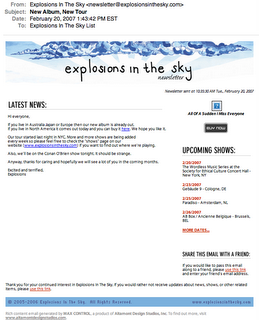
The newsletter arrived at 10:35 AM. For a band, it was a simple and well-designed email. A column on the right had a link to buy the new album and a list of upcoming tour dates. There were plenty of links to the band’s website and even a refer-a-friend link. Nothing flashy, just the facts. The one problem was a broken image, which should have shown the new album’s cover art.

Exactly three hours later, at 1:35 PM, the same email arrived again. This time the email had blown up in the inbox (pun intended). It had no subject line, and the copy in the “Latest News” section was gone. The cover art image was still broken.

The band’s emails were built and managed by Altamont Design Studios. At the time, Altamont’s clients ranged from Rev Run and Shooter Jennings to Hatebreed. It also worked for the band’s management company, Constant Artists.
The criticism here is sharp for a reason. A band’s mailing list is about as loyal as an audience gets: these are people who signed up on purpose and will travel to see a show. Watching the people who work for the band drop the ball that carelessly is frustrating. The fix is simple. Management and the agency that sends the email need one clear sign-off process, so that the band’s email sends are as tight as its live set.
How to stop a send like this in 2026
Every error in this newsletter can be caught before it reaches a subscriber. Run these checks on every campaign, in this order.
- Check that the subject line and preheader are filled in. Mailchimp, for example, requires a subject line before a campaign can be sent. A resend that you build by hand or push through an API can still go out without one.
- Load every image from its live URL. Broken images usually come from a file that was never uploaded, a local or relative file path, or a typo in the URL. Gmail fetches and caches images through its own image proxy, so fix the hosted file before you send, not after.
- Write alt text for key images. If the album art fails to load or images are turned off, alt text such as “New album, out now” still gets the message across.
- Send a test to a seed list. Include Gmail, Outlook.com, Yahoo and Apple Mail addresses, and view the email on a phone and in dark mode. Most email is now read on mobile, so the mobile view is the one that matters most.
- Block duplicate sends. Check whether the campaign is still scheduled or queued before you resend, and send a correction only to the subscribers who need it.
- Confirm that authentication passes. SPF, DKIM and an aligned DMARC record are now the baseline for bulk mail to Gmail, Yahoo and Outlook.com.
If the email comes from a third party like an agency, the domain owner still has to publish the DNS records. A minimal DMARC record to start with looks like this:
_dmarc.example.com. IN TXT "v=DMARC1; p=none; rua=mailto:[email protected]"
Once your reports show that all your legitimate mail passes, move the policy to p=quarantine or p=reject.
FAQ
What should you do if you send a campaign twice by mistake?
First, stop anything still in the queue and check your ESP’s send report to see who got both copies. If the second copy was identical, it is usually best to leave it alone, because an apology email means a third message in the inbox. If the second copy was broken, like the subject-less version here, send one short correction only to the people who received it.
Why do images show up broken in email?
Usually the image file was never uploaded, the URL has a typo, or the email points to a file on someone’s computer instead of a public web address. Some email clients also block images until the reader allows them. Host images on your ESP or a reliable server, use full https URLs, and add alt text so the email still makes sense without images.
Can you send an email with no subject line?
Technically yes, but you shouldn’t. Mail clients show it as “(no subject)”, which looks like spam or a mistake, and subscribers are more likely to delete it or report it. ESPs such as Mailchimp require a subject line before a campaign can be sent, so this error usually happens with manual resends.
Does one duplicate send hurt deliverability?
One duplicate rarely does lasting harm by itself. The risk is the complaints it causes. Google tells bulk senders to keep their spam rate in Postmaster Tools below 0.1% and never let it reach 0.3%, and Yahoo uses the same 0.3% ceiling. Google began enforcing its sender requirements in February 2024. Since November 2025, Gmail has been stepping up enforcement and now delays or rejects mail from senders that don’t comply.
Do the bulk sender rules apply to a small band or artist newsletter?
Gmail’s stricter rules apply once you send about 5,000 or more messages a day to personal Gmail accounts. Microsoft has used the same threshold for Outlook.com, Hotmail and Live addresses since May 5, 2025, and can reject mail that fails with error 550 5.7.515. Even below those volumes, every sender needs SPF or DKIM and a low complaint rate, and an artist newsletter can pass 5,000 messages on a big release day.
How should you test a newsletter before it goes out?
Send test emails to a seed list of real inboxes at the major providers, and check each one on desktop, on mobile and in dark mode. Click every link, confirm every image loads, and have someone who didn’t build the email read it before it is scheduled. A preview service like Litmus or Email on Acid can show you more clients at once, but a careful check of the real inboxes catches the errors in this newsletter.
Sources
- Google, Gmail Help: Email sender guidelines and Email sender guidelines FAQ
- Yahoo Sender Hub: Best practices for senders
- Microsoft Tech Community, Outlook blog: Strengthening email ecosystem: Outlook’s new requirements for high-volume senders
- Wikipedia: Explosions in the Sky, and All of a Sudden I Miss Everyone
- Texas Monthly: Explosions in the Sky and the Friday Night Lights soundtrack