
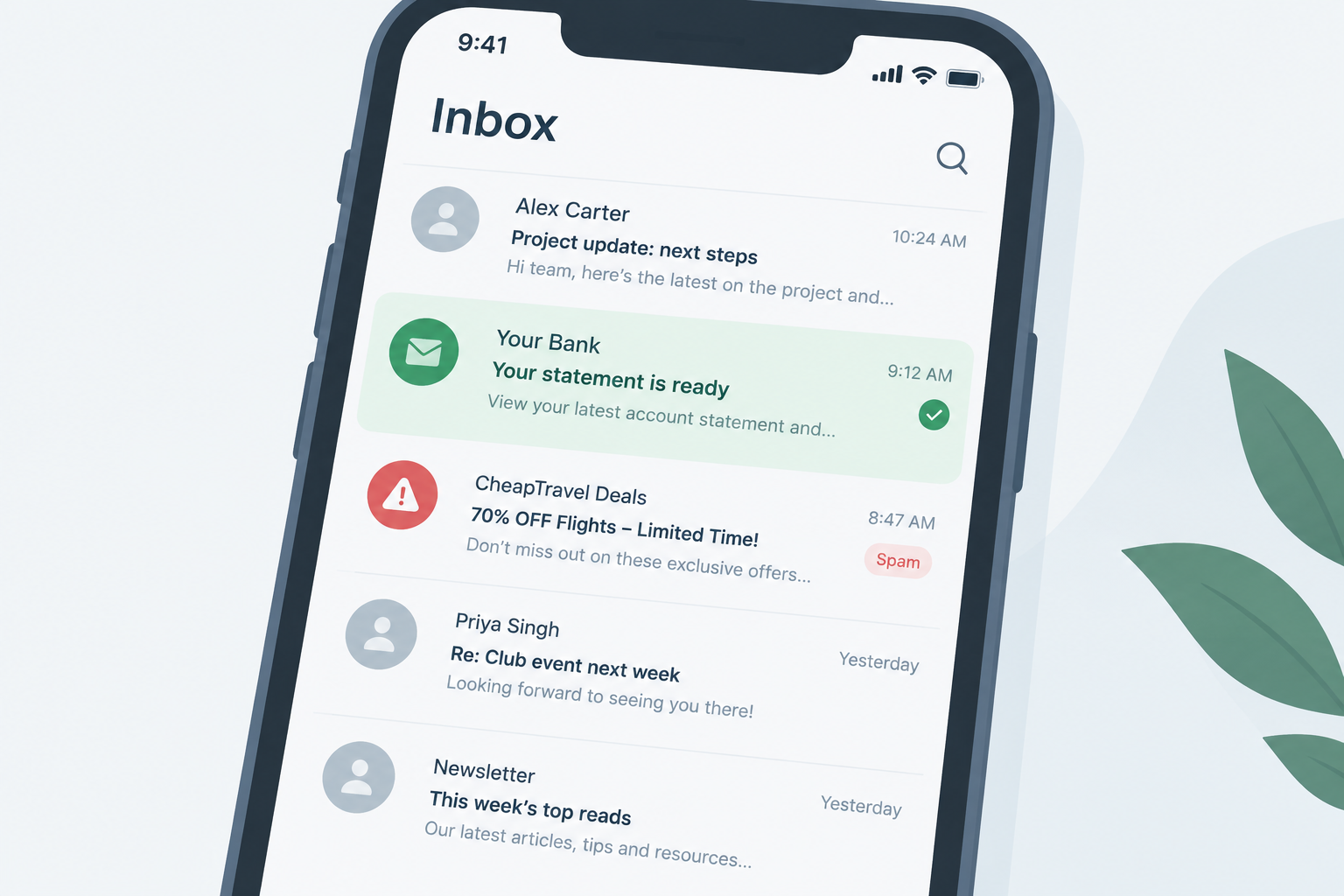
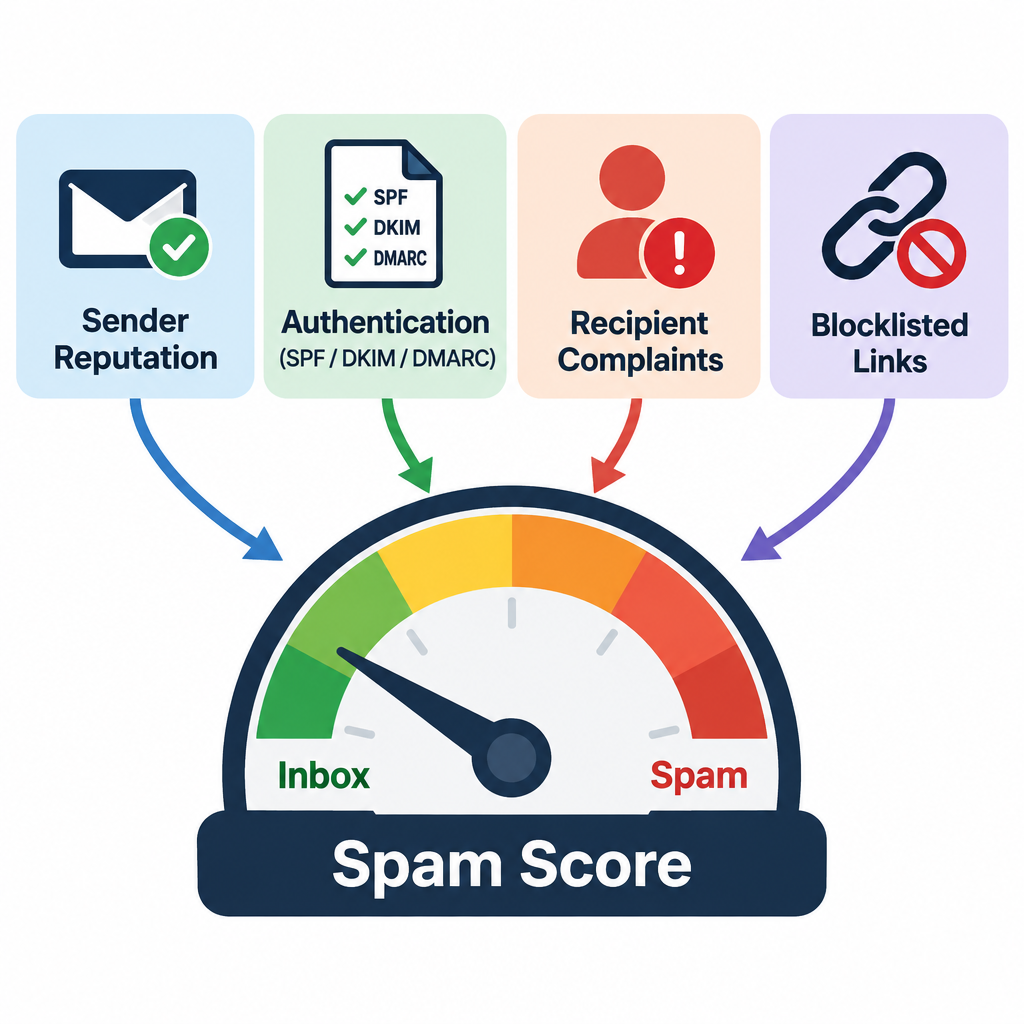
As of November 2026, your subject line matters much less to spam filtering than your sender reputation, your authentication and how many recipients press “Report spam”. Single words like “free” or “discount” seldom send a message to junk on their own. Misleading subject lines still do real harm, though: they lead to complaints, they break Google’s sender guidelines and they can break US law. The biggest change since this post was first written came in February 2024, when Gmail and Yahoo began requiring bulk senders to use SPF, DKIM and DMARC, offer one-click unsubscribe and keep spam complaint rates under 0.3%. Microsoft brought in similar rules for Outlook.com in May 2025.
Why subject lines can still land you in spam
Most email marketers worry most that their messages will be marked as spam and never reach the people who signed up. The subject line still plays a part, but today it works mainly through how people react to it, not through a list of banned words.
Early filters reacted strongly to words such as “free”, “offer” and “discount”, and many marketers learned to avoid them. That advice is mostly history now. Gmail, Yahoo Mail and Outlook.com judge a message mostly on who sent it, whether it is authenticated and how recipients have treated that sender’s mail before. A store that sends “Free shipping this weekend” to engaged subscribers will reach the inbox. A new domain with no reputation that sends the same line to a cold list will not.
Open source filters such as SpamAssassin, run by the Apache Software Foundation, still score messages on their content, so wording matters more on corporate servers and web hosts that use the filter. The old version of this post described a 0-to-5 scale, which was wrong. Each rule a message matches adds or subtracts points, and the total has no fixed upper limit. It can even go below zero. By default, a message is marked as spam once it reaches the required_score of 5.0. The filter’s own documentation calls 5.0 fairly aggressive and suggests that ISPs use 8.0 or 10.0. The higher a message scores, the more likely it is to be filtered. In practice, scores come mostly from header problems, authentication failures, blocklisted links and odd HTML, more than from single words in the subject.
Safe, consistent subject lines
The old advice went like this: if a safe format such as “Weekly Newsletter #1” and “Weekly Newsletter #2” works for you, stick with it. Consistency still helps. Subscribers learn to recognise your mail, and a recognisable sender name gives them a reason to open it.
The trade-off is engagement. A subject line that never changes tells readers nothing about this week’s issue, and mailbox providers notice when people stop opening or start deleting without reading. A good middle ground is a fixed label plus a specific detail, for example “Weekly Newsletter #48: three changes to Gmail’s Promotions tab”.
Catchy versus spammy
Witty or vague subject lines can confuse readers. Confused readers often report the message as spam instead of unsubscribing. Back then, those reports went to the reader’s ISP. Today they go straight to the mailbox provider, through the “Report spam” button in Gmail or Yahoo’s Complaint Feedback Loop, and they count against you.
That number now has hard limits. Google’s sender guidelines say bulk senders should keep the spam rate shown in Postmaster Tools below 0.3% and aim for under 0.1%. Yahoo sets the same 0.3% ceiling, and it works out the rate against mail that reached the inbox, not against everything you sent. So you can still write catchy subject lines. Just remember that the line between “catchy” and “spammy” is now drawn by your readers’ complaint clicks.
Fake “Re:” or “Fwd:” prefixes, made-up order confirmations and subject text dressed up as a sender name are the clearest examples of crossing that line. Google’s guidelines state that the subject, headers and display name must accurately represent the sender and the content of the message.
How to write subject lines that get opened
No single formula produces a good subject line every time. A few habits, though, separate subject lines that get opened from ones that get reported.
- Borrow from headline writers. If you are short of ideas, read a newspaper. Headlines put the most important part of the story first, and a subject line should do the same.
- Get to the point. Say what is inside. Most readers now see your subject on a phone, next to the preview text and often in dark mode, so the first few words carry most of the weight.
- Never mislead. If the subject promises something the email doesn’t deliver, readers lose trust in your brand. In the US it can also be illegal. The CAN-SPAM Act bans deceptive subject lines, and the FTC sets the maximum penalty at $53,088 for each email that breaks the law. That ceiling dates from January 2025, and the FTC announced in the Federal Register in September 2026 that it would not adjust penalties this year.
- Test as much as you can. Testing is still the only reliable way to learn which styles work for your list. Platforms such as Mailchimp and Klaviyo have built-in A/B tests for subject lines. Judge the winner on clicks or conversions, not opens. Since Apple launched Mail Privacy Protection with iOS 15 in 2021, Apple Mail preloads images, so open rates look higher than they are.
- Test delivery as well as wording. Send to seed accounts at Gmail, Yahoo and Outlook.com before a big campaign. Then watch Google Postmaster Tools and your ESP’s complaint reports after it goes out.
The technical basics a good subject line can’t replace
A perfect subject line can’t save mail that fails authentication. The rules from the big mailbox providers now set the minimum standard.
| Provider | Applies to | Key requirements | In force since |
|---|---|---|---|
| Gmail | Senders of about 5,000+ messages a day to personal Gmail accounts | SPF and DKIM, DMARC aligned with the From domain, one-click unsubscribe, spam rate under 0.3% | February 2024 (one-click unsubscribe from June 2024) |
| Yahoo Mail | Bulk senders (Yahoo publishes no exact volume) | SPF and DKIM, DMARC, one-click unsubscribe on marketing mail, complaint rate under 0.3% | February 2024 |
| Outlook.com, Hotmail.com, Live.com | Domains sending more than 5,000 messages a day | SPF and DKIM pass, DMARC of at least p=none aligned with SPF or DKIM; mail that fails goes to Junk | May 5, 2025 |
One-click unsubscribe uses two headers defined in RFC 8058. Most ESPs add them for you. Senders who run their own mail server add them like this:
List-Unsubscribe: <https://example.com/unsubscribe?id=abc123>, <mailto:[email protected]>
List-Unsubscribe-Post: List-Unsubscribe=One-Click
Both Google and Yahoo expect you to process unsubscribe requests within two days. An easy unsubscribe protects your subject-line experiments too: a reader who dislikes a line can leave in one click instead of reporting you as spam.
FAQ
Do spam trigger words still matter in subject lines?
Much less than they once did. Gmail, Yahoo and Outlook.com rely mainly on sender reputation, authentication and engagement, so one “free” or “sale” won’t sink a message from a trusted sender. Content-based filters on corporate and hosting servers still weigh wording, so avoid all-caps, long runs of exclamation marks and shouting about money.
Is a deceptive subject line illegal?
In the US, yes, for commercial email. The FTC’s CAN-SPAM guidance says the subject line must accurately reflect what the message contains, and each email that breaks the law can draw a penalty of up to $53,088. Laws such as the GDPR in the EU and the UK’s PECR add consent rules on top.
Should I still A/B test subject lines on open rate?
Opens are a weak signal now. Apple Mail Privacy Protection preloads images, which inflates open rates for a large share of readers. Pick winners on click rate, conversions or revenue per email, and use opens only as a rough trend.
How long should an email subject line be?
No length works best for every list. On a phone, the inbox shows only the first part of the subject next to the sender name and preview text, so put the key words first. Test short and long versions with your own audience instead of following a fixed character count.
What spam complaint rate is too high?
Google and Yahoo both treat 0.3% as the ceiling for bulk senders, and Google advises staying under 0.1%. That works out to one complaint per 1,000 delivered messages. If misleading or vague subject lines push complaints up, fix them before you send more mail.
Do emojis in subject lines hurt deliverability?
Emojis alone don’t put a message in spam at the major mailbox providers. They can display differently across clients and in dark mode, and too many can look like promotional clutter. Use them only if A/B tests show they lift clicks for your list.
Sources
- Google: Email sender guidelines
- Google: Email sender guidelines FAQ
- Yahoo Sender Hub: FAQs
- FTC: CAN-SPAM Act, A Compliance Guide for Business
- Federal Register: FTC Civil Penalty Inflation Adjustments (September 15, 2026)
- Microsoft Outlook Postmaster: Policies, Practices, and Guidelines
- Apache filter configuration reference (required_score)