
A new subscriber should get one welcome email straight away. Any follow-ups should each bring something new, like a preference prompt, a best seller or a first-order offer. Sending the same welcome message three days running is a broken trigger, and it should never be a tactic. What changed since this case was first written up: Gmail and Yahoo’s 2024 bulk sender rules now require SPF, DKIM, DMARC, one-click unsubscribe and a spam complaint rate below 0.3%, so repeated mail that pushes new subscribers to click “Report spam” puts all your mail at risk.
How the sign-up went
This case study started with this post at Email Wars, which led to a sign-up for Quiksilver’s emails. Quiksilver was a big name in surf wear: baggy boardshorts, t-shirts and jeans that many kids in beach towns wore for years. Plenty of former customers who no longer buy surf gear are still curious about what a brand they loved as kids is doing now, especially in their inbox.
The sign-up was standard. It asked for name, email address, birthday and zip code. After that, the subscriber expected to see how the brand would start the relationship.
The same welcome message, three days in a row
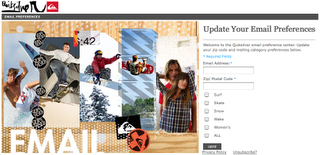
The brand did not open with useful engagement. It sent the same welcome message on three days in a row, with no changes at all. The repeats were annoying, but after the third one the subscriber was curious enough to click through to the preferences page. As the screenshot below shows, the page was short and easy to fill in. One thing was missing: the email address and zip code were already on file, yet the page did not fill them in.

The timing is telling too. Each welcome message arrived between 8:02 a.m. and 8:04 a.m. That points to an automated daily job, not a person pressing send. The likely cause is a scheduled send that kept picking up the same new subscriber, when it should have run once when the subscriber joined.

Why this is the wrong way to welcome a new subscriber
Sending the same welcome three times wastes your best chance to engage someone, because a new subscriber is never more interested than in the first few days. Someone outside the email industry would probably have unsubscribed after the second copy. Today, many of them would hit “Report spam” instead, and that is a bigger problem. The only fix for a start like this is to follow it with relevant offers and announcements, using the preferences the subscriber has just given you.
The brand has changed hands since then. Authentic Brands Group closed its purchase of Boardriders, the parent of Quiksilver, Billabong and Roxy, on September 1, 2023. Moody’s put the price at about $1.25 billion. The welcome program described here dates from long before that.
How to stop duplicate welcome emails today
Most duplicate welcomes come from one of a few setup mistakes. Modern email platforms have built-in tools for each of them.
| Likely cause | What it looks like | Fix |
|---|---|---|
| Daily recurring send to a “new subscribers” segment | Same email every morning at the same time, like the 8:02 a.m. sends above | Use a flow that runs once when someone joins a list, or limit the segment to people who joined in the last 24 hours |
| Subscriber can re-enter the flow | A new welcome each time a profile updates or the person joins a second list | Allow each profile into the flow only once |
| Duplicate contact records | Two or three copies sent at the same moment | Merge or deduplicate contacts by email address before the flow starts |
| No frequency cap | Welcome lands on the same day as a campaign and a second flow | Turn on frequency limits. In Klaviyo, Smart Sending skips a message if the profile got an email in the last 16 hours (the default for email) |
| Preference page not personalized | Subscriber retypes data you already hold | Pre-fill known fields with merge tags or a subscriber token in the preference link |
A good welcome series uses its emails for different jobs:
- Email 1, sent right away: confirm the sign-up, set expectations on frequency and deliver any promised discount.
- Email 2, a day or two later: ask for preferences, with the fields already filled in.
- Email 3, later in the first week: show products or content that match what the subscriber picked.
Why the stakes are higher now
When this happened, a repeat welcome cost a brand some goodwill and a few unsubscribes. Now it can hurt deliverability too.
- Spam complaints: Google’s sender guidelines tell senders to keep the spam rate in Postmaster Tools below 0.10% and to avoid reaching 0.30% or higher. A burst of complaints from new subscribers counts the same as complaints from anyone else.
- Bulk sender rules: Since February 2024, Gmail has treated anyone sending about 5,000 or more messages a day to personal Gmail accounts as a bulk sender. Bulk senders must authenticate with SPF, DKIM and DMARC, and their marketing mail must support one-click unsubscribe (RFC 8058) and honor requests within two days. Yahoo’s Sender Hub sets similar rules and does not publish a volume threshold.
- Open rates are unreliable: Apple Mail Privacy Protection preloads images through Apple’s proxy servers. Repeat welcomes can therefore show “opens” that nobody actually made. Watch clicks, preference-page completions and unsubscribes to judge how a welcome series is doing.
- Law: CAN-SPAM in the US requires a working opt-out and that you honor it within 10 business days. Each email that breaks the law can bring a civil penalty in the tens of thousands of dollars.
Here is a quick self-check. Sign up for your own list with a fresh address and leave it alone for a week. If any email arrives twice, or the preference page asks for something you already know, fix that before you change subject lines or offers.
FAQ
How many welcome emails should a new subscriber get?
A series of two to four emails over the first week or two works for most retail brands, as long as each one does a different job. The first should go out right away while interest is highest. Sending the same message more than once never helps.
What causes duplicate welcome emails?
The usual causes are a daily campaign sent to a “new subscriber” segment, a flow that lets people enter more than once, or duplicate contact records for the same address. Sends that arrive at the same time each day, like the 8:02 a.m. messages here, point to a scheduled job and not a real-time trigger.
Can repeated welcome emails hurt deliverability?
Yes. Gmail and Yahoo track spam complaints, and Google advises staying below 0.10% and never reaching 0.30%. New subscribers who get the same email again and again are quick to report it, and those complaints affect inbox placement for all your mail.
Should the preference center pre-fill subscriber data?
Yes. If you already hold the email address, zip code or birthday, show it pre-filled so the subscriber only has to confirm or edit it. Most email platforms can do this with merge tags or a personalized preference link.
Is open rate a good way to measure a welcome series?
Not on its own. Apple Mail Privacy Protection loads images automatically for many Apple Mail users, so opens are inflated. Clicks, preference updates, first purchases and unsubscribe rate give you a more honest picture.
What does a welcome email need to comply with CAN-SPAM?
It needs accurate header and “From” details, a subject line that is not misleading, your physical postal address, and a clear way to opt out. Opt-outs must be honored within 10 business days. For bulk senders, Gmail and Yahoo also require one-click unsubscribe, handled within two days.
Sources
- Google Workspace Admin Help: Email sender guidelines
- Yahoo Sender Hub: Sender Best Practices
- Federal Trade Commission: CAN-SPAM Act, A Compliance Guide for Business
- Klaviyo Help Center: Understanding Smart Sending in Klaviyo
- Fashion Dive: Authentic closes Boardriders deal