
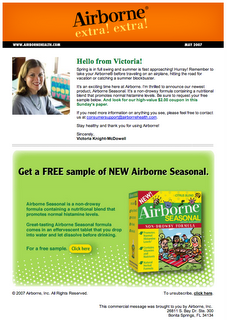
Victoria Knight-McDowell is the California schoolteacher who created Airborne, the vitamin and herbal supplement sold for years in boxes that read “Created by a School Teacher!” Her name in the From line of an Airborne email confused subscribers because most people knew the slogan but not the teacher. The lesson still applies in November 2026: use a person’s name as your From name only when readers already link that name to your brand. One thing has changed since this post first ran. The From name now sits on top of authentication rules. Since February 2024, Gmail and Yahoo require bulk senders to pass SPF, DKIM and DMARC with an aligned From domain, offer one-click unsubscribe and keep spam complaints under 0.3%, so a familiar name only helps once the mail actually gets delivered.
The email from Victoria Knight-McDowell
This post started with a subscriber who was a fan of Airborne. That reader took the tablets at the first scratchy throat or runny nose and had signed up for the brand’s emails. Those cold-fighting claims didn’t last. In August 2008 the Federal Trade Commission said Airborne’s founders had falsely claimed the products were clinically proven to treat colds. Airborne settled without admitting wrongdoing.

Then an email arrived from “Victoria Knight-McDowell” with the subject line “Get a FREE sample of NEW Airborne Seasonal.” The subscriber’s first thought was that it was spam. Was Airborne the new spam du jour? The subscriber opened it anyway, and the message really did come from Airborne. So it wasn’t spam. But why send it under Victoria Knight-McDowell’s name?
The schoolteacher behind the box
The Airborne box had a red banner across the top that read “Created by a School Teacher!” That teacher was Victoria Knight-McDowell, a second-grade teacher who developed the formula with her husband, Thomas John McDowell. The email never said so. The subscriber had to search online to find out who she was. Airborne had told everyone its product came from a schoolteacher, but it had done little to tell people who that teacher was.
The brand has changed a lot since then:
| Year | What happened |
|---|---|
| 2008 | Airborne settled the Wilson v. Airborne class action for $23.3 million. |
| August 2008 | The FTC announced a $6.5 million settlement with Airborne and its founders, bringing the refund fund to up to $30 million. |
| After 2008 | The packaging stopped talking about colds and started describing the product as immune support. |
| March 2012 | Schiff Nutrition bought Airborne for about $150 million. |
| November 2012 | Reckitt Benckiser completed its purchase of Schiff Nutrition, and Airborne came with it. Reckitt still owns the brand. |
So a subscriber today is even less likely to know the founder’s name. She hasn’t been the face of the brand for well over a decade.
When a person’s name works as the From name
Personalized From names have real support. If one person is closely tied to your brand, such as a founder people know, a host or a newsletter writer, then use that name as the From name in your campaigns. If the people behind your brand aren’t known, a personal name can confuse subscribers and make them doubt the message.
The Airborne email made that mistake. A name nobody recognized, plus a “FREE sample” subject line, looked just like the phishing and spam that inbox filters exist to catch. A recipient who hits “Report spam” because of that name hurts your sender reputation with the mailbox provider.
Here is how common From name formats compare:
| From name format | Example | When it works | Risk |
|---|---|---|---|
| Brand only | Airborne | Most retail and product email | Can feel impersonal, but people recognize it right away |
| Person at brand | Victoria at Airborne | A founder or host readers know, or one you have introduced | Low, because the brand name carries the trust |
| Person only | Victoria Knight-McDowell | A well-known personality whose name is the brand | High when readers don’t know the name |
| Brand plus team | Airborne Team | Service and account updates | Low, though it can read as generic |
The “Person at brand” format is usually the best compromise. It keeps the personal touch and leaves no doubt about who sent the message.
What the From name has to do in 2026
Today the From name has two jobs. It has to be recognizable to people, and its domain has to pass authentication checks run by machines. Mailbox providers check the domain behind the display name before readers ever see it.
- Authenticate the From domain. Google’s sender guidelines require every sender to personal Gmail accounts to use SPF or DKIM. Senders of about 5,000 or more messages a day need SPF, DKIM and DMARC, and the From domain must align with SPF or DKIM. Yahoo applies matching rules through its Sender Hub, and Microsoft began requiring the same three records from high-volume senders to Outlook.com in May 2025. A minimal DMARC record looks like this:
_dmarc.example.com. TXT "v=DMARC1; p=none; rua=mailto:[email protected]"
- Keep the From identity stable. Google’s subscription guidelines say each mailing list should use its own unique From address and keep transactional mail, such as receipts and password resets, separate from marketing. Changing the From name from one campaign to the next breaks the recognition you have built.
- Never mislead in the header. The FTC’s CAN-SPAM rules say the From, To, Reply-To and routing information must be accurate and identify who sent the message. A real employee’s name on a real brand domain is fine. A made-up persona meant to trick people is not.
- Make leaving easy. Gmail and Yahoo expect bulk marketing mail to support one-click unsubscribe under RFC 8058 and to process requests within two days. Gmail began stepping up enforcement in November 2025, including temporary and permanent rejections of mail that doesn’t comply.
- Judge From name tests by clicks. Apple Mail Privacy Protection, launched in 2021, loads images automatically and makes open rates look higher than they are. Gmail’s image proxy also blurs open data. Compare From name variants by clicks, conversions and spam complaints, not opens alone.
If you want a founder’s voice in your emails, introduce that person first. Use a welcome email or a signed note from the founder, then switch to “Name at Brand” once readers have seen it a few times. That builds the recognition Airborne’s email assumed it already had.
FAQ
Who created Airborne?
Victoria Knight-McDowell, a California second-grade teacher, created Airborne with her husband, Thomas John McDowell. The “Created by a School Teacher!” slogan referred to her. The brand was sold to Schiff Nutrition in 2012 and has belonged to Reckitt since late 2012.
Should the From name be a person or the brand?
Use the brand unless readers already know the person. A format such as “Victoria at Airborne” gives you the personal touch and keeps the brand recognizable. A personal name alone only works when that person is the brand, such as a well-known creator or a newsletter writer.
Can changing my From name hurt deliverability?
It can. A sudden change confuses recipients, and confused recipients report more mail as spam. Providers such as Gmail and Yahoo track that. Change it slowly, keep the same authenticated domain and watch your complaint rate in Google Postmaster Tools while you test.
Is it legal to send email under an employee’s name?
Yes, as long as the header is accurate. CAN-SPAM requires the From line to identify the person or business that sent the message. A real employee sending on your company’s domain meets that rule. An invented name meant to hide who sent the email does not.
What spam complaint rate do Gmail and Yahoo allow?
Both use a 0.3% spam complaint rate as a threshold that bulk senders should avoid reaching, not as a target. Google recommends staying below 0.1%. A From name that readers don’t recognize is a common cause of complaint spikes, especially on a first send to a new segment.
Does the From name affect open rates in 2026?
Yes. Along with the subject line, the From name is the main thing readers use to decide whether to open. Apple Mail Privacy Protection inflates opens, though, so measure a From name test by clicks and conversions rather than open rate alone.
Sources
- Google, Email sender guidelines and Email sender guidelines FAQ (Gmail Help)
- Google, Email subscription guidelines for senders (Gmail Help)
- Yahoo, Sender Hub best practices and FAQs
- Federal Trade Commission, CAN-SPAM Act: A Compliance Guide for Business
- Federal Trade Commission, complaint and August 2008 settlement announcement in the Airborne case
- Schiff Nutrition International, Form 10-Q for fiscal 2012 (SEC EDGAR)