
People opt out, or hit “report spam”, when they can’t tell who an email is from or why it reached them. In November 2026 that reaction costs more than one lost subscriber. Since February 2024, Gmail and Yahoo have required bulk senders to authenticate with SPF, DKIM and DMARC, offer one-click unsubscribe and keep spam complaints below 0.3%. Microsoft added its own authentication rules for Outlook.com in May 2025, and Gmail’s Manage subscriptions view (July 2025) lets readers drop a sender in a single click. A clear sender name, a visible reason for the email and an easy way out are now the minimum.
Why this email looked like spam
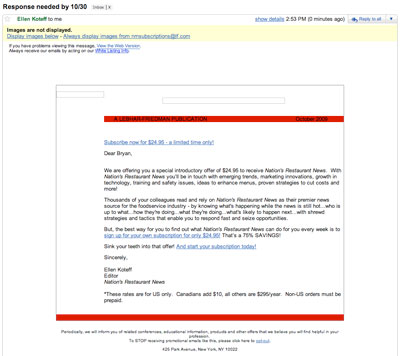
Here’s a simple test. If this email landed in your inbox, would you think it was spam?

Most readers would decide it was spam and unsubscribe straight away. Nothing in it signals that it’s legitimate, even though it was a real message from a real publisher.
Turning images on doesn’t help. Once the graphics load, the email still gives no clear sign of who sent it or why.

The reader never signed up with this sender
The bigger problem was consent. The reader had never signed up for email from Nation’s Restaurant News. Most likely, the address had been added through a partner network of email lists, where ticking one box sends your address to several publishers. Readers often blame themselves for missing the small print. But when they don’t recognize a sender, they don’t unsubscribe politely. They mark the email as spam.
That gap is worth fixing. Third-party and partner emails should carry a short disclaimer above the fold, and the first thing the reader sees should explain why the email arrived: for example, “You’re receiving this because you signed up for X’s partner offers.” A clear opt-out link should sit right beside that line.
Since 2024, part of this fix happens at the mailbox level. Bulk senders to Gmail and Yahoo must send a List-Unsubscribe header that supports one-click unsubscribe, so Gmail can show an Unsubscribe link next to the sender name. The disclaimer and the in-body link are still worth adding, because the header only helps in mail apps that show it.
The From name was a person nobody knew
The email didn’t come from “Nation’s Restaurant News”. It came from Ellen Koteff, who was the publication’s executive editor at the time. A reader who has never heard of her has no reason to open a message from a stranger, and a strong reason to report it.
If the email comes from a company, the From name should say so. A personal name only works when readers already know that person, and even then a format like “Ellen at Nation’s Restaurant News” keeps the brand visible. In today’s inboxes the From name is the first and often the only thing a reader checks before deciding. That’s even more true on phones, where the preview shows little more than sender and subject.
How the same email would fare in 2026
The same email would face much stricter mailbox filters today. These are the rules it would have to meet:
| Problem in the email | What the rule or mailbox does now | Who sets it |
|---|---|---|
| Unknown personal From name | The header information must accurately identify who sent the message. Readers who don’t recognize a sender report it, and complaints count against you | FTC (CAN-SPAM), Gmail, Yahoo |
| Address gathered through a partner network | Complaint rates must stay below 0.3%. Gmail recommends staying under 0.1% | Google email sender guidelines, Yahoo Sender Hub |
| No visible opt-out near the top | Bulk senders need one-click unsubscribe (RFC 8058) and must honor requests within two days | Gmail and Yahoo, enforced from June 2024 |
| No proof of the sender’s identity | SPF, DKIM and a DMARC record are required for senders of 5,000+ messages a day | Gmail and Yahoo (February 2024), Microsoft Outlook.com (May 5, 2025) |
| Opt-out handling | Opt-outs must be honored within 10 business days, with penalties up to $53,088 per violating email | FTC (CAN-SPAM), 2025 amount still in force in 2026 |
Authentication is what lets a brand name and logo appear in the inbox. A DMARC policy at enforcement (p=quarantine or p=reject) is the foundation for BIMI, which Gmail and Apple Mail use to show a verified logo next to the sender name. A minimal DMARC record looks like this:
_dmarc.example.com. IN TXT "v=DMARC1; p=quarantine; rua=mailto:[email protected]"
Open rates are no longer a reliable sign that a partner list is working. Apple Mail Privacy Protection, launched with iOS 15 in 2021, preloads images and records opens that never happened. Spam complaints, unsubscribes and clicks give you a more honest picture.
FAQ
Is it illegal to send email from a person’s name instead of the company name?
Not by itself. CAN-SPAM requires the From, To and Reply-To information to accurately identify the person or business that sent the message, and a real employee’s name can meet that rule. The problem is practical: readers who don’t recognize the name tend to report the email as spam. “Name at Brand” is the safer format.
Are partner or co-registration lists allowed?
CAN-SPAM doesn’t ban them, but under the FTC’s guidance, the company whose product is promoted and the company that sends the email can both be held responsible for violations. Under GDPR, consent must be specific and informed, so readers in the EU have to know which organisations will email them. Partner lists also drive complaint rates up quickly, and that puts your Gmail and Yahoo inbox placement at risk.
What spam complaint rate is too high?
Google and Yahoo both set 0.3% as the limit for bulk senders, measured in Google Postmaster Tools and through Yahoo’s Complaint Feedback Loop. Google recommends staying below 0.1%. Yahoo counts complaints against mail delivered to the inbox, so its figure can differ from the rate your ESP reports.
How fast do unsubscribe requests have to be processed?
CAN-SPAM allows up to 10 business days. Gmail and Yahoo require bulk senders to honor one-click unsubscribe requests within two days, so most ESPs now process them right away.
Does a disclaimer about why someone got the email still help?
Yes. A line near the top, such as “You’re getting this because you joined X’s partner offers”, reminds readers how they signed up. That turns some spam reports into unsubscribes, which don’t hurt your sender reputation the way complaints do. Pair it with a visible unsubscribe link, because not every mail app shows the List-Unsubscribe link.
Sources
- Google: Email sender guidelines
- Yahoo Sender Hub: Best practices and FAQs
- FTC: CAN-SPAM Act, a compliance guide for business
- Federal Register: FTC adjustments to civil penalty amounts (2025)
- Microsoft Tech Community: Outlook’s new requirements for high-volume senders
- Google Workspace Updates: Manage email subscriptions in Gmail