
Renting an email list is still a poor way to get results in November 2026, and it is now riskier than when this post was first written. Since February 2024, Gmail and Yahoo have required bulk senders to authenticate with SPF, DKIM and DMARC, offer one-click unsubscribe and keep reported spam below 0.3%. Microsoft’s Outlook.com began enforcing similar authentication rules for senders of more than 5,000 messages a day on May 5, 2025. Cold rented audiences complain more than people who signed up, and Mailchimp’s Acceptable Use Policy bans sending to purchased or rented lists outright, so the safest path is still a list you build yourself.
Why list rentals usually signal a problem
A list rental is often a sign of desperation. The push tends to come from a marketing department that wants results fast. A rented list rarely delivers those results, and the damage to your sender reputation can outlast the campaign.
The mechanics have changed since this post was written. Mailbox providers now score mail on complaint rates and engagement, so a send to strangers drags down every campaign that comes after it. Gmail’s sender guidelines ask senders to keep their spam rate under 0.1% and never let it reach 0.3%. Yahoo’s Sender Hub uses the same 0.3% limit.
What to look for in a list rental vendor
If you still decide that renting a list will help you reach your goals, know what to look for in a vendor. An article on clickz pointed out several warning signs to check before choosing a legitimate vendor. Those checks are still a sensible filter, with some updates for how email works today.
1. Compare their prices
Look at how the vendor prices the send. If the price slides sharply as the number of addresses goes up, be wary. Find out what other vendors charge, work out an average and get a sense of what you should be spending. If something seems too good to be true, it probably is.
2. Walk away if they hand you the addresses
A vendor that gives you the addresses to send to is not running a real rental. In a legitimate rental the list is the vendor’s asset, so the vendor sends your message and never releases the data. A vendor that hands addresses out freely is selling a list, not renting one, so walk away.
This matters more today. If you load those addresses into your own email service, you break its rules. Mailchimp’s Acceptable Use Policy bans uploading or sending campaigns to purchased, rented, third-party, co-registration, publicly available or partner lists. Most major ESPs have similar terms.
3. Ask whether the list is double opt-in
Ask whether the list is double opt-in. Double opt-in lists usually perform better, but that standard mostly applies to house lists. A vendor finds it hard, close to impossible, to prove opt-in without handing over the list. And if the vendor says its contacts opted in, the question remains: opted in to what?
The law has tightened that question. In the EU and UK, marketing consent generally has to cover the specific sender, so a broad “partners may contact you” checkbox rarely covers your brand. In the US, CAN-SPAM does not require opt-in, but the FTC’s compliance guide says both the company whose product is promoted and the company that sends the message can be held responsible for violations. The maximum civil penalty is $53,088 per violating email. The FTC confirmed in September 2026 that it would make no inflation adjustment this year, so that 2025 figure still applies.
4. Get the vendor’s sending IP and check its reputation
If the vendor won’t give you its sending IP address, don’t do business with it. If it does share the origin IP, take that as a sign of confidence. The original advice was to check the sending IP at Senderbase.org, ReputationAuthority and BarracudaCentral.org.
Those tools have changed:
| Tool named in the original post | Status today | What to use it for |
|---|---|---|
| Senderbase.org | Cisco folded it into the Talos Intelligence Reputation Center | Look up an IP’s email reputation, rated Good, Neutral or Poor |
| ReputationAuthority | WatchGuard’s older reputation lookup; WatchGuard has not kept it current in recent years | Treat any result from it as secondary |
| BarracudaCentral.org | Still running, with an IP lookup and a removal-request form | Check whether the IP is on the Barracuda Reputation Block List |
If you skip the reputation check and the IP turns out to be blocklisted, mailbox providers and readers may see your brand as spam.
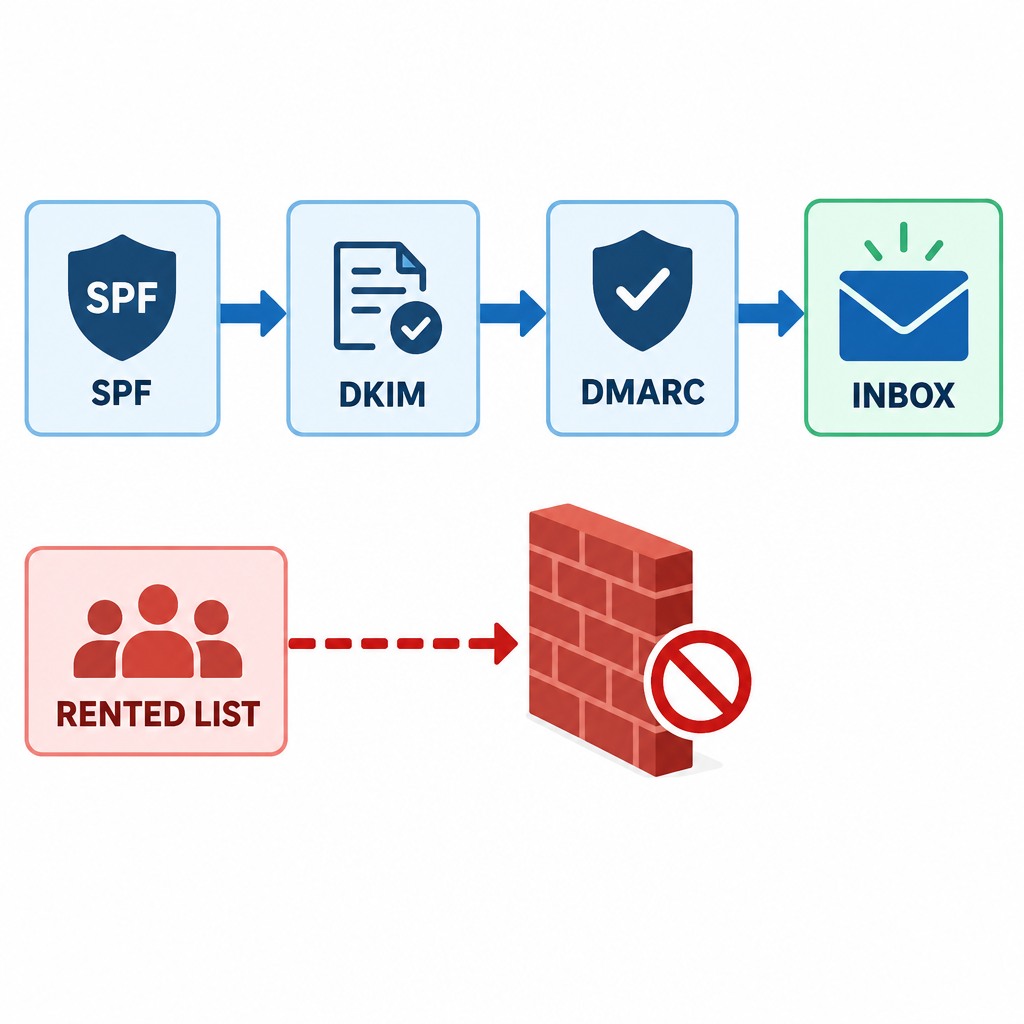
There is a newer problem too. If the rented mail goes out with your domain in the From address, Gmail, Yahoo and Outlook.com expect it to pass SPF or DKIM and align with your DMARC record. That means you have to authorize the vendor’s servers to send as your domain. From then on, every complaint the rental produces counts against your domain’s reputation, not only the vendor’s IP.
How to read the results
When the send is done and you collect the reports, don’t measure them against baselines from your organically grown lists. If you do, you will almost always be disappointed.
Open rates are also less reliable than when this post was written. Apple Mail Privacy Protection preloads images, which inflates opens, and Gmail serves images through its proxy. Judge a rental on clicks, conversions, unsubscribes and spam complaints instead. If the vendor sends the mail, you won’t see complaint data from Gmail’s Postmaster Tools or Yahoo’s feedback loop, so ask the vendor for complaint counts in writing.
The better route
However hard a vendor argues that its list is legitimate, paying for one is risky. The way to get results is to send timely, relevant messages to people who opted in to get your emails. That takes time, patience and attention.
If the pressure behind a rental is to grow fast, put the budget into list building you control: a sign-up form with a clear incentive, co-marketing where a partner promotes your sign-up page instead of mailing its list for you, or paid ads that send people to an opt-in page. Every address you get that way is one you can mail again, with no rental fee and no shared reputation.
FAQ
Is renting an email list legal in the US?
Yes, under CAN-SPAM, as long as every message follows the law. That means honest headers and subject lines, a physical postal address, a working opt-out and opt-outs honored within 10 business days. Both the advertiser and the company that sends the mail can be liable, with penalties up to $53,088 per email.
What is the difference between renting and buying an email list?
When you rent, the vendor sends your message to its list and you never see the addresses. When you buy, you get the addresses and mail them yourself. Buying is usually worse, because it breaks ESP terms such as Mailchimp’s Acceptable Use Policy and puts the complaints directly on your own account and domain.
Can I upload a rented list to Mailchimp or another ESP?
No. Mailchimp bans uploading or sending to purchased, rented, third-party, co-registration and partner lists, and most major ESPs have similar rules. Breaking them can get your account suspended, and the high bounce and complaint rates hurt your deliverability either way.
Do the Gmail and Yahoo bulk sender rules apply to rented sends?
They apply to whoever’s domain and infrastructure the mail goes out on. If the mail carries your From domain, it has to pass SPF or DKIM with DMARC alignment and offer one-click unsubscribe for marketing mail. The complaints count against your domain, and complaint rates near 0.3% can push mail to spam or get it rejected.
Can a list rental ever work?
It can work in narrow cases, usually B2B or trade publications that send a sponsored message to their own engaged subscribers under their own name. Even then, treat it as advertising: track clicks and opt-ins to your own list, not opens. Don’t compare the numbers with your house list.
Sources
- Google: Email sender guidelines
- Google: Email sender guidelines FAQ
- Yahoo Sender Hub: FAQs
- Microsoft Outlook: New requirements for high-volume senders
- FTC: CAN-SPAM Act compliance guide for business
- Federal Register: FTC civil penalty inflation adjustments, September 15, 2026
- Mailchimp: Acceptable Use Policy
- Cisco Talos: Reputation Center overview
- Barracuda Central: Removal request