
A good unsubscribe page lets someone leave in one step, confirms that it worked, and offers fewer emails as an option without making threats. Since February 2024, Gmail and Yahoo have required bulk senders to support one-click unsubscribe through the List-Unsubscribe header (RFC 8058) and to honor requests within two days. Microsoft announced that Outlook.com’s requirements for domains sending more than 5,000 messages a day would be enforced beginning May 5, 2025. Most people now unsubscribe with the button in their inbox, so your landing page is the second place they can leave. The two examples below still show what a bad exit and a good exit look like.
This post looks at two very different unsubscribe pages. One is funny. The other is infuriating.
The bad one comes first.
The bad extreme: Adorama’s warranty threat
A customer bought new headphones from the retailer Adorama and wanted to activate the extended warranty. All it took was filling out the postcard that came in the box and mailing it back. The card had four fields: first name, last name, email address and order number. Nothing on it mentioned a newsletter.
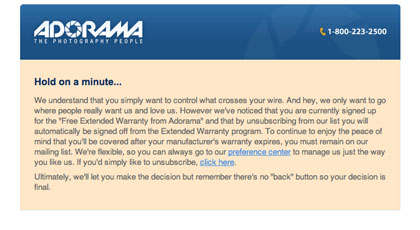
A week later an email arrived confirming that the warranty was active. Then the newsletters started. The customer had never opted in to updates or tips, so they clicked the unsubscribe link and landed on this page:

The copy on the page says that opting out makes the extended warranty null and void. The preference center is no clearer. The account showed two subscriptions, General and Workshops. If the customer turned off both newsletters without fully unsubscribing, would the warranty still be valid? The page doesn’t say. The customer is stuck: they need the warranty and they don’t want the emails.
This is a shady practice, plain and simple. It is also bad for deliverability. A reader who feels trapped usually stops looking for the unsubscribe link and hits “Report spam” on every message. Each complaint lowers the sender’s reputation with mailbox providers. Today Google tells bulk senders to keep the spam rate shown in Postmaster Tools below 0.3%, and ideally under 0.1%. A sender who makes leaving hard is choosing complaints over clean unsubscribes.
Why the warranty threat doesn’t hold up
Under CAN-SPAM, warranty notices and marketing emails are different kinds of mail. The FTC treats warranty, recall, safety and security information about a product the recipient bought as transactional or relationship content. Those messages are mostly exempt from the Act, and a company can keep sending them after someone unsubscribes from marketing. A newsletter is commercial email. So nothing in the law or the technology forces an opt-out to touch the warranty. Linking the two only puts pressure on the customer.
The FTC’s opt-out rules point the same way. A sender can’t charge a fee to unsubscribe. It can’t ask for personal information beyond an email address. It can’t make people do more than send a reply email or visit a single web page. Opt-outs must be honored within 10 business days. Each email that breaks the rules can bring a civil penalty of up to $53,088. That is the 2025 level, and in September 2026 the FTC said it would keep using it because no inflation adjustment is being made this year.
There is a consent problem too. A warranty postcard is not a newsletter signup. US law allows opt-out marketing to existing customers. Even so, adding people to a list they never asked for, and then making it hard to leave, is how a list fills up with people who report spam.
The good extreme: Groupon’s “Punish Derrick” page
This unsubscribe page comes from Groupon:

A screenshot can’t show why this page worked, so click here for the direct page and see for yourself. The best part was a button labeled “Punish Derrick.” Derrick was the employee who supposedly signed you up. When you pressed the button, a short silent clip played: Derrick’s boss comes around the corner, has a pointed word with him, and throws a cup of coffee at him.
The page turned a moment that email marketers usually dread into a joke the subscriber was in on. Some readers even resubscribed on the spot. Well played, Groupon.
The page dates from the early 2010s, so treat it as a classic rather than a template to copy. The lessons still apply:
- The unsubscribe works first. The joke came after the confirmation and never blocked the exit.
- The tone fits the brand. Groupon’s voice was playful everywhere, so a playful goodbye felt natural.
- Coming back is easy. A resubscribe option on the confirmation page catches the people who clicked by accident or changed their mind.
- No guilt trips that cost the reader anything. Derrick took the blame for a moment. The subscriber lost nothing.
What a good unsubscribe flow looks like today
Today a good unsubscribe flow has three parts: a one-click header for the inbox button, a visible link in the email body, and a simple landing page. The header and the body link are requirements for bulk senders. The landing page is where brand voice and options like Groupon’s belong.
| Part of the flow | What the rules expect | Where it comes from |
|---|---|---|
| List-Unsubscribe header with one-click (RFC 8058) | Required for marketing and subscribed mail | Gmail and Yahoo, since February 2024 |
| Processing time | Within two days | Gmail and Yahoo bulk sender rules |
| Visible unsubscribe link in the body | Required, clear and working | Gmail, Yahoo, Microsoft, CAN-SPAM |
| Opt-out deadline under US law | 10 business days at most | FTC, CAN-SPAM |
| Steps to opt out | One reply email or one web page, no fee, no extra personal data | FTC, CAN-SPAM |
Most ESPs add the one-click header for you, but check the raw headers of a test send to confirm it. A typical pair looks like this:
List-Unsubscribe: <https://example.com/unsub?id=abc123>, <mailto:[email protected]?subject=unsubscribe>
List-Unsubscribe-Post: List-Unsubscribe=One-Click
Google defines a bulk sender as one that sends close to 5,000 or more messages to personal Gmail accounts within a 24-hour period. Microsoft uses the same 5,000-a-day line for Outlook.com. Mail that fails Microsoft’s applicable high-volume sender requirements can be rejected with error code 550 5.7.515. If your volume is lower, follow the same rules anyway. They cost nothing and they keep complaints down.
FAQ
Can I require people to log in before they can unsubscribe?
No. CAN-SPAM limits an opt-out to a reply email or a visit to a single web page, with no fee and no personal data beyond the email address. Gmail and Yahoo also require one-click unsubscribes for bulk senders, with no login or extra steps. A login wall usually turns would-be unsubscribers into spam complaints.
Is a preference center allowed on the unsubscribe page?
Yes, as long as a full opt-out is also offered and is easy to find. The FTC allows a menu of choices only if one of them is to stop all commercial messages from you. A preference center that offers only “fewer emails” and hides the full unsubscribe falls short of the rules.
Can I keep sending order and warranty emails after someone unsubscribes?
Yes. Messages whose main purpose is transactional or relationship content are mostly exempt from CAN-SPAM, and the opt-out applies to commercial email. Examples include receipts, shipping updates, account alerts and warranty or recall notices. Keep marketing out of those messages, or the subject line and content can make them count as commercial.
How fast do unsubscribes have to be processed?
US law allows up to 10 business days. Gmail and Yahoo expect bulk senders to honor one-click requests within two days. Aim for the stricter deadline. In practice, most ESPs suppress the address within minutes.
Does a funny unsubscribe page like Groupon’s actually reduce churn?
It can win back a few people, but it doesn’t fix the reasons they’re leaving. It works best when the humor fits your usual voice and comes after the unsubscribe is confirmed. If many people are leaving, look at how often you send and how relevant the emails are before you work on the goodbye page.
Does it hurt deliverability when people unsubscribe?
Unsubscribes don’t hurt your reputation. Spam complaints do. Someone who unsubscribes quietly leaves your list, while someone who can’t find the link often reports the email as spam, which pushes your Gmail spam rate toward the 0.3% limit. Making it easy to leave protects the inbox placement of everyone who stays.
Sources
- FTC: CAN-SPAM Act, A Compliance Guide for Business
- Federal Register: FTC Civil Penalty Inflation Adjustments, September 15, 2026
- Google Workspace Admin Help: Email sender guidelines
- Yahoo Postmaster: More Secure, Less Spam
- Yahoo Sender Hub: Sender Best Practices
- Microsoft Tech Community: Outlook’s New Requirements for High-Volume Senders