
Designing an email to look like your Facebook Page can still grow your audience there, but today the goal is followers, not “likes.” Facebook dropped Page Likes in favor of Followers in its 2021 Page redesign, and Meta retired the Like button plugin for outside websites on February 10, 2026. So the email should push one clear “Follow us on Facebook” call to action, built from Meta’s official brand assets. The email also has to clear the Gmail, Yahoo and Microsoft sender rules and read well on a phone in dark mode.
The original idea: an email that looks like your Facebook Page
Say one goal of your email is to grow your Facebook audience. Which design choices and strategies help, and is it worth designing the whole email around that one goal?
LA Fitness tried a simple answer in an older campaign aimed at Facebook. It worked well.

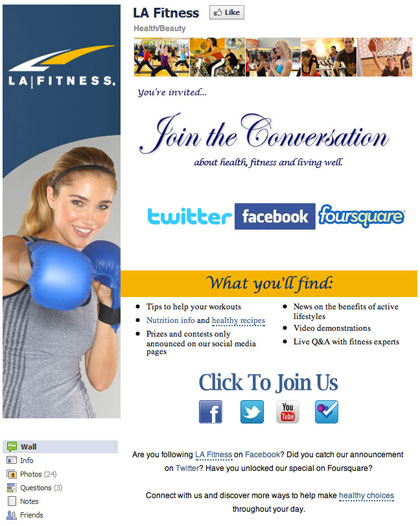
The image shows how the email design very closely resembles the gym’s actual Facebook Page, right down to the site’s standard navigation bar of the time. Better typefaces and logo placement would have made it more polished, but overall it works. The idea is easy to grasp: LA Fitness’s Facebook Page arrives in the inbox. It is simple and gets straight to the point. Sometimes a direct approach like this is the best design solution for a campaign.
What has changed since this campaign ran
The core idea still holds: show people what they will get and make the next step obvious. Most of the details around it have changed.
| Then | Now (November 2026) |
|---|---|
| Pages collected “Likes” and showed a like count | Pages show a Follow button and a follower count, a change made in the 2021 Page redesign |
| Websites could embed Facebook’s Like button | Meta discontinued its Like and Comment plugins for external websites on February 10, 2026 |
| Desktop email clients often hid images until the reader allowed them | Gmail shows images by default through its image proxy, but some clients and corporate setups still block them |
| Open rates were a fair measure of interest | Apple Mail Privacy Protection, introduced with iOS 15 in 2021, inflates opens, so clicks are the better measure |
| Few formal rules for bulk senders | Gmail and Yahoo have required authentication, one-click unsubscribe and low spam rates since February 2024; Microsoft added requirements in May 2025 |
The navigation bar in the LA Fitness email belongs to an older version of Facebook. If you copy the interface pixel for pixel, the email looks dated as soon as Facebook redesigns again.
How to use the idea in a campaign today
Borrow the feel of your Facebook Page, not a full screenshot of Facebook’s interface. Readers should recognize your content at a glance and see one action to take.
- Lead with your own content. Use your Page’s cover image, a recent post or a photo from an event, so readers see what following you gets them.
- Use official Facebook assets. Download the logo from Meta’s Brand Resource Center and use it unaltered. Meta says it enforces its trademark rights against misuse.
- Ask for a follow, not a like. The button text should match what readers will see on Facebook, for example “Follow us on Facebook.”
- Make the button live HTML text. Readers whose images are blocked still see a working call to action. Give every image alt text too.
- Design for mobile and dark mode. Use a single column, tap-sized buttons and logos with transparent backgrounds that still read well on a dark background.
- Track clicks. Add UTM tags to the Facebook link and measure click-throughs and new followers, not opens.
The honest counter-argument
An email that copies Facebook’s interface too closely can look like a fake Facebook notification, which is a common phishing trick. Readers who think it is a scam report it as spam, and spam complaints hurt your deliverability. Keep your own brand in the From name, the subject line and the header, and use Facebook styling as an accent. Never make the email look like it came from Facebook.
Deliverability rules a social-promo email still has to meet
A Facebook-themed campaign is a marketing email. All the bulk-sender rules apply to it.
- Gmail and Yahoo (since February 2024): Gmail requires bulk senders to authenticate with SPF and DKIM, publish a DMARC policy, support one-click unsubscribe (RFC 8058) for applicable marketing and subscribed messages and keep the reported spam rate below 0.3%. Yahoo’s requirements are similar: SPF and DKIM authentication, a DMARC policy of at least p=none, one-click unsubscribe for applicable messages and a spam complaint rate below 0.3%. Gmail treats senders of about 5,000 messages a day to personal Gmail accounts as bulk senders. In November 2025 Google announced it was stepping up enforcement, with temporary and permanent rejections for mail that does not comply.
- Microsoft Outlook.com (since May 5, 2025): domains that send more than 5,000 emails a day to Outlook.com addresses must pass SPF, DKIM and DMARC. Mail that fails can bounce with the error “550 5.7.515 Access denied.”
- CAN-SPAM: the From line and subject line must not mislead, and every message needs a valid physical postal address and a working opt-out. This is one more reason not to dress the email up as a message from Facebook itself.
A minimal DMARC record to start monitoring looks like this:
_dmarc.example.com. TXT "v=DMARC1; p=none; rua=mailto:[email protected]"
Move to p=quarantine or p=reject once the reports show that all your legitimate mail passes.
FAQ
Can I still ask subscribers to “like” my Facebook Page?
Ask them to follow it instead. Facebook replaced Page Likes with Followers in its 2021 redesign, and visitors now see a Follow button. Using the same word in your email avoids confusion when readers reach the Page.
Can I put a working Facebook Like button inside an email?
No. Email clients do not run the scripts that interactive social widgets need. Meta also retired its Like and Comment plugins for external websites on February 10, 2026. Use a linked button or icon that takes readers to your Page.
Is it legal to use the Facebook logo in my email?
You can link to your Facebook presence with the official logo from Meta’s Brand Resource Center, as long as you follow Meta’s brand guidelines and do not alter the logo. Do not suggest that Facebook sponsors or sent the message.
Will a Facebook-style email land in the Promotions tab?
Probably. Gmail sorts most marketing mail into Promotions whatever the design. That is fine for a social campaign, as long as your authentication is in place and your spam rate stays low so the mail is not filtered as spam.
How do I measure whether the campaign grew my Facebook audience?
Tag the Facebook link with UTM parameters and track clicks in your email platform. Then compare new followers in Meta Business Suite for the days after the send. Opens are unreliable because Apple Mail Privacy Protection inflates them.
Should social promotion get its own email or go in the footer?
Social icons in the footer are fine for every send. A dedicated campaign makes sense when you have a reason to follow, such as a Facebook-only offer, a live event or a community group. Without a reason, a whole email asking for follows usually gets weak results.
Sources
- Google Gmail Help: Email sender guidelines and the Email sender guidelines FAQ
- Yahoo Sender Hub: Sender best practices and requirements
- Microsoft Outlook.com Postmaster: Policies, Practices, and Guidelines
- Microsoft Support: Fix NDR error 550 5.7.515 in Outlook.com
- Federal Trade Commission: CAN-SPAM Act, A Compliance Guide for Business
- Meta for Developers blog: Facebook social plugins to be discontinued February 2026
- Meta Brand Resource Center: Facebook logo guidelines