
The best lesson from that first day in Miami still holds in November 2026. Before you send anything, ask why you are sending it: what is the objective, and what is the best way to reach it? Then test until your subscribers’ behavior gives you the answer. What changed is how you measure and what the inbox demands: Apple Mail Privacy Protection has inflated open rates since September 2021, Gmail and Yahoo have required SPF, DKIM, DMARC, one-click unsubscribe and low spam rates from bulk senders since 2024, and Microsoft’s Outlook.com added its own rules in May 2025.
Day one in Miami
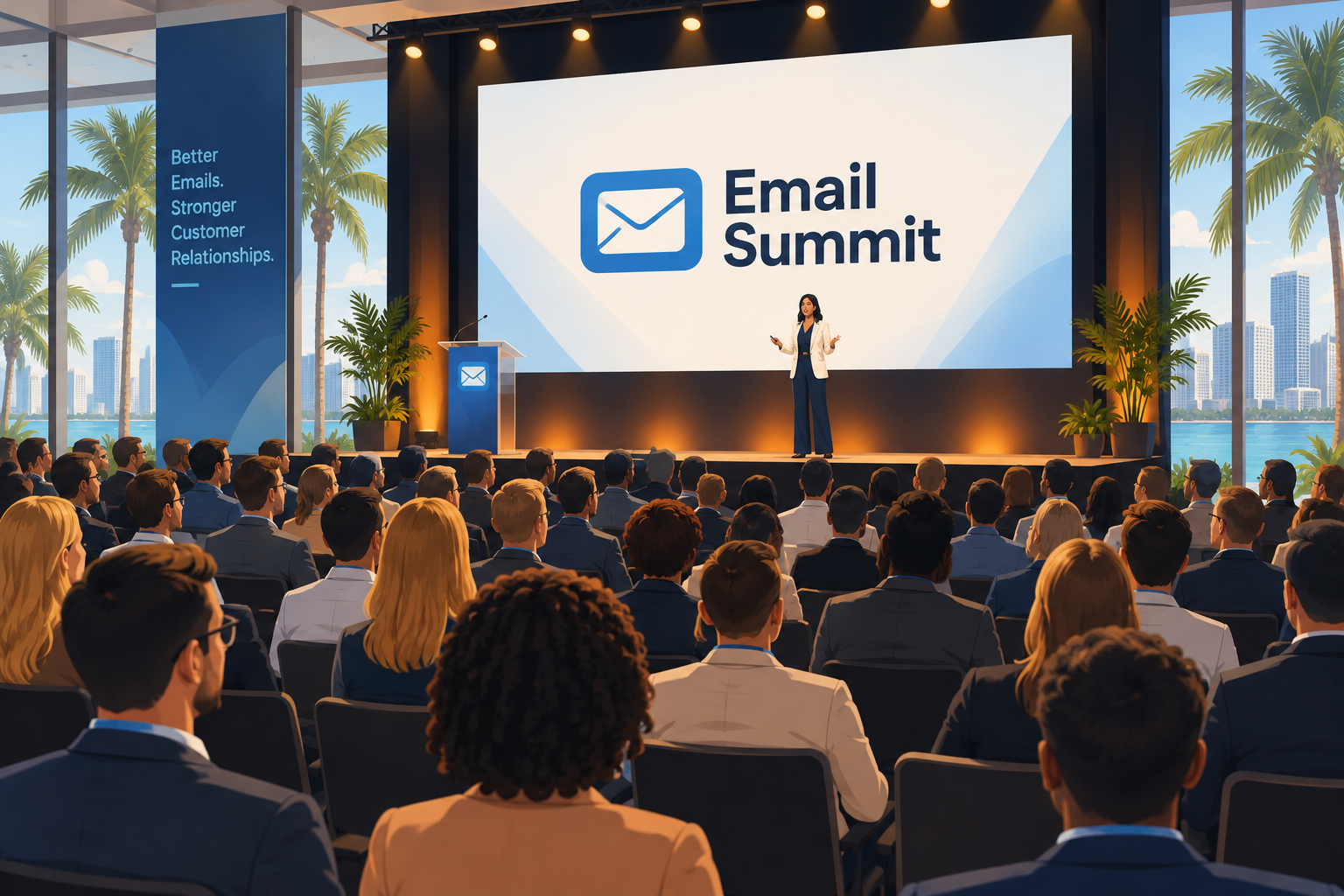
The summit opened in Miami with three full days of sessions planned, and the first day alone gave attendees enough material to write about for weeks. The theme came through clearly. A campaign that works is not always the most effective campaign you could be running. The way to find the better version is to test, test and test again until the results show you what works.
MarketingSherpa EM@IL SUMMIT ’08 Expo & Awards
The sessions kept returning to the same point. Plenty of what marketers think they already know about email does not hold up once they test it against their own lists.
Coverage from the event floor followed the program day by day, passing on what speakers shared about planning, testing and measuring email programs.
A note on testing in 2026
The “test everything” advice still stands, but what you test against has changed. When this summit took place, open rate was the standard score for a subject line test. Since Apple launched Mail Privacy Protection with iOS 15 in September 2021, Apple Mail can preload images and tracking pixels for users who turn the feature on. Those emails register as “opened” whether or not anyone read them.
For tests that matter, score them on clicks, conversions or revenue per email sent. Keep open rate as a rough signal at most, and leave Apple Mail opens out where your ESP lets you filter them.
Start with why: the two planning questions
The summit drew speakers and attendees with deep experience, and one of the most useful conversations was a 15-minute one-on-one with Eric Stockton, then President of
.
His message was direct. Email marketing was not dead. It was growing, and it belonged in any marketing campaign. He also made the point that email is simpler than marketers make it, and that teams complicate it far too often.
He insisted that before any piece of marketing, email or blog, you ask why you are doing it. Two questions come before planning and execution:
- What is your objective?
- What is the best way to achieve that objective?
Get real answers to both before you build anything. Don’t rely on what you assume as a marketer. Get the answers from the people you are marketing to. It is the oldest rule in sales: know your audience.
What the two questions look like in practice?
Say an online store wants more repeat purchases. The objective is specific: get customers who haven’t bought in 180 days to place a second order. The best way to get there might be a short win-back series sent only to that segment, rather than another discount blast to the whole list. Success is measured in orders from that segment, not in opens.
Asking the audience can be as simple as a one-question survey in the first email, or looking at what lapsed buyers clicked on before they went quiet.
Why “know your audience” now protects your deliverability too?
Back then, knowing your audience was about relevance. Today it also keeps you in the inbox. Gmail and Yahoo watch how recipients react to your mail, and both have told bulk senders to keep their spam complaint rate below 0.3%. Google advises aiming for under 0.1% in Postmaster Tools. Irrelevant mail sent to people who never asked for it is the quickest way past that limit.
How the rest of the day’s advice holds up
Everything covered in that one-on-one came up again in the main presentations. Here is how those themes compare with email in 2026.
| Theme at the summit | Status in 2026 |
|---|---|
| Ask why before you market | Still holds. Objective first, channel and tactic second. |
| Test until you find what works | Still holds, but score on clicks and conversions because of Apple Mail Privacy Protection. |
| Email marketing is not dead | Still holds. Gmail, Yahoo and Microsoft now publish dedicated rules for high-volume senders. |
| Keep email simple | Still holds for content. The technical setup is stricter: SPF, DKIM and DMARC are expected of bulk senders. |
| Know your audience | Still holds, and complaint rates now affect whether your mail reaches the inbox at all. |
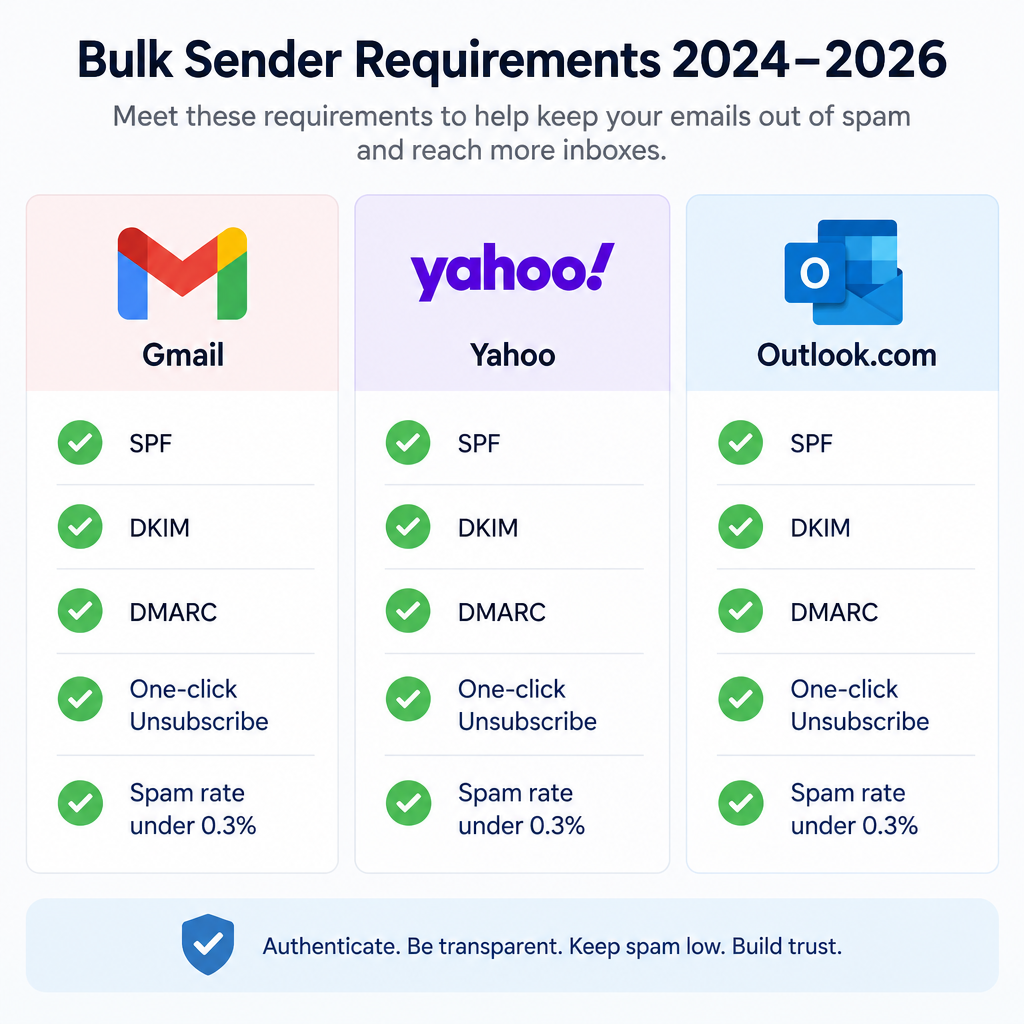
The rules that didn’t exist back then are now the baseline for anyone sending at volume:
- Gmail (from February 2024): senders of roughly 5,000 or more messages a day to personal Gmail accounts must authenticate with SPF and DKIM, publish a DMARC record, use one-click unsubscribe on marketing mail (required from June 2024) and honor unsubscribes within two days. Google stepped up enforcement in November 2025, and non-compliant mail can be rejected temporarily or permanently.
- Yahoo (from February 2024): the same core requirements, including the 0.3% complaint ceiling and two-day unsubscribe processing, though Yahoo publishes no numeric volume threshold.
- Microsoft Outlook.com (from May 5, 2025): domains sending more than 5,000 emails a day to Outlook.com, Hotmail.com and Live.com addresses must pass SPF, DKIM and DMARC. Non-compliant mail goes to junk, and rejection follows if the problems continue.
A minimal DMARC record to start monitoring looks like this:
_dmarc.example.com. TXT "v=DMARC1; p=none; rua=mailto:[email protected]"
Once your reports show all legitimate mail passing, move to p=quarantine and then p=reject.
The two questions from Miami still come first. Before your next campaign, write down the objective and the best way to reach it, then check that your authentication and unsubscribe setup will let that campaign reach the inbox.
FAQ
Is the MarketingSherpa Email Summit still held?
The Email Summit ran in Miami in the late 2000s and later moved to Las Vegas, where the 2015 edition was billed as the 10th annual Email Summit. It was then rebranded as the broader MarketingSherpa Summit, and the February 2017 edition took place at ARIA Las Vegas. Check MarketingSherpa directly for any current events before you plan travel.
Is email marketing really still worth it?
Yes. Gmail, Yahoo and Microsoft have all written rules specifically for high-volume senders, which shows how much legitimate commercial email still moves through their systems. The work has shifted toward permission, authentication and relevance, but the channel Eric Stockton described as growing is still a core part of most marketing programs.
What should you A/B test now that open rates are unreliable?
Test against clicks, click-to-conversion rate and revenue per email sent. Subject lines are still worth testing, but judge the winner on downstream clicks or sales, not opens inflated by Apple Mail Privacy Protection. Run each test on a sample large enough to show a real difference before you roll it out to the full list.
Do the Gmail and Yahoo bulk sender rules apply to small senders?
The strictest requirements apply to bulk senders, which Google defines as close to 5,000 or more messages a day to personal Gmail accounts. All senders are still expected to set up SPF or DKIM, keep spam rates low and send to people who asked for the mail. Google also says that once a sender is classified as bulk, the classification does not expire.
Does CAN-SPAM still apply to marketing email in the US?
Yes. The FTC’s CAN-SPAM rules require honest headers and subject lines, a physical postal address, a clear way to opt out and opt-outs honored within 10 business days. The maximum civil penalty stays at the 2025 level of $53,088 per violating email, because the FTC announced no inflation adjustment for 2026.
How do you find out what your audience wants?
Ask them and watch what they do. A preference center, a one-question survey or a quick reply prompt gives you direct answers, while click data by segment shows which topics actually get attention. Put both ahead of internal assumptions, which is exactly the point made at the summit.
Sources
- Google: Email sender guidelines and Email sender guidelines FAQ (Gmail Help and Google Workspace Admin Help)
- Yahoo Sender Hub: Best practices and FAQs
- Microsoft: Outlook’s new requirements for high-volume senders (Microsoft Tech Community) and Outlook.com Postmaster policies
- Federal Trade Commission: CAN-SPAM Act, A Compliance Guide for Business
- Federal Register: FTC notice on civil penalty amounts (January 2025 adjustment and 2026 notice)
- Apple: Mail Privacy Protection documentation (Apple Support)