
Yes. One apology email for a real problem builds trust, but a run of “We’re sorry” messages that each come with a discount starts to look like a sales tactic. In 2026 it also carries a real cost. Since February 2024, Gmail and Yahoo have required bulk senders to keep reported spam rates below 0.3%, offer one-click unsubscribe and authenticate with SPF, DKIM and DMARC. Microsoft added similar rules for Outlook.com in May 2025. Every extra message that annoys subscribers now raises your risk of landing in the spam folder.
The VistaPrint case: four apologies in two weeks
The original post answered its own question with a plain “yes”, and the example still holds up.
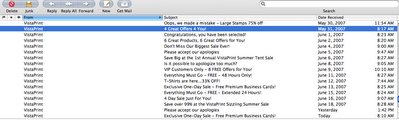
Starting on May 30, one subscriber received four apology emails from VistaPrint (now part of Cimpress) in about two weeks. Three of them blamed technical problems with ordering on the website. By the fourth, the steady flow of apologies was starting to feel insincere.
Each “We’re Sorry” message came with a discount to make up for the trouble. That raised an obvious question: were the discounts really about the problems? The same subscriber received 13 other VistaPrint emails over the same period, and every one of those was also promoting a discount.

Why repeated apologies backfire
Could a website really have technical problems for two full weeks? If it could, the problem was very serious, and customers needed a status update far more than another coupon.
If there was no real problem, inventing one was a poor strategy. It drew negative attention to the brand for no reason. VistaPrint was already sending plenty of sale emails, and the extra volume left the subscriber close to opting out. At the time, mostly curiosity about what the brand would send next kept them on the list.
What has changed since this was written
In VistaPrint’s case, the extra emails mainly risked brand fatigue. Today the same pattern can also damage deliverability, because mailbox providers now track how subscribers react and enforce rules that did not exist back then.
| Change | What it means for apology emails |
|---|---|
| Gmail and Yahoo bulk sender rules (February 2024) | Senders of more than 5,000 messages a day to Gmail need SPF, DKIM and DMARC, plus a spam rate below 0.3% (Google recommends staying under 0.1%). |
| One-click unsubscribe (enforced from June 2024) | Marketing mail needs List-Unsubscribe and List-Unsubscribe-Post headers. Annoyed readers can leave in one tap, and unsubscribes must be honored within two days. |
| Microsoft Outlook.com rules (May 2025) | Domains sending more than 5,000 emails a day to Outlook.com, Hotmail.com and Live.com addresses must pass SPF, DKIM and DMARC (at least p=none). |
| Apple Mail Privacy Protection (iOS 15, 2021) | Open rates are inflated, so a “sorry” email that seems to be “opened” may not actually be read. Track clicks, unsubscribes and complaints instead. |
| Gmail Promotions tab | An apology full of discounts looks like a promotion and gets sorted like one, so the actual explanation may never be seen. |
The legal baseline also still applies. Under the FTC’s CAN-SPAM rules, a commercial email dressed up as an apology is still a commercial email. It needs a working opt-out, opt-outs must be honored within 10 business days, and each violating message can cost up to $53,088. That figure was set in January 2025, and the FTC kept it for 2026.
How to apologize without overdoing it
A good rule of thumb is one apology per real incident, sent to the people it affected, with a single follow-up only when the issue is fixed.
- Confirm the problem is real and say what it is. Tell readers what broke, who was affected and when it happened.
- Send it only to affected subscribers. If only checkout failed, only people who tried to order need to hear about it.
- Keep the apology and the sale apart. A goodwill credit is fine, but don’t run it through a regular discount campaign.
- Send one “fixed” message, then go back to normal. If the problem is still going on, post updates on a status page instead of sending more emails.
- Watch complaints in Google Postmaster Tools and Yahoo Sender Hub for the next few days.
The HBO Max incident of June 17, 2021 shows the scale that works. After a blank “Integration Test Email #1” went out to part of its list, the company posted one short, honest apology on social media (it joked that “yes, it was the intern”) and moved on. Most of the coverage was friendly. Some critics still objected to it blaming a junior employee.
FAQ
How many apology emails is too many?
For a single incident, one apology plus at most one “it’s fixed” update is usually enough. Beyond that, readers start to see a pattern rather than a mistake. If you need to apologize again for a different problem within weeks, fix your process before you send anything else.
Should an apology email include a discount?
A discount can work if the mistake cost customers money or time. Keep it to a single offer that clearly ties back to the problem. If every apology comes with a coupon, as in the VistaPrint example, readers start to see the apologies as sales emails.
Is an apology email a transactional or a commercial message under CAN-SPAM?
That depends on its main purpose. A message that only explains a problem with an existing order can count as transactional. Once it promotes a sale or offer, the FTC treats it as commercial, and all CAN-SPAM requirements apply, including a working opt-out.
Can apology emails hurt deliverability?
Yes, if they push up complaints. Gmail and Yahoo require bulk senders to stay below a 0.3% spam rate, and extra unexpected emails are exactly what make people hit “report spam”. Sending only to affected subscribers keeps that risk low.
How quickly should a brand send an apology after an email mistake?
Send it within a day, once you know what happened and who was affected. For a minor slip like a blank test email, a social post or no follow-up at all may be better. Sending a second email to your whole list doubles the disruption.
Sources
- Google Workspace Admin Help: Email sender guidelines
- Yahoo Sender Hub: Best practices
- Microsoft Tech Community: Outlook’s new requirements for high-volume senders
- FTC: CAN-SPAM Act, A Compliance Guide for Business
- Federal Register: FTC adjustments to civil penalty amounts (January 2025)