
A personalized from name works when subscribers learn the person’s name at signup, see it on a fixed schedule, and can tell which brand that person speaks for. In November 2026 the best format puts both in the display name, such as “Patty at Brand”, and sends it from your own domain, authenticated with SPF, DKIM and DMARC. Since February 2024, Gmail and Yahoo have required that authentication from bulk senders, along with one-click unsubscribe and low spam complaint rates. Apple Mail Privacy Protection also inflates open rates, so a rise in opens is no longer proof that a new from name is working.
The campaign below is an old example, but its lessons still apply. An earlier post looked at personalizing messages with the from name, and at the risk you take when your “brand spokesperson” is someone nobody has heard of.
How the from name was introduced at signup
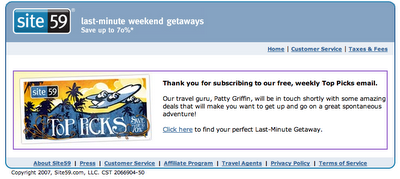
The email program from Site 59 handled this well. It told subscribers the name of their “Travel Guru”, Patty Griffin, at the moment they signed up. Site 59 was a last-minute travel seller that Travelocity bought in March 2002 for about $43 million. In 2007, Travelocity’s parent company Sabre announced plans to move it to the lastminute.com name. The brand and this campaign no longer exist, so read what follows as a case study.
Introducing the name at signup is what made the rest work. When a person’s name appears in the From line with no warning, it looks like a stranger or a phishing attempt. When the welcome flow says who will be writing and why, that same name is expected when it shows up.

A fixed weekly schedule
Every Tuesday, between 10:00 AM and 1:00 PM Eastern, subscribers got a message from Patty Griffin. Each one opened with a short, well-written personal note from Patty, with links to different parts of the site.
Sending often and on a steady schedule made subscribers more willing to accept mail from Patty. With seven days between messages, the name was hard to forget. Compare that with the example covered a few weeks earlier, which arrived at random and never built that habit.
This advice is stronger in 2026 than it was then. Gmail and Yahoo filter partly on how recipients engage, and a regular schedule from a familiar sender keeps people opening instead of marking mail as spam. Google’s sender guidelines ask bulk senders (those sending 5,000 or more messages a day to personal Gmail accounts) to keep the spam rate reported in Postmaster Tools below 0.3%. A sender name nobody recognizes is one of the quickest ways to get spam reports.

What the email contained
The layout was a two-column newsletter, and each block had a clear job.
Left column
- Patty’s personal note. A short, friendly opening tied to the week’s deals.
- Patty’s Pick. A different vacation spot featured each week.
- Getaway 411. Extra travel information, plus more links to the site’s travel discounts.
Right column
- Now Departing. Deals from the departure city each subscriber chose at registration, filled in automatically.
- Tour Guide. A search tool for last-minute deals.
- Need Ideas? Links to International, Sun and Beach, Under $250 and Luxury trips. These helped subscribers who wanted to travel but hadn’t settled on where to go.
The sections were different sizes. A grey header and footer on each one tied them together visually.
The “Now Departing” block was an early version of what email platforms now call dynamic or conditional content. It used one piece of signup data, the home city, to make every send more relevant. That idea has aged well. The two-column layout has aged less well. Most email is now read on phones, where two columns either stack or shrink, and many readers use dark mode, which can turn light grey section headers into dark blocks with low contrast. A design like this today would use one column and be tested in dark mode.
Why an unknown name worked
Before signing up, most subscribers had never heard of travel guru Patty Griffin. Within a few weeks, many looked forward to her weekly deals. The from name worked because three things lined up:
- Introduction. The name was explained at signup, so it never felt like a stranger’s email.
- Consistency. Same name, same day, same time window, every week.
- Payoff. Each message had real, personalized deals, so the name became a signal that the email was worth opening.
Remove any one of those and the persona becomes a risk. A made-up name that sends at random times with generic offers just looks like spam.
Applying the same approach in 2026
The core lesson still holds. The rules around it have changed, and the table below shows how.
| Element | How it worked then | What to do in 2026 |
|---|---|---|
| Display name | Person’s name alone | Person plus brand, such as “Patty at Brand”, so the sender is recognizable in crowded inboxes |
| From address | Often any working mailbox | Your own domain, aligned with SPF or DKIM and covered by a published DMARC record, as Gmail and Yahoo require of bulk senders |
| Measuring the change | Open rate | Clicks, conversions and spam complaints, because Apple Mail Privacy Protection inflates opens |
| Brand trust | Name recognition only | A BIMI logo, and in Gmail a blue checkmark if you hold a Verified Mark Certificate |
| Unsubscribe | Link in the footer | One-click unsubscribe header (RFC 8058) plus a visible link, with requests honored within two days |
| Layout | Two columns, grey section bars | One column, built mobile-first and checked in dark mode |
Legal accuracy matters too. Under the FTC’s CAN-SPAM rules, the From, To and Reply-To fields have to identify the person or business that sent the message accurately. A persona who really represents your company, sending from your domain, is fine. A display name meant to pass the mail off as coming from someone else is not. The most recent inflation adjustment, effective January 17, 2025, set the maximum civil penalty at $53,088 per violating email.
FAQ
Should the from name be a person or the company?
For most senders, use both: a person’s first name plus the brand. The brand is what makes the email recognizable, and the person makes it feel personal. Use a person’s name alone only if you introduce them at signup and send on a schedule, the way the Patty Griffin campaign did.
Does changing the from name hurt deliverability?
A sudden change can lead to more spam complaints if subscribers don’t recognize the new name. Mailbox providers watch those complaints closely. Tell subscribers about the change in the email before you make it, keep the same sending domain, and watch complaint rates in Google Postmaster Tools for the next few sends.
Can a fictional persona be used as the from name under CAN-SPAM?
The FTC’s guidance requires header information that accurately identifies the business sending the message. A clearly branded persona sent from your company’s domain identifies you. A name designed to make the email look like it came from someone unconnected to your business is a misleading header and is not allowed.
How should a from name test be measured if open rates are unreliable?
Use click rate, conversions and spam complaint rate as the main measures. Apple Mail Privacy Protection preloads images, which records opens that may never have happened, so a jump in open rate after a from name change may not mean anything. Run the test long enough to cover several regular sends.
Do Gmail and Yahoo rules apply to the from name itself?
Not to the display name. They apply to the address and domain behind it. Bulk senders need SPF and DKIM, a DMARC record, and a From domain that aligns with one of them. Google’s guidelines also prohibit pretending to be a Gmail address in the From header.
What makes a brand logo appear next to the from name?
Gmail shows a logo through BIMI. That needs a DMARC policy at enforcement, a BIMI DNS record pointing to an SVG logo, and a Verified Mark Certificate or Common Mark Certificate. With a VMC, Gmail also adds a blue verified checkmark. Even with everything set up correctly, Gmail may still not show the logo.
Sources
- Google Workspace Admin Help: Email sender guidelines
- Gmail Help: Learn about verified emails
- Yahoo Sender Hub: Sender FAQs
- FTC: CAN-SPAM Act, A Compliance Guide for Business
- Federal Register: FTC Adjustments to Civil Penalty Amounts (January 2025)
- Litmus: Email client market share