
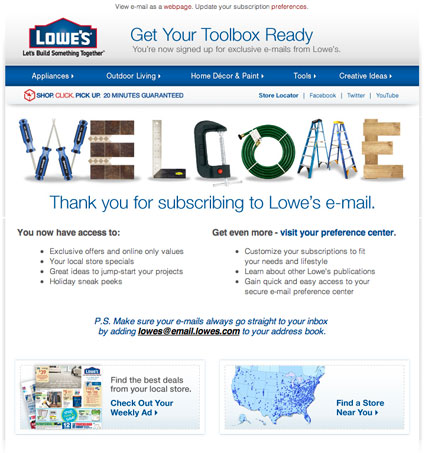
A welcome email should go out within minutes of signup. One that arrives a year late is really a cold email to someone who has probably forgotten they ever opted in. Mailing a long-dormant list is riskier now than when this Lowe’s example landed. Gmail and Yahoo have required SPF, DKIM and DMARC, one-click unsubscribe on marketing mail and spam complaint rates under 0.3% since February 2024, and in November 2025 Gmail began rejecting mail that breaks those rules. If contacts have gone months without hearing from you, ask them to confirm they still want your mail before you start selling.
A welcome letter that arrived a year late

The email above is a well-made welcome letter from Lowe’s, sent around the turn of 2011. On the surface it gets everything right. The design is clean and the copy is friendly. The problem is the timing. The subscriber who got it had signed up for Lowe’s emails a full year earlier and had heard nothing from the retailer since.
Think of that subscriber as a squatter who had lived inside the walls of the list for a year, unnoticed and undisturbed. Then Lowe’s found the dark corner of the basement. From there, only two things can happen. The squatter starts paying rent (receiving marketing and sales emails) or gets thrown out (unsubscribes). Which one happens depends on the landlord’s mercy and overhead, meaning how relevant the mail is and how well the sender follows best practice.
Today there is a third outcome that matters more than either one. A subscriber who doesn’t remember signing up clicks “Report spam,” and that complaint counts against the sender at Gmail, Yahoo and Outlook.
How a delay like this happens
Lowe’s never explained the gap. The two causes below are the usual reasons a welcome email shows up this late.
- A move to a new email service provider. This is the likeliest explanation. Instead of importing old, unused contacts quietly, the sender fired a welcome message at every address it had, trying to get value out of whatever contacts it was holding. That is a knee-jerk, short-sighted way to run a migration, and it is the wrong one.
- Nobody watching the welcome settings. The other possibility is that the team wasn’t keeping an eye on its welcome automation and had no idea these emails were going out. A trigger that sat broken for a year and then got fixed would fire for every stuck contact at once.
Either cause leaves a trail. A sender that checked its past campaigns and list statistics would have seen that this contact signed up a year earlier and had never been mailed.
Why list hygiene matters most
Managing attrition and keeping the list clean is one of the most important parts of email marketing. There is a good case that it is the most important part. How strong your list is, and how well you maintain it, maps directly onto your results.
In 2011 that was a strategy argument. Now the mailbox providers enforce it too.
| Mailbox provider | Rules in force since | Who they apply to | Key requirements |
|---|---|---|---|
| Gmail | February 2024, with enforcement stepped up from November 2025 | Bulk senders of about 5,000+ messages a day to Gmail addresses (all senders need SPF or DKIM) | SPF, DKIM and an aligned DMARC record; one-click unsubscribe on marketing mail; unsubscribes honored within two days; spam rate below 0.1% and never 0.3% or higher |
| Yahoo Mail | February 2024 | Bulk senders (Yahoo publishes no volume number) | SPF, DKIM and DMARC; one-click unsubscribe; unsubscribes honored within two days; complaint rate below 0.3% |
| Outlook.com, Hotmail, Live.com | May 5, 2025 | Domains sending over 5,000 messages a day | SPF and DKIM passing; DMARC of at least p=none, aligned with SPF or DKIM |
A year-late blast to a dormant list puts pressure on every row of that table. People who have forgotten you complain. Addresses that have gone dead bounce. Some abandoned addresses are later turned into spam traps. Google recalculates the spam rate every day, so a single careless send can push a domain over the line.
Two technical pieces matter most here. The first is the one-click unsubscribe header pair (RFC 8058), which your ESP adds for you once it is set up:
List-Unsubscribe: <https://example.com/unsubscribe?id=abc123>, <mailto:[email protected]>
List-Unsubscribe-Post: List-Unsubscribe=One-Click
The second is a DMARC record on your sending domain. Starting at monitoring mode is acceptable:
_dmarc.example.com. TXT "v=DMARC1; p=none; rua=mailto:[email protected]"
Why opens no longer tell you who is still interested
Back when Lowe’s sent this, an open was a fair sign that someone was paying attention. That changed in 2021, when Apple Mail Privacy Protection started loading images and tracking pixels on its own, whether or not the person ever read the message. Opens from Apple Mail users now look real even when nobody looked. So if you are deciding which old contacts are still engaged, go by clicks, replies and purchases, not opens.
What Lowe’s should have sent instead
Ideally, this email should have resembled a campaign like BigCartel’s. BigCartel admitted it hadn’t been more proactive about staying in touch. Because so much time had passed since people first signed up, it asked anyone who had lost interest to opt out. That is the exact opposite of what Lowe’s did, and BigCartel came out ahead. Its list got smaller, but the people who stayed on it were actively interested in the brand. That is a good trade.
How that approach looks today
BigCartel’s ask-to-leave email was good practice for its time. For contacts who haven’t been mailed in a year or more, current practice goes a step further. You ask people to opt back in (a re-permission campaign), then stop mailing anyone who doesn’t confirm. Mailchimp’s help center warns that sending reconfirmation messages to unengaged contacts can itself hurt your sending reputation, so prepare the list before you hit send.
- Export each contact’s signup date, signup source and last-send date.
- Remove hard bounces, invalid syntax and addresses that already unsubscribed.
- Send in small batches, starting with the most recent signups.
- Say plainly where and when they signed up, and why you’ve been quiet.
- Give one clear “Yes, keep me subscribed” button and include one-click unsubscribe headers.
- Stop mailing anyone who hasn’t clicked once the window closes. Thirty days is a common choice.
- Start a proper welcome series only for the people who confirmed.
There is a real cost to this. A re-permission campaign shrinks a list hard, and some people who skip the confirm button might have bought later. For a gap of a few weeks, a plain “sorry we’re late” welcome with a visible unsubscribe link is enough. For a gap of a year, like the Lowe’s case, reconfirm. The complaint risk is greater than the revenue you would lose.
The legal floor
In the US, CAN-SPAM doesn’t require opt-in consent. It does require honest headers and subject lines, a valid physical postal address, and a working opt-out that you honor within 10 business days. The FTC can seek civil penalties of up to $53,088 per violating email. A Federal Register notice in September 2026 confirmed that the FTC’s penalty amounts stay at their 2025 levels for 2026. For contacts in the EU or UK, GDPR raises the bar further, because you must be able to show when and how each person consented. A year-old signup with no record attached is hard to defend.
The takeaway for any sender
A late welcome email points to a broken automation, not just a bad send. Once a month, sign up for your own list with a test address and time how long the welcome email takes to arrive. Check before every platform migration too. If it takes longer than a few minutes, or never arrives, you have found your own Lowe’s problem before your subscribers do.
FAQ
How soon should a welcome email go out after someone signs up?
Right away, ideally within minutes. That is when the subscriber remembers you and expects to hear from you. Every day of delay makes the email feel less like a reply and more like unsolicited marketing.
Can you still send a welcome email to contacts who signed up months ago?
If the delay is a few weeks, yes. Acknowledge the gap and make unsubscribing easy. Once contacts have gone many months or a year without any mail, send a re-permission email asking them to confirm, and only welcome the people who do.
What spam complaint rate is safe for Gmail and Yahoo?
Google tells senders to stay below 0.1% and never reach 0.3% or higher, measured daily in Postmaster Tools. Yahoo uses 0.3% as its ceiling. A blast to a stale list is one of the quickest ways to go over either number.
Will a re-permission campaign hurt deliverability?
It can if you send it to a dirty list all at once. Clean out bounces and invalid addresses first, send in batches starting with the newest signups, and watch bounce and complaint rates between batches. Done that way, the campaign usually improves your reputation, because the contacts dragging it down drop off.
Do you need consent to email US subscribers?
CAN-SPAM works on an opt-out basis, so US law doesn’t strictly require prior consent for commercial email. Mailbox providers apply their own standard, though. If people don’t recognize your mail, they complain, and complaints send you to spam or get you rejected no matter what the law allows.
Why can’t open rates show which old subscribers are still active?
Apple Mail Privacy Protection loads tracking pixels automatically, so many opens are recorded even when nobody read the email. Use clicks, replies or purchases to judge engagement, and treat a click on a confirm button as the clearest signal.
Sources
- Google Workspace Admin Help: Email sender guidelines, and the Email sender guidelines FAQ
- Yahoo Sender Hub: Sender Requirements and Recommendations
- Microsoft Defender for Office 365 Blog: Outlook’s new requirements for high-volume senders (April 2025)
- Federal Trade Commission: CAN-SPAM Act, A Compliance Guide for Business
- Federal Register: FTC notice keeping civil penalty amounts unchanged for 2026 (September 15, 2026)
- Mailchimp Help Center: Reconfirm contacts
- Litmus: Apple Mail Privacy Protection for marketers