
For most senders in November 2026, your brand name belongs in the From name. It only earns a place in the subject line when the brand is the reason to open, or when the From name alone could leave readers unsure who wrote. Testing is still the right way to settle it, but judge the test on clicks and conversions, not opens. The biggest change since this post was written is that open rates stopped being trustworthy once Apple Mail Privacy Protection arrived in September 2021. On top of that, the 2024 Gmail and Yahoo bulk sender rules made an authenticated, consistent From name the main signal of who you are.
An older post from Email Marketing Reports asked whether it is a good idea to put your brand’s name in the subject line.
One camp argues that sender recognition is clearly valuable because it lifts open rates. The other camp says the From name is all the recognition recipients need, and that a brand name wastes valuable subject line space. In the end, the answer depends on the brand and the audience receiving the email.
The second argument has grown stronger since then. Phones show fewer subject line characters than a desktop inbox, so every word your brand name takes pushes the actual offer closer to the cut-off. Inboxes also show who the sender is more clearly than before. Gmail displays brand logos for senders who set up BIMI with DMARC at enforcement. It adds a blue verified checkmark for senders who hold a Verified Mark Certificate (VMC). The checkmark appeared on the web in May 2023 and reached the Gmail apps for Android and iOS in 2024.
If your brand faces this choice, the smart move is to start testing. Try several subject lines, some with the brand name and some without. The proof will be in the pudding (meaning the metrics, of course, not Jell-O. That would just be silly).
One part of that advice needs updating. When the post was written, open rate was the obvious way to score a subject line test. It isn’t anymore. Apple Mail Privacy Protection launched with iOS 15 in September 2021, and it preloads remote images and tracking pixels. That means many Apple Mail users count as opens whether or not they read the message. A test judged on opens can pick the wrong winner, so judge it on clicks, conversions or revenue. Mailchimp, for example, lets you test the subject line, From name, content or send time with up to three variations, and you can choose clicks, opens or revenue as the winning metric.
When a brand name in the subject line helps or hurts
A brand name in the subject line pays off when it adds information the From name can’t. It costs you when it only repeats the From name.
| Situation | Brand in subject line? | Why |
|---|---|---|
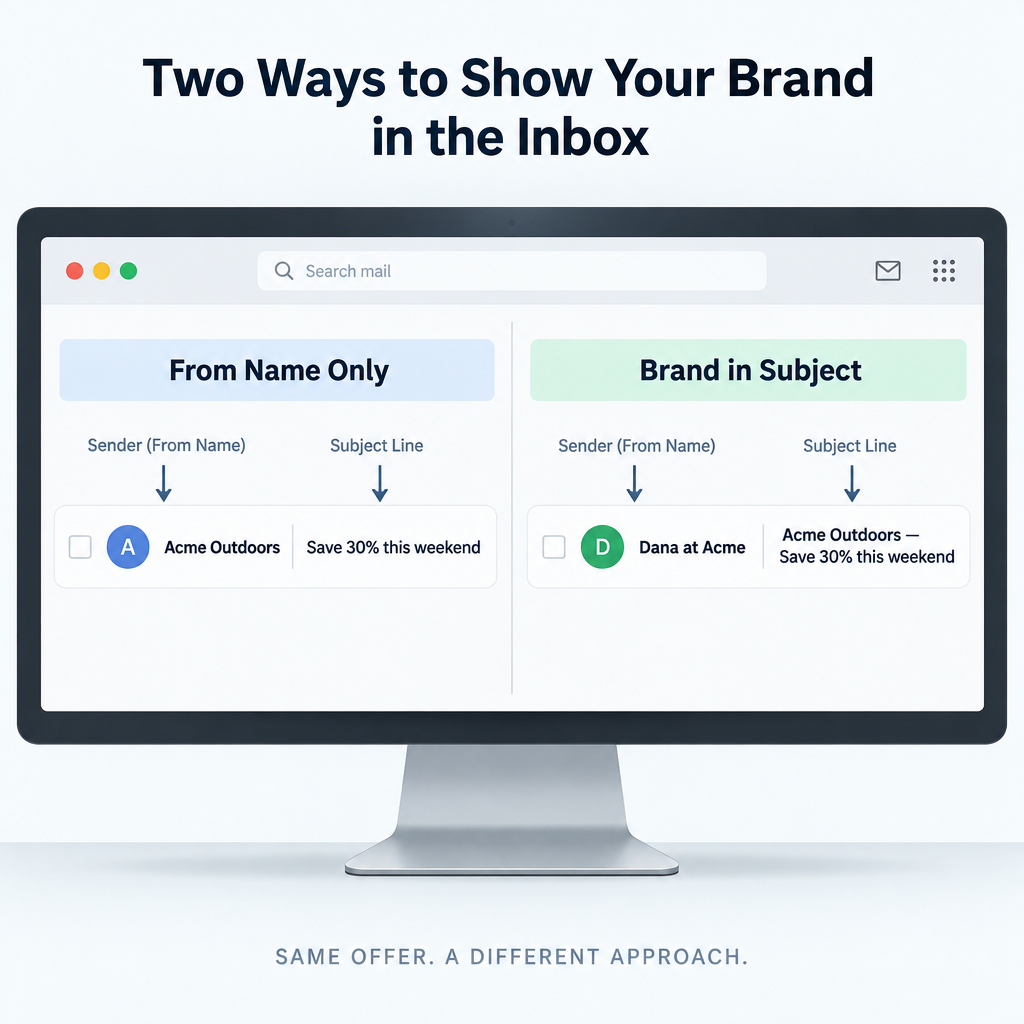
| From name is already the brand (“Acme Outdoors”) | Usually no | It repeats what readers already see and eats into the shorter mobile preview |
| From name is a person (“Dana at Acme”) | Often yes | It tells readers which company Dana works for |
| Named newsletter or series readers look for | Yes | The name is the hook, as with a weekly digest people search their inbox for |
| Co-branded or partner promotion | Yes, for the partner | It explains a name readers may not expect from you |
| Flash sale from a loved store | Test it | The brand and the offer compete for the first few words |
| Transactional email (receipts, shipping) | Brand plus order detail | Readers scan for it, and it helps them spot real mail when phishing copies your brand |
Rules that apply either way
The law doesn’t care whether your brand name is in the subject line. It does care that the subject line is honest. The FTC’s CAN-SPAM compliance guide says your subject line must reflect what the message is actually about, and that your From, To and Reply-To details must accurately identify who is sending. Both the company whose product is promoted and the company that sends the message can be held responsible.
Gmail’s email sender guidelines add rules for the inbox itself. Display names should identify the sender. They shouldn’t contain subject line text, urgent-sounding phrases or the recipient’s name. Subject lines shouldn’t start with “Re:” or “Fwd:” unless the message really is a reply or a forward.
The bulk sender rules matter more to your inbox placement than any subject line choice:
- Gmail (in force since February 2024): if you send more than 5,000 messages a day to personal Gmail accounts, you need SPF, DKIM and DMARC. Your marketing mail must support one-click unsubscribe. Google recommends keeping your spam rate in Postmaster Tools below 0.1% and never letting it reach 0.3% or higher. Since November 2025, Gmail has moved from warnings to temporary and permanent rejections for senders who don’t comply.
- Yahoo (one-click unsubscribe enforced since June 2024): bulk senders need SPF and DKIM, a passing DMARC policy of at least p=none, and the List-Unsubscribe header (RFC 8058 preferred). Unsubscribe requests must be processed within two days, and Yahoo asks senders to keep the spam rate below 0.3%.
- Microsoft (since May 5, 2025): high-volume senders to outlook.com, hotmail.com and live.com addresses must pass SPF, DKIM and DMARC.
Here is a minimal DMARC record that meets the Gmail and Yahoo baseline:
_dmarc.example.com. TXT "v=DMARC1; p=none; rua=mailto:[email protected]"
To show a logo through BIMI, you need to move that policy to p=quarantine or p=reject.
FAQ
Does putting the brand name in the subject line increase open rates?
Sometimes it does, especially when readers like the brand and the From name is a person’s name. Your measured open rate is the wrong judge, though, because Apple Mail Privacy Protection records opens for many Apple Mail users who never read the email. Look at clicks and conversions to see whether the brand name actually helped.
Should the brand go in the From name or the subject line?
Put it in the From name first. That’s where Gmail, Yahoo and Outlook show sender identity, and where readers look to decide whether they trust the email. Add it to the subject line only when it tells readers something new, such as a partner brand or a named newsletter.
How should you A/B test a branded subject line?
Change one thing only: the same subject line with and without the brand name, sent at the same time to random halves of a segment. Choose clicks or revenue as the winning metric. Repeat the test across a few campaigns before you change your standard format.
Is it legal to use another company’s brand name in a subject line?
CAN-SPAM requires subject lines that aren’t deceptive and sender details that accurately identify who is sending. Implying that a partner or a famous brand sent your email breaks that rule. In a co-branded campaign, both companies can be held responsible, so agree in writing on who sends and who handles opt-outs.
Does a brand logo in Gmail replace the need for the brand in the subject line?
For brands that qualify, it largely does. A BIMI logo or verified checkmark shows next to every message, and a subject line can’t do that. BIMI needs DMARC at quarantine or reject, and the blue checkmark also needs a Verified Mark Certificate. Senders who haven’t set this up can lean more on a clear, consistent From name.
Do subject lines affect spam filtering?
Yes, but less than your sending reputation, authentication and complaint rates. A misleading subject line raises spam complaints, and complaints count heavily against you under the 0.3% limits set by Gmail and Yahoo. An honest subject line that matches your From name helps keep complaints low.
Sources
- Google, Email sender guidelines (Gmail Help)
- Yahoo Sender Hub, Sender Best Practices
- Yahoo Sender Hub, FAQs
- Federal Trade Commission, CAN-SPAM Act: A Compliance Guide for Business
- Mailchimp Help, About A/B Tests
- Postmark Support, Open tracking and Apple Mail