
Yes, email is still part of everyday life for consumers, and it reaches more people than it did in 2005. The Radicati Group puts worldwide email users at about 4.73 billion in 2026, sending and receiving roughly 392.5 billion messages a day. The big change since this study came out is that inbox providers now decide who gets in. Since 2024, Gmail and Yahoo have required bulk senders to use SPF and DKIM, publish a DMARC policy, offer one-click unsubscribe on applicable promotional messages and keep reported spam rates below 0.3%, and Microsoft began enforcing similar rules for Outlook.com on May 5, 2025, including SPF, DKIM and DMARC for domains sending more than 5,000 messages a day. Opens are also harder to read now, because Apple Mail Privacy Protection loads tracking pixels for its users automatically.
What the DoubleClick Consumer Email Study found
In December 2005, DoubleClick Email Solutions released its sixth annual Consumer Email Study. The study found that email had become an essential part of the way consumers live.
The business behind the study changed hands shortly afterwards. Alliance Data Systems, through its Epsilon unit, agreed in February 2006 to buy DoubleClick Email Solutions, and the deal closed in April 2006. Trade press put the price at about $90 million. Google later bought the rest of DoubleClick, so the study series is now history. Its findings still show where today’s email habits started.
Email at work, at home and on weekends
The data showed that 57 percent of respondents read their work email at work at least occasionally during the day. Almost as many read work email from home in the evening (55 percent) and on weekends (54 percent).
Personal and work email were already mixing. About 48 percent of respondents checked personal email at work at least occasionally, and 21 percent did so all the time. Eric Kirby said the data called into question the idea of a single best time of day to send a campaign.
That point matters even more now that people read email on their phones. In 2005, “reading at home in the evening” meant sitting at a desktop computer. Today the same reader may check a message on a phone at breakfast, in Outlook at work and in the Gmail app late at night, often in dark mode. To get send times right in 2026, test against your own audience’s engagement data instead of picking a fixed hour that suits everyone.
Most consumers had more than one address
Nearly half of all respondents said they had at least three email accounts.
One key account, one shopping address
95 percent of respondents said one of their addresses was their main account, and 72 percent used a single address for online shopping.
Splitting addresses like this has become more deliberate. Apple’s Hide My Email feature in iCloud+ creates a random forwarding address for each sign-up. Many shoppers also keep a separate Gmail or Outlook.com address just for brands. For marketers, this means the address on your list may not be the one the customer reads first thing in the morning. Engagement on that address tells you more than the list size does.
Email worries in 2005
Spam was not the biggest worry. Respondents were more concerned about viruses (75 percent) and identity theft (67 percent). The study also reported that 78 percent of respondents had bought something after receiving a marketing email.
The marketer’s challenge, then and now
Eric Kirby, general manager of DoubleClick Email Solutions at the time, said: “This year’s study shows that email is firmly entrenched as a critical communications tool for the majority of consumers. For marketers this presents enormous opportunities, while at the same time requiring a significant degree of sophistication to communicate and interact with consumers on their terms in a mutually beneficial manner. If the marketer can balance these factors, the opportunities for effective email marketing are boundless.”
In 2005, “on their terms” was mostly about manners. Today, mailbox providers write it into their rules.
What “on their terms” means for senders in 2026
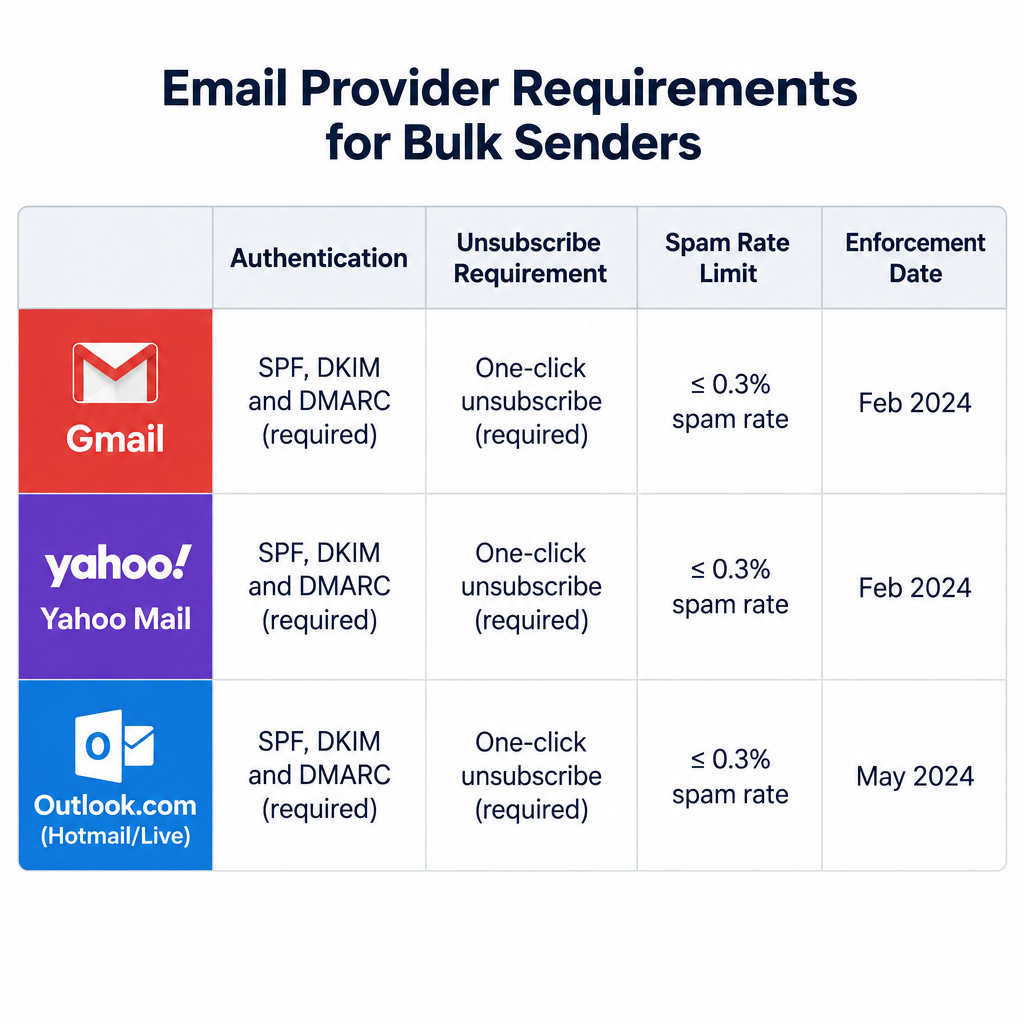
Consumers still rely on email. The difference is that Gmail, Yahoo and Microsoft now enforce what users want: proof that the sender is real, an easy way out of the list and few spam complaints. The table compares the current rules.
| Mailbox provider | Who the rules cover | Authentication | Unsubscribe | Spam rate |
|---|---|---|---|---|
| Gmail | Senders of close to 5,000 or more messages a day to personal Gmail accounts, enforced since February 2024 | SPF, DKIM and DMARC, with the From domain aligned | One-click unsubscribe on marketing mail since June 1, 2024, honored within 2 days | Below 0.1%, never 0.3% or higher |
| Yahoo Mail | Bulk senders, with no published volume threshold, enforced since February 2024 | SPF, DKIM and DMARC, with the From domain aligned | One-click unsubscribe (RFC 8058) on marketing mail, honored within 2 days | Below 0.3% |
| Outlook.com, Hotmail, Live | Senders of more than 5,000 messages a day, since May 5, 2025 | SPF and DKIM must pass, DMARC at least p=none and aligned | A working unsubscribe link is a recommended practice | Not published as a fixed number |
Microsoft says mail from high-volume senders that miss these requirements goes to the junk folder, and mail with problems that are not fixed may be rejected. Google says its enforcement is gradual, but senders lose access to its mitigation support once their spam rate passes 0.3%.
A basic DMARC record that meets the minimum Gmail, Yahoo and Microsoft ask for looks like this:
_dmarc.example.com. IN TXT "v=DMARC1; p=none; rua=mailto:[email protected]"
Start at p=none so the reports show you every service that sends mail as your domain. Move to p=quarantine and then p=reject once all of those services pass.
Why open rates no longer tell the whole story
Apple launched Mail Privacy Protection with iOS 15 in 2021. It preloads images, including tracking pixels, for users who turn it on, so those messages count as “opened” whether or not anyone read them. Litmus estimates that MPP now affects roughly 55 to 60 percent of all email opens. Clicks, conversions and replies are more reliable signs of engagement. This matters most when you decide which inactive subscribers to remove before they turn into spam complaints.
The law has not loosened either
In the United States, the CAN-SPAM Act still requires an accurate sender, honest subject lines, a physical postal address and an opt-out that you honor within 10 business days. Each separate email that breaks the law can cost up to $53,088. The FTC set that amount in January 2025 and kept it unchanged for 2026.
FAQ
Is email still worth investing in compared with social media and text messaging?
Yes, for most brands. Email reaches billions of people who signed up to hear from you, and you own the list, so an algorithm change on another platform cannot take your audience away. The cost of entry is higher than in 2005, though: you need proper authentication and a clean list, or your mail goes to spam.
What is the best time to send a marketing email?
No single hour works for every audience, which the 2005 DoubleClick data already suggested. People read email at work, at home and on weekends, now mostly on phones. Test send times against click and conversion data from your own list, because MPP makes open-based timing unreliable.
Do the Gmail and Yahoo rules apply to small senders?
The full set of bulk sender rules covers senders that reach close to 5,000 messages a day to Gmail, and Yahoo applies its rules to bulk mail without publishing a threshold. Smaller senders still need SPF or DKIM, and Yahoo’s 0.3% complaint limit applies to everyone. Setting up all three records costs little, so set them up whatever your volume.
Should subscribers with Apple Mail Privacy Protection be treated as engaged?
No, not based on opens alone. An MPP “open” only shows that Apple’s servers loaded the images. Use clicks, purchases, site visits or replies to decide who is active, and base re-engagement and removal on those signals.
What happens if your spam complaint rate goes above 0.3%?
At Gmail, your mail is more likely to be filtered or rejected, and you cannot get mitigation help until the rate stays under the limit. Yahoo treats 0.3% as its ceiling too. The usual causes are mailing old or purchased lists, sending too often and hiding the unsubscribe link, so start fixing those.
Do consumers really use separate email addresses for shopping?
Many still do, as 72 percent did in 2005, and tools like Apple’s Hide My Email make it easier. Expect some signups to come from secondary or forwarding addresses. A clear welcome email and a reason to whitelist your sender address help your messages get read on those accounts.
Sources
- Google Workspace Admin Help: Email sender guidelines FAQ
- Yahoo Sender Hub FAQs
- Microsoft Tech Community: Outlook’s new requirements for high-volume senders
- Microsoft SNDS postmaster policies, practices and guidelines
- FTC: CAN-SPAM Act compliance guide for business
- Federal Register: FTC adjustments to civil penalty amounts (2025)
- Litmus: Email client market share
- The Radicati Group: Email Statistics Report, 2024-2028, Executive Summary