
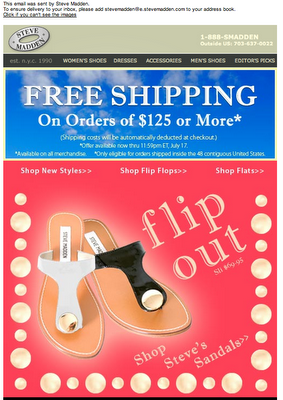
Free shipping with a minimum order is still one of the strongest offers you can put in a subject line, because shoppers will often add items they didn’t plan to buy just to avoid a delivery fee. That extra spend is real revenue for you, but the minimum has to sit in plain view next to the word “free,” or subscribers feel misled and the offer starts working against you. Some things have changed since this post was first written. Open rates are now inflated by Apple Mail Privacy Protection, so judge the offer by orders and revenue. And since 2024 Gmail and Yahoo require bulk senders to use SPF, DKIM, DMARC and one-click unsubscribe and to keep spam complaints low, so a promo that annoys people now hurts your inbox placement as well as your brand.
Why “free shipping” works in the subject line
A lot of retailers put “Free Shipping” in their subject lines, and it works. It gets people to open, and it gets them to buy. The question is how many subscribers feel tricked when they reach checkout and find out they have to spend a minimum amount to get the deal.
The thinking behind it is simple. A delivery fee feels like a loss, and people will pay more than the fee to avoid it. Baymard Institute’s checkout research keeps finding the same thing: extra costs such as shipping, tax and fees are the top reason shoppers abandon their carts. In a Baymard survey of 1,012 US adults run in February 2024, 48% said they had abandoned a cart because the extra costs were too high.
The shopper’s side of the math
Here is a familiar situation. A shopper has $23.00 in an Amazon cart and ends up spending $45 just to qualify for free shipping. Paying the shipping on the original order would have been cheaper, but it still feels like a win to get the free shipping.
The numbers show why this works so well for the retailer. These figures are an example, not any store’s actual rates:
| Option | Items in cart | Shipping | Total paid | What the shopper gets |
|---|---|---|---|---|
| Pay for shipping | $23.00 | $6.00 (example fee) | $29.00 | The item they wanted |
| Pad the cart to qualify | $45.00 | $0.00 | $45.00 | The item plus $22 of extras |
The shopper “saves” $6 and spends $16 more. The retailer collects $22 of revenue it would not otherwise have had. Whether that is a good deal for the shopper depends on whether they actually wanted the extra items.
The minimum in that example has also changed over the years. When this post was written, Amazon’s free-shipping minimum for shoppers without Prime was $25. In 2023 the company raised it to $35 for non-Prime members in many US regions, and it said the minimum is set by ZIP-code-based region, so not every shopper sees the same number. Prime members skip the minimum on most items in exchange for a $14.99 monthly or $139 yearly membership.
Minimum purchase or no minimum: the Steve Madden and Nike examples
When Steve Madden emails a “Free Shipping” offer, will subscribers who want it buy two pairs of shoes instead of one to qualify? A minimum is designed to make exactly that happen.

Steve Madden’s US promotional emails still advertise free standard shipping on orders that meet “the qualifying threshold as stated on the website.” The email sells the offer and the website sets the terms. That is a reasonable setup, as long as the subscriber can find the threshold before checkout instead of discovering it there.
So how does a free-shipping offer with no minimum purchase, like the Nike email below, affect overall sales? Are shoppers more likely to buy only what they came for when there is no minimum?

The no-minimum offer in that email is a dated example. Today Nike gives free shipping to Nike Members on orders of $50 or more, according to its membership page. That says a lot: even a brand that once tested free shipping with no minimum now pairs it with both a threshold and a free account signup. The threshold raises order value, and the signup grows the customer list Nike can email.
Free shipping is a good way to give subscribers a chance to “save,” and adding a minimum purchase is a reliable way to bring in extra revenue. That still holds. What has changed is that the cost of doing it badly is now higher.
Choosing between a threshold and no minimum
A threshold usually wins when you want to raise order value. A no-minimum offer usually wins when you want to win back lapsed customers or remove the last obstacle for a first-time buyer. Neither is right for every send.
| Offer type | Best used for | Main upside | Main risk |
|---|---|---|---|
| Free shipping over a threshold | Everyday promos, raising order value | Shoppers add items to qualify | Feels like a bait-and-switch if the minimum is hidden |
| Free shipping, no minimum | Win-back, first order, holiday deadlines | Removes the top checkout objection | Thin margins on small orders |
| Free shipping for members or loyalty tiers | Growing accounts and repeat buyers | Builds a list you own | Guests may abandon at checkout |
| Free shipping on one product category | Clearing stock, launching a line | Directs demand where you want it | Confusing if the rules are long |
A sensible starting threshold sits a little above your current average order value. That way a typical shopper needs to add one small item to qualify, not double the order. Test it against your own order data. Don’t copy another retailer’s number.
Writing the offer so it doesn’t backfire
Put the minimum where the reader sees “free.” “Free shipping on orders $50+” in the subject line or preheader is honest and still persuasive. A subject line that just says “Free Shipping” with the minimum hidden at the bottom of the email is the version that leaves subscribers feeling cheated.
This is also a legal point. The FTC’s Guide Concerning Use of the Word “Free” (16 CFR Part 251) says the terms and conditions for getting a “free” item should be set out clearly and conspicuously at the start of the offer. Separately, CAN-SPAM prohibits deceptive subject lines in commercial email. A free-shipping subject line that fits neither the offer nor its conditions creates risk under both.
What has changed for free-shipping emails since this was written
The offer itself still works. What has changed is how inboxes treat promotional mail and how you measure the results.
- Bulk sender rules. Since February 2024, Gmail and Yahoo have required anyone sending around 5,000 or more messages a day to their users to authenticate mail with SPF, DKIM and DMARC, support one-click unsubscribe, honor unsubscribe requests within two days, and keep the spam complaint rate below 0.3%. Google’s own guidance recommends staying under 0.1%. Microsoft added similar requirements for Outlook.com in May 2025.
- Complaints are a deliverability metric. A subscriber who feels tricked by a hidden minimum is more likely to hit “Report spam” than to unsubscribe. A few of those on every promo can push you toward the complaint ceiling.
- Open rates can’t be trusted to judge the offer. Apple Mail Privacy Protection, launched in 2021, preloads images and records opens that never happened. Compare free-shipping subject lines on click-through rate, conversion rate, average order value and revenue per recipient.
- The Promotions tab. Gmail sorts most retail mail into Promotions, where a clear, specific offer in the subject line and preheader matters even more, because readers skim dozens of competing deals.
- Mobile and dark mode. Most promo emails are read on phones, so the threshold should appear in live text near the top of the email, not only inside an image that may load slowly or look wrong in dark mode.
FAQ
Should the free-shipping minimum go in the subject line?
Yes, if there is room. “Free shipping over $50” sets accurate expectations, matches the FTC’s guidance that conditions be clear from the start, and cuts the complaints that hurt deliverability. If the subject line is too long, put the threshold in the preheader.
Does free shipping with a minimum actually raise order value?
It is designed to, and retailers like Nike keep using thresholds for that reason. Shoppers close to the line often add an item to qualify. Measure it by comparing average order value and revenue per recipient for threshold offers against your other promos.
How do you set the right free-shipping threshold?
Start a little above your current average order value, so a typical shopper has to add one modest item. Then test different levels against margin, conversion rate and return rates. A threshold set too high gets ignored and works like no offer at all.
Is “free shipping” a spam trigger word?
Not by itself. Modern filters at Gmail, Yahoo and Microsoft rely mostly on authentication, sender reputation and how recipients engage, including spam complaints. Misleading offers that people report as spam do far more damage than any single phrase.
How should free-shipping campaigns be measured now that open rates are inflated?
Use clicks, conversion rate, average order value and revenue per email sent. Apple Mail Privacy Protection records machine opens, so a subject line can look like a winner on opens while selling less. Keep an eye on spam complaint rates in Google Postmaster Tools too.
Is free shipping for members only worth it?
It often is, because it grows a list of logged-in customers you can email and recognize at checkout. The trade-off is friction for guests, who may abandon if signup feels forced. Make joining quick and say clearly in the email that the offer requires an account.
Sources
- Google: Email sender guidelines
- Yahoo Sender Hub: Best practices
- FTC: CAN-SPAM Act compliance guide for business
- FTC: Guide Concerning Use of the Word “Free” and Similar Representations
- Nike: Membership
- Baymard Institute: Cart abandonment rate statistics