
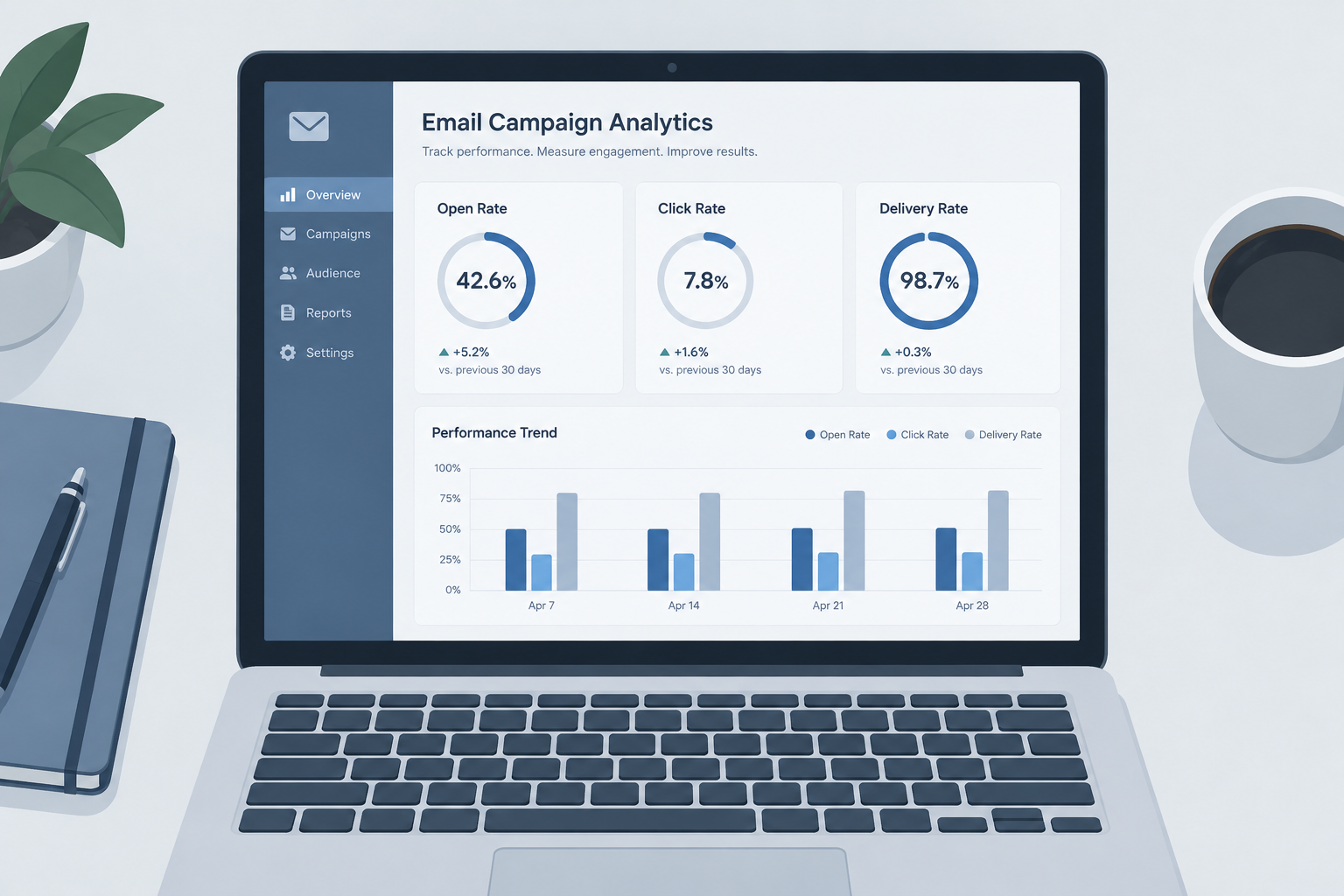
The Email Experience Council (EEC) tried to give the email industry one shared set of metric definitions through its S.A.M.E. project. Its guide came out in June 2010. It never became a binding standard, and as of November 2026 email service providers (ESPs) still count opens, clicks and deliveries in their own ways. Open rates have also become much less reliable. Apple Mail Privacy Protection, launched with iOS 15 in September 2021, preloads tracking pixels and records “opens” that no person made. On top of that, Gmail, Yahoo and Microsoft now judge bulk senders on authentication and spam complaint rates, so those numbers now count as metrics alongside engagement.
The background is below. The original article described the effort as it was starting in 2010.
Email marketers have struggled to agree on how to measure their results for as long as email marketing has existed. When this post was first written, the industry had no agreed standards at all.
Each marketer and each ESP picked its own method for measuring email results. One ESP’s “delivered” or “opened” could mean something quite different at the next.
The EEC set out to change that by proposing industry-wide standards for email metrics. The EEC was then the email marketing arm of the Direct Marketing Association (DMA). It brought together a group of industry leaders called the Measurement Accuracy Roundtable, co-chaired by John Caldwell and Luke Glasner. The group focused on getting ESPs on board, because ESPs build the reporting that marketers actually see. Their first goal was to get 10 to 15 percent of the ESP market to adopt the standards.
For more information on the S.A.M.E. (Support Adoption of Metrics for Email) project, visit the EEC’s site. The EEC’s old website now redirects to the Association of National Advertisers (ANA), so the original documents are mostly of historical interest today. The most useful one was the Project Guide PDF, and in particular its ESP Reporting Matrix. That matrix compared how 10 ESPs calculated Delivery, Opens and Clicks, and each one did it differently. That alone showed why a standard was needed.
The gap was easy to measure. An earlier EEC survey, reported by MediaPost, found that 79 percent of ESPs calculated “delivered” by subtracting all failures from the total mailed. The other 21 percent subtracted only hard bounces. Two senders with identical results could therefore report different delivery rates.
The predicted shift came true only in part. The Roundtable proposed new terms. One was a “render rate” to replace the open rate, with an open counted when the tracking pixel displays or when the reader clicks any link in the email. The guide also said plainly that nobody can reliably know how many subscribers actually looked at an email, and that both measures undercount. The new terms prompted debate and sharpened how professionals talked about opens. Most ESP dashboards, though, kept the label “open rate.”
What happened to the S.A.M.E. standards
The S.A.M.E. definitions stayed voluntary, and no single standard ever won. The EEC moved to the ANA after the ANA took over the DMA in 2018. Today it runs as the ANA Email Excellence Center, which hosts committee meetings, webinars and the Email Evolution Conference rather than publishing metric standards.
The project still changed how the industry thinks. It made one point mainstream: an open rate is a ratio of tracked events to emails sent. It is not a count of people who read your message. That point matters even more since 2021.
How to read email metrics in 2026
Use clicks, conversions and complaint rates as your main measures. Treat opens as a rough trend line at best. Three changes since 2010 explain why:
- Apple Mail Privacy Protection (September 2021). Apple Mail on iOS 15, iPadOS 15 and macOS Monterey or later can load remote content, including tracking pixels, through Apple’s proxy servers. Many of those loads are recorded as opens even if nobody reads the email. Many ESPs, including Postmark and Litmus, now flag or separate these machine opens.
- Gmail and Yahoo bulk sender rules (February 2024). Gmail counts anyone sending more than 5,000 messages a day to Gmail addresses as a bulk sender. Bulk senders must use SPF, DKIM and DMARC, offer one-click unsubscribe on marketing mail and handle unsubscribe requests within two days. Google says to keep your reported spam rate below 0.1 percent and never let it reach 0.3 percent. Yahoo has similar rules but does not publish a volume threshold.
- Microsoft Outlook.com rules (May 5, 2025). Domains sending more than 5,000 emails a day to Outlook.com, Hotmail.com and Live.com addresses must pass SPF, DKIM and DMARC. Microsoft’s postmaster guidance says mail that fails is sent to junk, and repeated problems can lead to rejection.
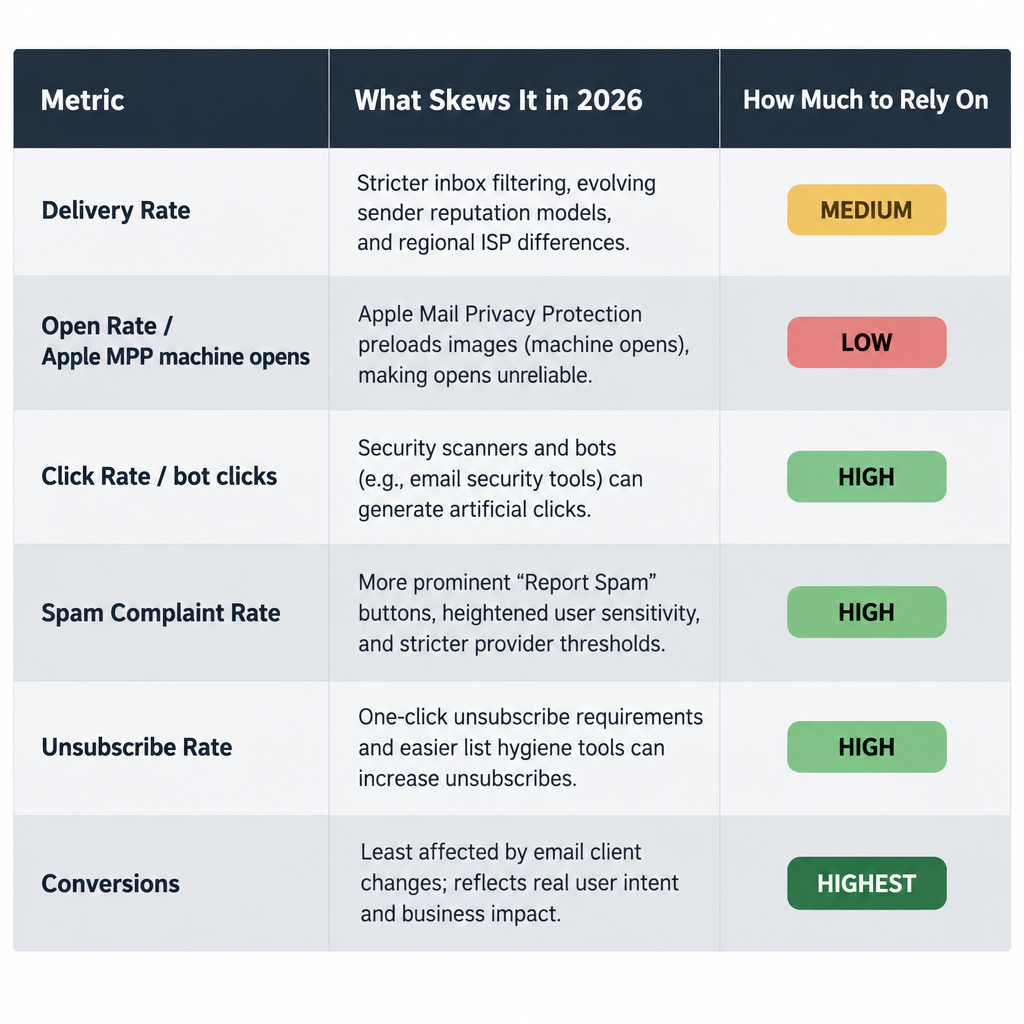
| Metric | What skews it in 2026 | How much to rely on it |
|---|---|---|
| Delivery rate | ESPs still calculate it differently, and a “delivered” email can still land in spam | Medium: check how your ESP defines it |
| Open rate | Apple MPP machine opens, image blocking, Gmail image caching | Low: trends only |
| Click rate | Security scanners that follow links can add bot clicks | High, once bots are filtered out |
| Spam complaint rate | Visible only through tools such as Google Postmaster Tools and Yahoo’s feedback loop | High: mailbox providers use it to filter mail |
| Unsubscribe rate | One-click unsubscribe makes opting out easier, so the rate may rise | High as a sign of list health |
| Conversions and revenue | Attribution windows and tracking settings vary | Highest for business results |
To compare results across two ESPs, or against an industry benchmark, first find out how each one defines “delivered,” “open” and “click.” The S.A.M.E. Project Guide was making that same point back in 2010.
FAQ
What was the EEC’s S.A.M.E. project?
S.A.M.E. was a project by the Email Experience Council’s Measurement Accuracy Roundtable. It aimed to get every ESP to report email metrics the same way. Its guide, published in June 2010, set out standard definitions for delivery, opens, clicks and related terms. Adoption was voluntary.
Is there an official industry standard for email open rate today?
No. ESPs still decide for themselves how to count opens and whether to filter out Apple Mail Privacy Protection opens or bot activity. The ANA Email Excellence Center and other groups publish guidance, but none of it is a binding standard.
Why did my open rate jump after 2021?
Apple Mail Privacy Protection preloads email content through Apple’s servers, which fires tracking pixels even when nobody reads the email. A list with many Apple Mail users can show a much higher open rate while clicks stay the same. Check whether your ESP separates these machine opens from real ones.
Which email metrics matter most to Gmail and Yahoo?
The ones that matter most are authentication results (SPF, DKIM and DMARC) and the spam complaint rate. Google asks bulk senders to keep complaints below 0.1 percent and never let them reach 0.3 percent. Gmail and Yahoo also require one-click unsubscribe on marketing mail. Google Postmaster Tools shows how Gmail sees your domain.
Is render rate the same as open rate?
They measure the same thing. The EEC proposed “render rate” as a more honest name, because a tracking pixel shows that images loaded, not that someone read the email. Most ESPs kept the term “open rate,” but render rate describes the measurement more accurately.
What does CAN-SPAM require from a reporting standpoint?
CAN-SPAM, enforced by the FTC, sets no metric definitions. It does require a working opt-out method in commercial email, and opt-out requests must be honored within 10 business days. Gmail and Yahoo set a stricter two-day window for bulk senders, so plan your unsubscribe handling around the shorter deadline.
Sources
- Google Workspace Admin Help: Email sender guidelines FAQ
- Yahoo Sender Hub: FAQs
- Microsoft Tech Community: Outlook’s new requirements for high-volume senders
- Microsoft Outlook.com Postmaster: Policies, Practices, and Guidelines
- FTC: CAN-SPAM Act Compliance Guide for Business
- Postmark Support: Open tracking and Apple Mail
- ANA: Email Excellence Center Committee