
No. Sending subscribers content they never asked for is still a weak strategy, and it costs more in 2026 than it did when KFC filled its list with softball contests. Since 2024, Gmail and Yahoo have required bulk senders to keep spam complaint rates under 0.3%, offer one-click unsubscribe and authenticate with SPF, DKIM and DMARC. Google started rejecting mail that breaks these rules in November 2025, so emails that feel irrelevant and get reported can now keep your whole program out of the inbox. The fix this post pointed to years ago still works: ask subscribers what they care about, then segment by it.
KFC had an interesting messaging strategy. Two-thirds of the marketing emails one subscriber got from the chain over a single summer, starting in June, were not about chicken at all.
The first message promoted a Bat Girl contest for the KFC World Cup of Softball, the international tournament in Oklahoma City where KFC was title sponsor. It was an odd choice for a general mailing list, and it raised a simple question: how many subscribers could even enter? A parent on the list could easily be too old to qualify, have a child who was too young, and know nobody worth forwarding it to.
The second message promoted the Drums and Thighs bucket. That was much closer to what subscribers expect from a fried chicken chain.
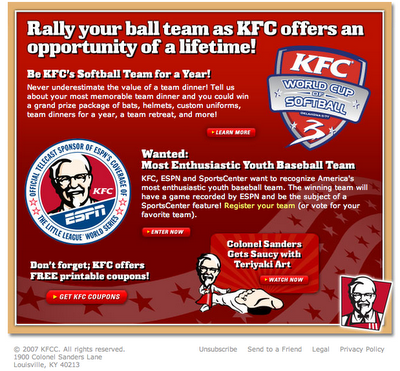
The third message went back to softball. It invited subscribers to enter “Be KFC’s Team for a Year,” a contest KFC ran with the Amateur Softball Association. Entrants wrote about their most memorable team dinner for a chance to win prizes for their softball team. The grand prize included custom uniforms and helmets, bats, balls, a team retreat and $500 in KFC team dinners.

The same email also announced a chance to be named the “Most Enthusiastic Youth Baseball Team.” It included a link to enter and a way to vote for a favorite team. How many parents forwarded that message to everyone they knew, asking for votes for their child’s team? This part was smart: a voting contest turns subscribers into distributors and spreads the KFC name for free. Forwarding still works as a growth tactic. The difference today is that anyone who joins the list through a forward has to opt in on their own.
The latest email had a link to printable coupons. The link went straight to a website page that required registration to get the coupons. That page had pre-checked boxes that opted the visitor into the email program and saved their details so they would not need to register again. The boxes were easy to miss, and they probably added to KFC’s spam complaints.
That tactic has aged badly, and printable coupons themselves are largely a thing of the past. Under the GDPR, pre-ticked boxes do not count as consent (Recital 32 says so directly). The EU Court of Justice confirmed the point in its Planet49 ruling of 1 October 2019. In the United States, CAN-SPAM is an opt-out law, so a pre-checked box is not illegal there on its own. But people who land on a list without noticing are exactly the people who click “Report spam.” With Gmail and Yahoo both enforcing a 0.3% complaint limit, one sneaky sign-up form can hurt delivery for every campaign that follows.
There was also a link to a YouTube video promoting KFC’s new Teriyaki Wings. Linking out to video is still the right approach. Gmail, Outlook and most other major email clients will not play video inside a message, so the standard method is a still image with a play button that links to the video page.
It’s safe to assume that plenty of KFC’s subscribers care about the menu. It’s much harder to believe that many of them care about softball, or about contests that only a small slice of the list can enter.
KFC would have done better to find out what its subscribers were interested in and send messages to match. Today that means a short preference choice at sign-up (“menu deals,” “new items,” “sports and sponsorships”), plus segments built from click behavior. Only people who clicked sponsorship content should keep getting it. Everyone else gets the chicken.
FAQ
Is it a mistake to send emails that are not about your main product?
Not always. Sponsorships, contests and causes can work well with the audience that cares about them. The mistake is sending them to the whole list. Send that content to a segment that opted into it or clicked on similar emails, and keep your main list focused on what people signed up for.
Are pre-checked opt-in boxes legal?
In the EU and the UK, pre-ticked boxes do not count as valid consent under the GDPR, and the CJEU’s Planet49 judgment confirmed this in 2019. In the US, CAN-SPAM does not require prior consent for commercial email, so they are not banned there. They still bring in subscribers who never meant to join, and those subscribers drive spam complaints. An unchecked box is the safer choice everywhere.
What spam complaint rate is too high?
Google’s and Yahoo’s guidance both call for bulk senders to keep spam complaint rates below 0.3%. Google Postmaster Tools reports your Gmail complaint rate, but it does not cover Yahoo. Google defines a bulk sender as anyone sending 5,000 or more messages a day to personal Gmail accounts. Most deliverability guidance says to aim for under 0.1%, because once you pass 0.3% you are not eligible for mitigation until your rate stays below it for a while. Microsoft began enforcing its own authentication rules for senders of 5,000+ daily emails to Outlook.com, Hotmail.com and Live.com on 5 May 2025.
How do you find out what subscribers actually want?
Ask at sign-up with two to four clear interest choices, and offer a preference center in every email next to the one-click unsubscribe link. Then watch what people click and build segments from it. A preference center cannot replace one-click unsubscribe, though. Gmail requires the one-click option, and unsubscribe requests must be honored within two days.
Do open rates show whether a message was relevant?
Not reliably. Apple Mail Privacy Protection arrived with iOS 15 in 2021 and preloads images, which records “opens” whether or not the person read the email. Clicks, conversions, unsubscribes and complaints are much better signs of whether a message matched what subscribers wanted.
What are the penalties for breaking CAN-SPAM?
Each email that breaks the law is a separate violation. The FTC’s inflation adjustment of January 2025 set the maximum civil penalty at $53,088 per violation. The main requirements are honest header and subject lines, identifying the message as an ad, a valid physical postal address, and a working opt-out that you honor within 10 business days.
Sources
- Google Workspace Admin Help: Email sender guidelines and Email sender guidelines FAQ
- Yahoo Sender Hub: Best practices for senders
- Microsoft Defender for Office 365 blog: Strengthening email ecosystem, Outlook’s new requirements for high-volume senders
- Federal Trade Commission: CAN-SPAM Act, A Compliance Guide for Business
- Federal Register: FTC Adjustments to Civil Penalty Amounts (17 January 2025)
- Court of Justice of the European Union: Press release No 125/19, Planet49 judgment (Case C-673/17)