
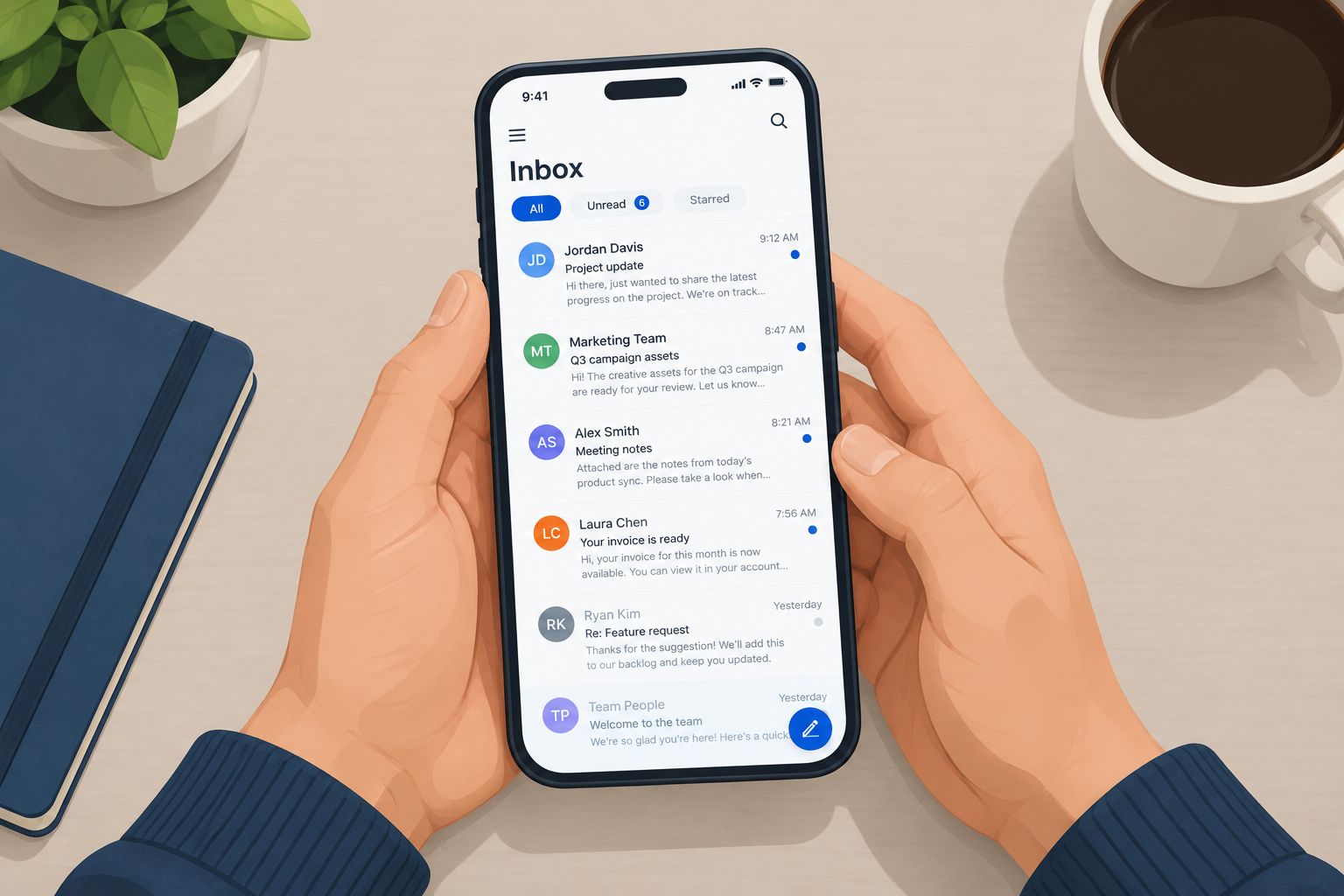
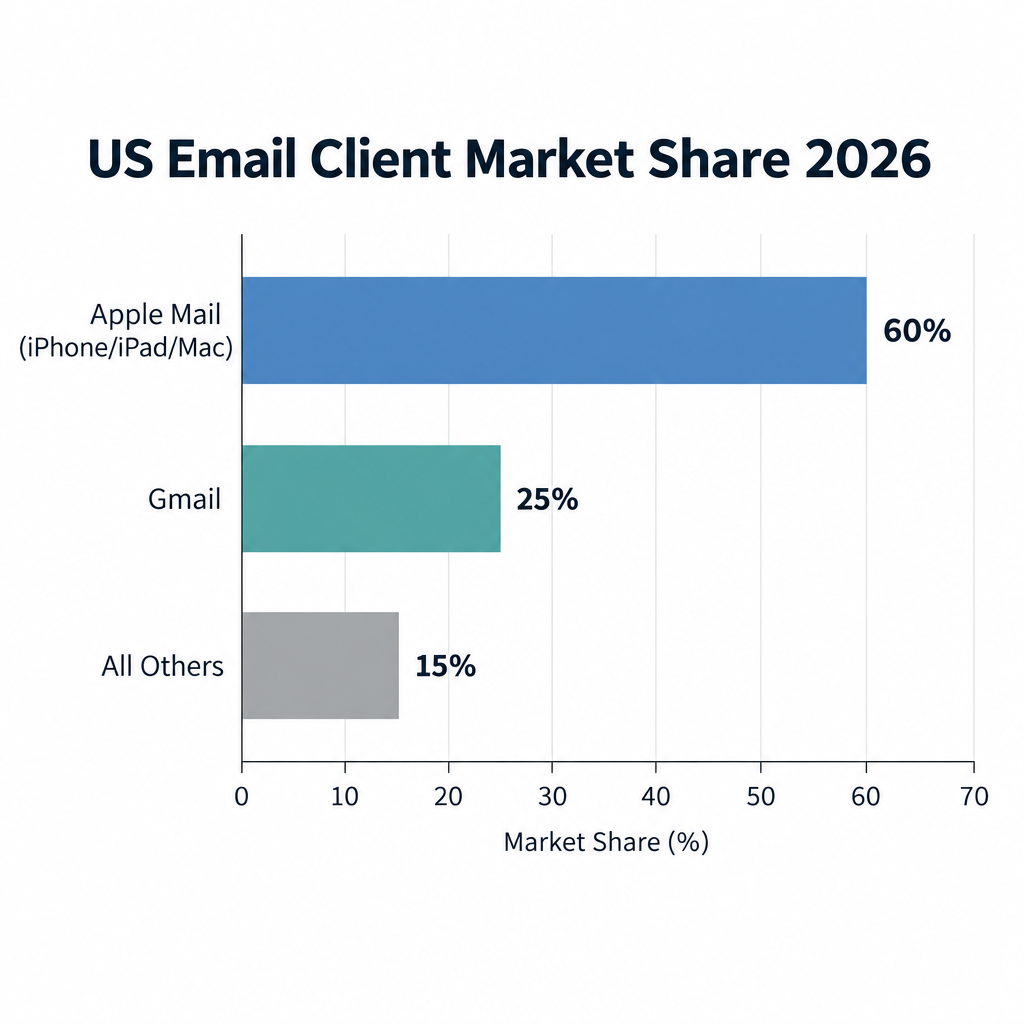
By November 2026, reading email on a phone is the default in the US. About nine in ten US adults own a smartphone, according to Pew Research Center. Litmus’s 2026 market-share tracking puts Apple Mail (iPhone, iPad and Mac combined) at roughly 60 percent of tracked opens, with Gmail second at about a quarter. Since this post was first written, Apple Mail Privacy Protection (2021) has inflated those open counts. Gmail, Yahoo and Microsoft’s Outlook.com now also require bulk senders to authenticate with SPF, DKIM and DMARC, and Gmail and Yahoo add one-click unsubscribe and a spam-complaint ceiling to that list.
How US smartphone adoption looked in early 2007
The rest of this section is the original post from January 2007, written on the day Apple announced the first iPhone. The facts have been corrected and the old predictions are marked as history.
According to studies reported at the time by redherring.com and cellular-news.com, the US was slowly catching up with Europe on smartphones. Italy led the European countries, and it “spends the most on devices and data usage as compared to the other European countries” (cellular-news.com).
Network speed mattered a lot back then. In 2007, high-speed 3G networks were more widely available in Europe than in the US, and that alone probably explained why Europeans were quicker to buy smartphones. That gap has long since closed, and high-speed mobile data is now standard across the US.
Smartphones were also catching on outside the US and Europe, in places like India. According to this report, India made nearly one billion dollars in revenue from cell phones in the year before the post was written. Carriers adding more value to their service plans was expected to make phones even more attractive there.
As smartphones got more popular, people used them to get more information, and that included email, especially on unlimited data plans. The original post predicted that smartphones would become normal and that marketers, email marketers in particular, would have to adapt to how people read their mail. Apple made its official announcement of the long-awaited iPhone at Macworld in San Francisco on January 9, 2007. The phone went on sale in the US on June 29, 2007, on AT&T’s network. The post expected the iPhone to help the US catch up with Europe in using smartphones every day. That prediction came true, and then some.
What mobile email looks like today
Mobile is now the main way many subscribers read email, so your campaigns have to work on a small screen first. The changes that matter most for senders came after 2007:
| Change | When | What it means for senders |
|---|---|---|
| Gmail inbox tabs (Primary, Promotions, Social) | 2013 | Marketing mail usually lands in Promotions, including in the Gmail mobile app |
| Gmail image proxy | December 2013 | Gmail caches images, which limits device and location data from opens |
| Dark mode in iOS 13 and Android 10 | 2019 | Logos, colours and text can flip or vanish unless you design for dark backgrounds |
| Apple Mail Privacy Protection (iOS 15) | September 2021 | Apple Mail preloads images, so opens count even when no one reads the email |
| Gmail and Yahoo bulk sender rules | February 2024 | SPF, DKIM and DMARC, one-click unsubscribe, spam rate kept below 0.3% |
| Outlook.com high-volume sender rules | May 5, 2025 | Domains sending more than 5,000 emails a day must pass SPF, DKIM and DMARC |
Here is what this means in practice. Use a single-column layout with large tap targets. Keep the subject line and preheader short enough to show on a phone lock screen. Judge results on clicks and conversions rather than opens. Google treats any domain that sends close to 5,000 or more messages to personal Gmail accounts in 24 hours as a bulk sender. It asks for a spam rate below 0.1% and says never to reach 0.3%. At minimum, a basic DMARC record looks like this:
_dmarc.example.com. IN TXT "v=DMARC1; p=none; rua=mailto:[email protected]"
FAQ
What share of email is opened on mobile in 2026?
Most industry roundups put mobile at around 60 percent of opens. Litmus’s client tracking shows Apple Mail at roughly 60 percent of tracked opens. Treat these numbers as rough, because Apple Mail Privacy Protection counts machine-generated opens, and much of Apple’s share comes from those.
Are open rates still reliable for mobile campaigns?
Only as a rough trend signal. Since iOS 15 in 2021, Apple Mail preloads images for users who turn on Mail Privacy Protection, so many recorded opens are not real reads. Clicks, conversions and revenue per email are more dependable measures.
Do the Gmail and Yahoo rules apply to small senders?
Every sender to personal Gmail accounts needs SPF or DKIM and valid DNS. The stricter rules apply to bulk senders, meaning about 5,000 or more messages a day to Gmail. Those rules require SPF, DKIM, a DMARC record and one-click unsubscribe for marketing mail. Google advises keeping the reported spam rate below 0.1% and avoiding 0.3% or higher. Yahoo’s rules follow a similar pattern and ask you to keep the complaint rate below 0.3%.
How should you design emails for dark mode?
Use logos with transparent backgrounds or a light outline so they stay visible on dark backgrounds. Avoid text placed inside images. Test in Apple Mail, Gmail and Outlook on mobile, because each one handles dark mode differently. Some invert your colours fully and others only partly.
Does CAN-SPAM treat mobile email differently?
No. The FTC’s CAN-SPAM rules apply to commercial email whatever device it is read on. You need accurate header and subject information, a valid physical postal address, and a working opt-out that you honour within 10 business days. Text messages sent to phone numbers fall under separate rules from the FCC and the TCPA.
Sources
- Google: Email sender guidelines and Email sender guidelines FAQ (Gmail Help)
- Yahoo Sender Hub: Sender requirements and recommendations
- Microsoft: Outlook.com Postmaster policies and the Outlook high-volume sender requirements announcement
- FTC: CAN-SPAM Act, A Compliance Guide for Business
- Litmus: Email Client Market Share
- Pew Research Center: Mobile Fact Sheet