
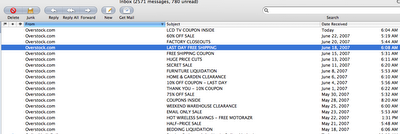
All-caps subject lines still read as shouting in 2026, and they usually cost you more than they earn. Readers see them as spammy. Some content filters add points for them; SpamAssassin’s SUBJ_ALL_CAPS rule scores 1 point by default. And each annoyed subscriber who clicks “Report spam” pushes up your complaint rate, which Google advises keeping below 0.10% and never letting reach 0.30%, while Yahoo asks bulk senders to stay below 0.3%. The main change since this post was first written is that inbox placement now depends mostly on authentication (SPF, DKIM, DMARC), one-click unsubscribe and complaint rates, so irritating your readers is now a bigger risk than any single word or letter case.
Since the early days of the internet there have been rules called “netiquette”: the do’s and don’ts of behaving well online. RFC 1855, the Netiquette Guidelines published by the IETF in 1995, says it plainly: use mixed case, because upper case looks as if you are shouting.
According to Wikipedia, typing in capitals came to be read as shouting with bulletin board systems and the early internet, and that link goes back to at least 1984. If you write a whole email or subject line in uppercase, readers hear shouting, and many will take it as rude.
When this post was first written, Overstock.com had apparently never got the word. Its promotional emails regularly screamed about sales and great deals in capital letters.

That was an odd choice for a well-known discount retailer. Its subscribers had signed up on purpose to hear about bargains, and they browsed the site because you never knew what you might find. Those are the readers a retailer most wants to keep. Shouting at them in every subject line wears them down.
The all-caps subject line looked a lot like the spam that filled neglected webmail inboxes back then, including old Yahoo! Mail accounts. The only thing missing was the usual row of exclamation points.
The advice then was simple, and it still applies to any sender today: a well-recognized brand doesn’t need to yell at its subscribers. The brand has changed a lot since then. Its parent company relaunched the Bed Bath & Beyond online storefront in August 2023 and adopted the name Beyond, Inc. in November 2023. It then brought Overstock back as a separate site, starting with a phased relaunch in March 2024 and a “Grand Reopening” in July 2024.
Why all caps still hurts in 2026
Capitals in subject lines now cost you in three places: spam scoring, complaint rates and how readers react on small screens. None of these on its own sends a good sender to spam. Taken together, though, a shouty habit is a poor trade for a brief jump in attention.
| Where it shows up | What happens | How much it matters |
|---|---|---|
| Content filters (SpamAssassin, Rspamd) | SpamAssassin’s SUBJ_ALL_CAPS adds 1 point by default, against a common spam threshold of 5.0. Rspamd’s rule of the same name scores 3.0 | Minor alone, adds up with other rules |
| Gmail and Yahoo filtering | Both rely mainly on authentication, sender reputation and user complaints | High, through complaints |
| Complaint rate | Google says to keep spam rates under 0.10% and never reach 0.30%. Yahoo uses the same 0.3% ceiling | High for bulk senders |
| Mobile and dark mode inboxes | Capital letters are wider, so fewer characters fit in a phone preview, and a block of capitals is harder to read | Moderate |
| Brand perception | Subject lines that look like old spam undercut trust in a known name | Long term |
The bulk sender rules took effect in February 2024. They apply to anyone sending 5,000 or more messages a day to personal Gmail accounts. Google began enforcing them more strictly in November 2025, and mail that fails the rules can be rejected or sent to spam. Yahoo has required working one-click unsubscribe since June 2024 and asks senders to honor opt-outs within two days.
If you want emphasis, use one capitalized word (“Last chance: 40% off ends TONIGHT”), a specific number or a clear deadline. Each of these gives the reader a reason to open without shouting at them.
FAQ
Do all-caps subject lines send email to spam?
Not on their own. Gmail and Yahoo filter mainly on authentication, reputation and complaints, while rule-based filters such as SpamAssassin add a small score for a subject written entirely in capitals. The real danger is indirect: readers who find the email shouty are more likely to hit “Report spam,” and that hurts every future send.
Is it OK to capitalize one word in a subject line?
Yes. One capitalized word for emphasis reads as stress, not shouting, and it won’t trip SpamAssassin’s all-caps subject rule, which looks at the whole subject. Use it sparingly so it still stands out.
Does CAN-SPAM ban all-caps subject lines?
No. The FTC’s CAN-SPAM rules ban deceptive subject lines and require that the subject accurately reflect what is in the message. Capital letters are legal, but a capitalized “YOU’VE WON” on a generic promotion can be misleading, and each violating email can draw a civil penalty of more than $53,000.
What spam complaint rate do Gmail and Yahoo allow?
Google tells senders to keep their spam rate, as shown in Postmaster Tools, below 0.10% and to avoid ever reaching 0.30%. Yahoo uses 0.3% as its ceiling too. If Gmail sees your rate above 0.3%, you aren’t eligible for its delivery mitigation until the rate stays below that line for seven days.
How should you test whether capitals help a subject line?
Judge the test on clicks, conversions and complaints, not opens. Since Apple Mail Privacy Protection arrived with iOS 15 in September 2021, Apple Mail preloads images for many users, which counts as an “open” whether or not the person read anything. An all-caps version that seems to win on opens can still lose on clicks and unsubscribes.
Do exclamation points and emojis count as shouting too?
A row of exclamation points looks like caps and spam, and several filter rule sets score excessive punctuation. A single emoji or exclamation point is fine for most audiences. As with capitals, the risk comes from repetition and stacking.
Sources
- Google Workspace Admin Help: Email sender guidelines FAQ
- Yahoo Postmaster: More Secure, Less Spam
- FTC: CAN-SPAM Act Compliance Guide for Business
- IETF RFC 1855: Netiquette Guidelines
- Apache SpamAssassin configuration documentation
- Rspamd subject checks rule source